International Solar Alliance proposes solar hub in India
Source:The Hindu ↗
Why It Matters
Highlights India's leadership role in global climate action and renewable energy transitions. The operationalization of ISA initiatives, fulfillment of India's non-fossil fuel targets, and infrastructural concepts like OSOWOG are directly relevant to GS3 (Energy) and GS2 (Global groupings involving India).
Summary
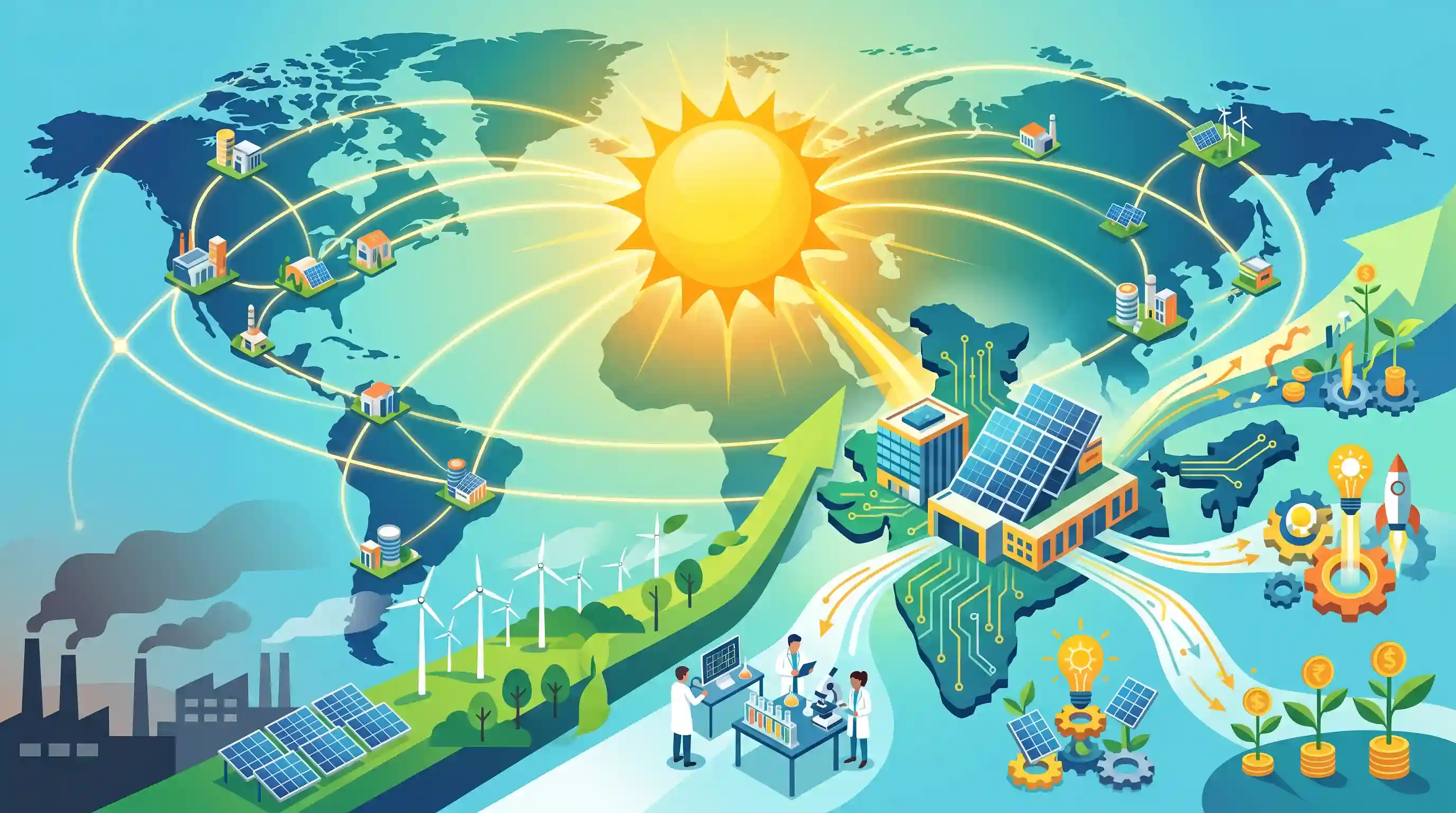
The International Solar Alliance (ISA) has proposed setting up a 'Global Capability Centre' in India to act as a 'Silicon Valley for solar', alongside 17 global centres of excellence. This initiative aims to foster innovation, provide laboratory training, and nurture a startup ecosystem in the renewable energy sector. The development underscores India's growing leadership in global solar transition, particularly its progress towards non-fossil fuel targets and ambitious projects like 'One Sun, One World, One Grid' (OSOWOG).
Key Points
- The International Solar Alliance (ISA) plans to establish a Global Capability Centre in India to serve as a 'Silicon Valley for solar', focusing on testing, training, and building a startup ecosystem.
- The initiative will be supported by 17 centres of excellence located in 17 different member countries.
- India's solar capacity has grown to approximately 119 GW as of July 2025, and the country now sources 50% of its total electric power capacity from non-fossil fuels.
- The 'One Sun, One World, One Grid' (OSOWOG) initiative remains a key focus, aiming to interconnect national grids, such as a potential undersea cable link between India and the UAE.
Important Terms
International Solar Alliance (ISA)

An intergovernmental organization launched by India and France in 2015 to scale solar energy deployment in sun-rich countries. It is headquartered in Gurugram, Haryana.
UPSC context
GS Paper II/III: Crucial for topics on international groupings, India’s climate diplomacy, and global renewable energy leadership.
One Sun, One World, One Grid (OSOWOG)
India’s global initiative to interconnect regional solar grids worldwide, enabling 24/7 clean energy supply by leveraging the sun’s continuous presence across different time zones.
UPSC context
GS Paper III: Relevant for energy security, technical diplomacy, and cross-border infrastructure development.
COP21 (Paris Agreement)
The 21st UN Climate Change Conference (2015) in Paris, where the Paris Agreement was adopted and the International Solar Alliance was officially launched.
UPSC context
GS Paper III: Foundational event for climate negotiations, emission reduction targets (INDCs), and international environmental law.
Global Capability Centre (GCC) - Solar
A proposed centralized hub in India by ISA to manage knowledge, standardized digital tools, and innovation, envisioned as a 'Silicon Valley' for solar energy.
UPSC context
GS Paper III: Relevant for science & technology institutional frameworks and India's emerging role as a global R&D hub.
STAR-C Programme
The Solar Technology Application Resource Centre; a network of training and research hubs designed to build capacity and standardize solar applications across ISA members.
UPSC context
GS Paper III: Important for skill development and technology transfer in the renewable energy sector.
Prelims Trap
India currently generates over 50% of its total electricity from non-fossil fuel sources.
Aspirants confuse installed capacity with actual generation. Non-fossil fuels form 50% of installed capacity, but under 30% of actual generation due to solar's low Capacity Utilisation Factor.
Static Concepts Connected
What is the framework of the International Solar Alliance (ISA)?
- Origin & HQ: Launched by India and France at COP21 (2015). Headquartered in Gurugram, it is India's first treaty-based inter-governmental body.
- Universal Membership: Initially restricted to countries partially or fully between the Tropics, the framework agreement was amended to allow all UN member states to join.
How does Capacity Utilisation Factor (CUF) affect power generation metrics?
- Concept: CUF is the ratio of actual energy output to the maximum possible energy output of a power plant over a specific period.
- Implication: Solar and wind have much lower CUFs compared to thermal plants, meaning high installed capacity does not equal high actual electricity generation.
Cross-Topic Patterns
OSOWOG + Submarine HVDC cables
OSOWOG's undersea links require High-Voltage Direct Current (HVDC) technology to minimize long-distance transmission losses, merging IR initiatives with S&T infrastructure basics.
Grid integration + BESS economics
Interconnecting time zones reduces reliance on costly Battery Energy Storage Systems (BESS), solving the intermittency challenge of solar power during peak evening demand.

Expect a multi-statement prelims Q contrasting renewable 'installed capacity' vs 'actual generation' paired with OSOWOG time-zone benefits.
Linked PYQs · 4
Linked PYQs · 4
- 2016PrelimsGS1
Consider the following statements: 1. The International Solar Alliance was launched at the United Nations Climate Change Conference in 2015. 2. The Alliance includes all the member countries of the United Nations. Which of the statements given above is/are correct?
- 2021MainsGS3
Explain the purpose of the Green Grid Initiative launched at World Leaders Summit of the COP26 UN Climate Change Conference in Glasgow in November, 2021. When was this idea first floated in the International Solar Alliance (ISA)?
- 2020MainsGS3
Describe the benefits of deriving electric energy from sunlight in contrast to the conventional energy generation. What are the initiatives offered by our Government for this purpose?
- 2022MainsGS3
Do you think India will meet 50 percent of its energy needs from renewable energy by 2030 ? Justify your answer. How will the shift of subsidies from fossil fuels to renewables help achieve the above objective ? Explain.
