Demographic Transition and Reimagining Geriatric Care in India
Source:Indian Express ↗
Why It Matters
The aging population is a critical emerging issue for India. As the country's demographic dividend peaks, understanding how to support and utilize the growing elderly demographic through health and social policies is essential for GS1 (Population issues) and GS2 (Welfare of vulnerable sections).
Summary
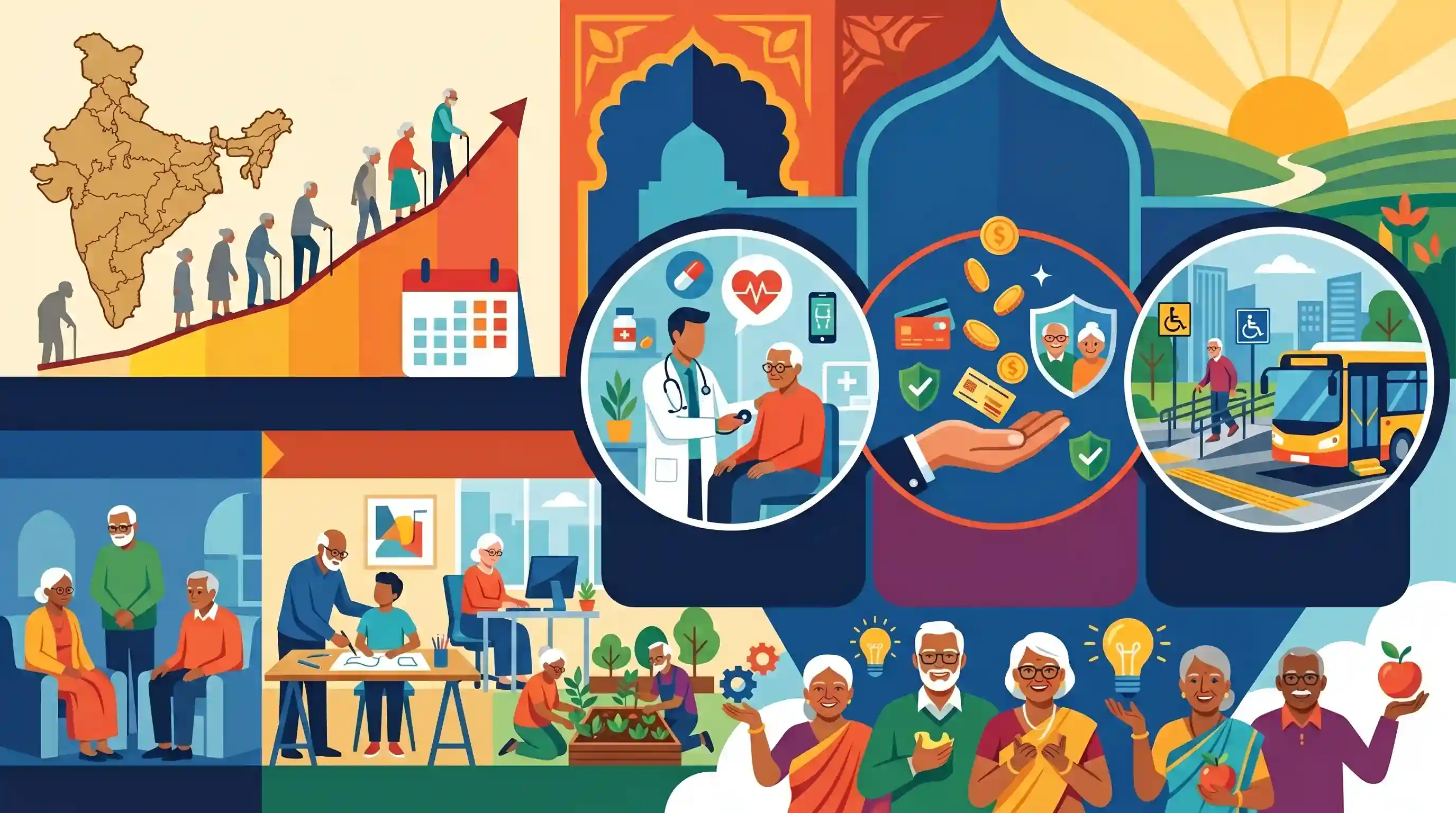
On International Day of Older Persons, the focus shifts to India's growing elderly population and the necessity of reimagining care for them. As India undergoes a demographic transition, it must move beyond traditional models of elderly dependency towards 'productive ageing'. This involves integrating older individuals into the workforce and social initiatives to utilize their experience. To successfully navigate this demographic shift and avoid a future 'demographic winter' or burden, policymakers must prioritize comprehensive geriatric healthcare, robust social security systems, and age-friendly infrastructure.
Key Points
- India is undergoing a rapid demographic transition, leading to a growing population of older persons alongside its current demographic dividend.
- The concept of elderly care needs to be reimagined from a dependency-based model to one of 'productive ageing', empowering seniors to contribute to society and the economy.
- Adequate geriatric healthcare, age-friendly infrastructure, and robust social security frameworks are crucial for managing the shift towards an aging demographic.
- Integrating the elderly into social and economic initiatives can harness their experience and mitigate the challenges of a 'demographic burden'.
Important Terms
Demographic Transition

A model describing the shift from high birth and death rates to low birth and death rates as a country develops socio-economically.
UPSC context
GS Paper I (Population) and GS III (Economy); tests knowledge of how development alters population structure.
Geriatric Healthcare
A specialized branch of medical science focusing on the healthcare, preventive treatment, and rehabilitation of the elderly population (60+ years).
UPSC context
GS Paper II (Health/Social Justice); evaluates understanding of specialized public health needs for vulnerable groups.
Productive Ageing
A concept advocating for the continued active participation of older adults in economic and social activities, rather than viewing them as dependent.
UPSC context
GS Paper II (Social Justice); explores strategies for the 'silver economy' and social inclusion of senior citizens.
Demographic Winter
A phenomenon where birth rates fall significantly below the replacement level (2.1), leading to a shrinking workforce and a rapidly aging population.
UPSC context
GS Paper I (Society) and GS II (Demographics); tests awareness of long-term socio-economic risks of declining fertility.
International Day of Older Persons
Observed annually on October 1st; the 2024 theme was 'Ageing with Dignity: Strengthening Care and Support Systems for Older Persons Worldwide'.
UPSC context
Prelims (Current Affairs) and GS II (Social Justice); tests factual knowledge of global welfare frameworks.
Vulnerable Sections
Specific groups, like the elderly, who face heightened risks of poverty, social isolation, and health issues requiring targeted state interventions.
UPSC context
GS Paper II (Social Justice); a core syllabus topic testing policy knowledge for marginalized demographics.
Prelims Trap
The SACRED portal for elderly re-employment is an initiative of the Ministry of Labour and Employment.
SACRED (Senior Able Citizens for Re-Employment in Dignity) was launched by the Ministry of Social Justice and Empowerment, not the Labour Ministry.
Static Concepts Connected
What are the 4 stages of Demographic Transition Theory?
- Stage 1: High birth and high death rates. Population remains stable but low. Characteristic of pre-industrial societies with poor healthcare.
- Stage 2: High birth rate, but rapidly falling death rate due to better medical care. Results in a population explosion (India post-independence).
- Stage 3: Falling birth rate and low death rate. Population growth slows. This is where the 'Demographic Dividend' peaks.
- Stage 4: Low birth and low death rates. Population stabilizes or declines, leading to an aging society (Demographic Winter).
Which Constitutional provisions mandate welfare for the elderly in India?
- Article 41 (DPSP): Directs the State to secure the right to work, to education, and to public assistance in cases of unemployment, old age, sickness, and disablement.
- Entry 24 (Concurrent List): Places the welfare of labor, including conditions of work, provident funds, employers' liability, invalidity, and old age pensions under the Concurrent List.
Cross-Topic Patterns
Silver Economy & Startup India
Ageing intersects with 'Silver Economy' initiatives like the SAGE (Seniorcare Ageing Growth Engine) portal, linking demographic shifts directly to entrepreneurship and tech-driven geriatric care markets.
Feminisation of Ageing
Women statistically outlive men, leading to a surge in elderly widows. This creates a dual vulnerability, linking demographic transition directly to gender justice and property rights.

Expect a 2026 Mains question linking the UNFPA Ageing Report to the 'Silver Economy' and the shift from demographic dividend to burden.
Linked PYQs · 5
Linked PYQs · 5
- 2024MainsGS1
What is the concept of a 'demographic winter'? Is the world moving towards such a situation? Elaborate.
- 2013MainsGS1
Critically examine the effect of globalization on the aged population in India.
- 2020MainsGS2
In order to enhance the prospects of social development, sound and adequate health care policies are needed particularly in the fields of geriatric and maternal health care. Discuss.
- 2024PrelimsGS1
Consider the following countries : 1. Italy 2. Japan 3. Nigeria 4. South Korea 5. South Africa Which of the above countries are frequently mentioned in the media for their low birth rates, or ageing population or declining population?
- 2011PrelimsGS1
India is regarded as a country with “Demographic Dividend”. This is due to
