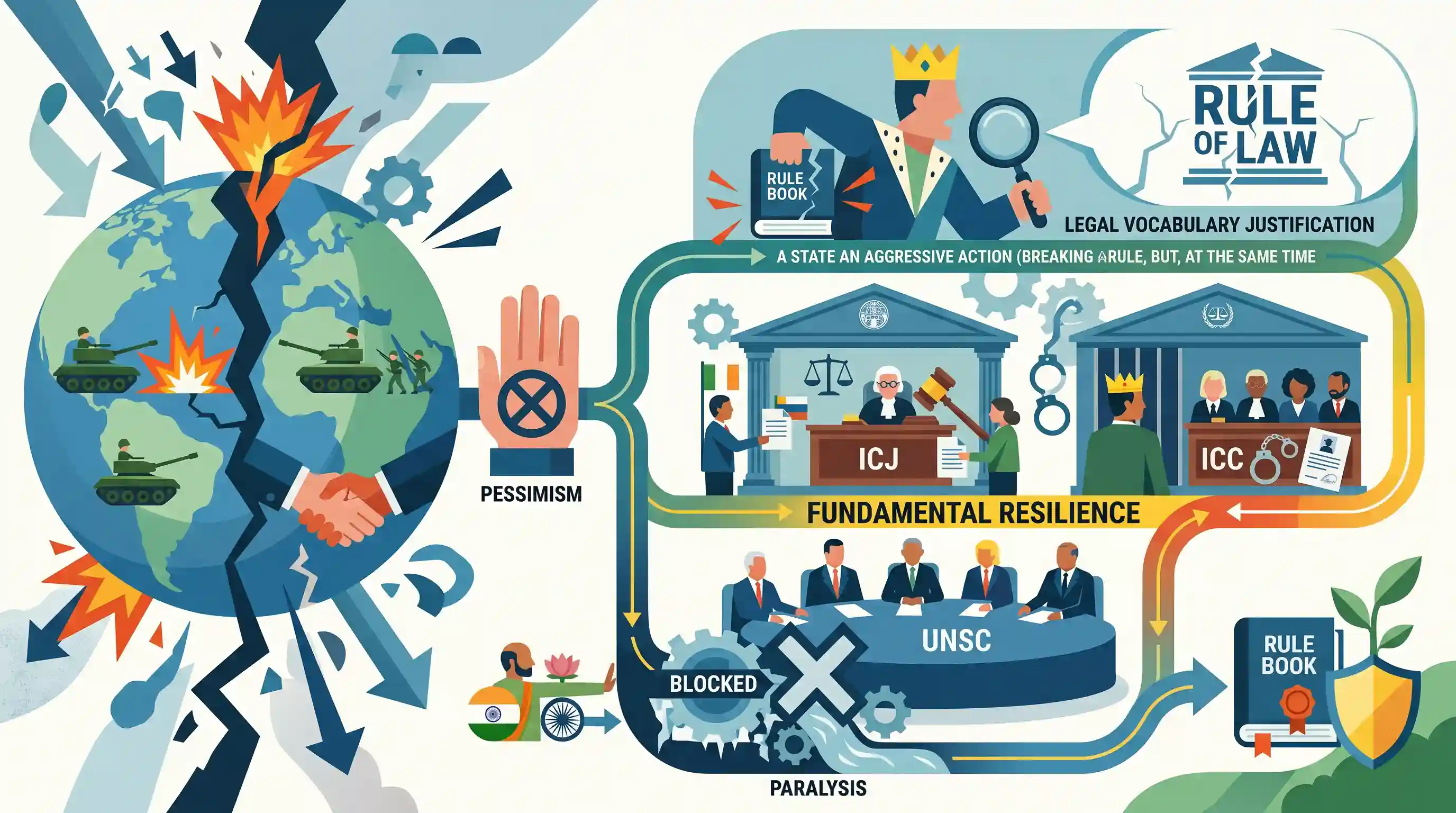
International Law retains Resilience despite Geopolitical Crises
Source:The Hindu ↗
Why It Matters
Provides a crucial counter-narrative for GS2 Mains answers regarding the 'decline' of multilateralism, UN reforms, and the relevance of international law amidst modern conflicts like those in Ukraine and Gaza.
Summary
The article argues against the growing pessimism surrounding international law, triggered by ongoing geopolitical conflicts and high-profile violations of global norms. It posits that international law remains fundamentally resilient, as evidenced by the fact that states, even when committing violations, continue to use legal vocabulary to justify their actions. Highlighting the ongoing activities of institutions like the International Court of Justice (ICJ) and the International Criminal Court (ICC), the piece concludes that while enforcement mechanisms may be flawed or hindered by the UN Security Council's paralysis, the rules-based international order is far from dead and continues to shape global governance.
Key Points
- The article counters the prevailing cynicism that widespread contemporary conflicts signify the failure or 'death' of international law.
- Despite high-profile breaches, states still predominantly justify their geopolitical actions using the vocabulary of international law, underscoring its enduring normative power.
- The distinction between violating a rule and invalidating a rule is vital; breaches highlight the need for stronger enforcement mechanisms rather than rendering the legal framework obsolete.
- Global multilateral institutions and judicial bodies like the ICJ and ICC continue to actively define the boundaries of legitimate state behavior and pursue accountability.
Important Terms
International Humanitarian Law (IHL)

A set of rules (jus in bello) seeking to limit the effects of armed conflict. It protects non-combatants and restricts warfare methods, primarily through the Geneva and Hague Conventions.
UPSC context
GS Paper II: International Relations; tests knowledge of global norms during conflicts and humanitarian legal frameworks.
UN Charter
The 1945 foundational treaty of the United Nations. It outlines the rights and obligations of member states and establishes the UN’s principal organs and core principles.
UPSC context
GS Paper II: International Relations; fundamental for understanding global governance, sovereignty, and international law.
UN Security Council (UNSC)
A principal UN organ tasked with maintaining international peace and security. It consists of 15 members, including five permanent members with veto power (P5).
UPSC context
GS Paper II: Important Institutions; focuses on structural reforms, veto power, and India’s permanent seat bid.
International Court of Justice (ICJ)
The UN's principal judicial organ ("World Court") that settles legal disputes between states and gives advisory opinions on international legal issues.
UPSC context
GS Paper II: Important Institutions; relevant for state-to-state dispute resolution and global judicial mechanisms.
International Criminal Court (ICC)
An independent permanent court that prosecutes individuals for genocide, war crimes, and crimes against humanity. It is governed by the Rome Statute.
UPSC context
GS Paper II: Important Institutions; tests individual accountability vs state sovereignty and India’s non-party status.
Rules-based International Order
A system of global governance where sovereign states conduct activities according to established laws, norms, and institutions to ensure predictability and peace.
UPSC context
GS Paper II: International Relations; essential for discussing multilateralism, unilateralism, and India’s "reformed multilateralism" vision.
Prelims Trap
"The International Criminal Court (ICC) is the principal judicial organ of the United Nations."
Aspirants often confuse the ICC with the ICJ. The ICJ is a primary UN organ, while the ICC is an independent body established by the Rome Statute, which India has not signed.
Static Concepts Connected
What are the key jurisdictional and structural differences between the ICJ and the ICC?
- Mandate & Target: The ICJ settles legal disputes between sovereign states, whereas the ICC investigates and prosecutes individuals for grave offenses like genocide and war crimes.
- UN Affiliation: The ICJ is the principal judicial organ of the UN. The ICC is an independent, treaty-based body established by the 1998 Rome Statute.
- Membership & India: All UN members are automatically party to the ICJ statute. In contrast, the ICC requires specific ratification (India, the US, and China are not ICC members).
How are the judgments of the International Court of Justice (ICJ) enforced?
- Binding Nature: ICJ judgments are binding, final, and without appeal for the states involved in the specific dispute.
- UNSC Role: Under Article 94 of the UN Charter, if a state defaults on a judgment, the aggrieved state can approach the UN Security Council for enforcement measures.
- The Veto Hurdle: Enforcement is frequently paralyzed because any UNSC resolution attempting to enforce an ICJ ruling is subject to the veto power of the five permanent members (P5).
Cross-Topic Patterns
UNSC Veto Paralysis + Multilateral Reforms
The inability of the UNSC to enforce ICJ rulings highlights the structural flaws of the UN, directly linking to the Global South's demand for comprehensive multilateral institutional reform in GS-II.
International Law + GS-IV Ethics
The justification of geopolitical conflicts using legal vocabulary underscores the tension between rigid state sovereignty and international humanitarian ethics, a highly testable theme for GS-IV case studies on international morality.

Expect a Prelims question comparing ICJ and ICC mandates, focusing on UN affiliation, individual vs state prosecution, and India's stance.
Linked PYQs · 4
Linked PYQs · 4
- 2024MainsGS2
‘Terrorism has become a significant threat to global peace and security.’ Evaluate the effectiveness of the United Nations Security Council's Counter Terrorism Committee (CTC) and its associated bodies in addressing and mitigating this threat at the international level.
- 2025MainsGS2
"The reform process in the United Nations remains unresolved, because of the delicate imbalance of East and West and entanglement of the USA vs. Russo-Chinese alliance.” Examine and critically evaluate the East-West policy confrontations in this regard.
- 2018PrelimsGS1
"Rule of Law Index" is released by which of the following?
- 2022PrelimsGS1
With reference to the "United Nations Credentials Committee", consider the following statements : 1. It is a committee set up by the UN Security Council and works under its supervision. 2. It traditionally meets in March, June and September every year. 3. It assesses the credentials of all UN members before submitting a report to the General Assembly for approval. Which of the statements given above are correct?
