International Fleet Review and Indian Navy Maritime Diplomacy
Source:Indian Express ↗
Why It Matters
Highlights the strategic importance of the Indian Navy not just as a traditional coastal defense force, but as a key tool for maritime diplomacy and a net security provider—key themes for GS3 (Security) and GS2 (International Relations).
Summary
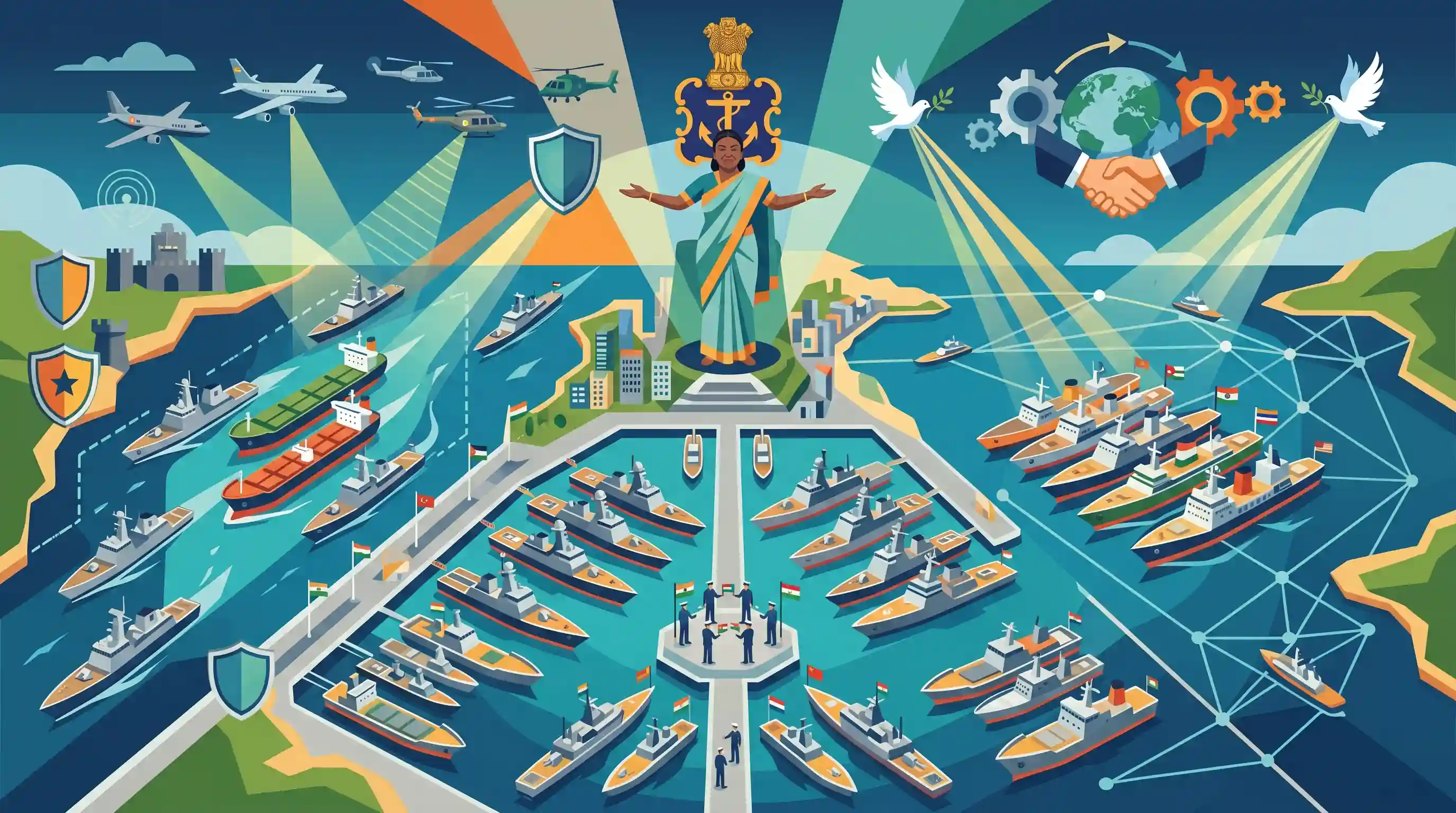
During an International Fleet Review at Visakhapatnam, President Droupadi Murmu emphasized the Indian Navy's critical importance in protecting the country's maritime interests and projecting soft power. The event highlighted the Navy's multidimensional role: maintaining vigilant coastal and maritime security to protect vital sea-trade routes, while simultaneously promoting global goodwill and cooperation through active maritime diplomacy.
Key Points
- President Droupadi Murmu highlighted the Indian Navy's dual role in ensuring national defense and serving as an instrument of global diplomacy during a fleet review in Visakhapatnam.
- Robust maritime security remains vital to safeguarding India's sea trade routes, economic interests, and coastal frontiers.
- Through events like international fleet reviews and joint exercises, the Indian Navy promotes international goodwill, projecting India's soft power.
- The event underscores India's evolving strategic posture as a net security provider in the Indian Ocean Region and a proactive global maritime power.
Important Terms
Indian Navy

The maritime branch of the Indian Armed Forces, tasked with safeguarding the nation's 7,516 km coastline and maritime interests.
UPSC context
GS-III (Security) & GS-II (IR): Tests knowledge of maritime doctrine, modernization, and India's role in the Indo-Pacific.
International Fleet Review (IFR)
A ceremonial parade of naval ships from various nations reviewed by the Head of State to foster global cooperation and showcase naval power.
UPSC context
GS-II (IR) & GS-III (Security): Relevant for understanding India's "Bridges of Friendship" and multilateral naval diplomacy.
Maritime Diplomacy
The use of naval activities like port visits and joint exercises to manage international relations and achieve favorable diplomatic outcomes.
UPSC context
GS-II (IR): Focuses on India's strategic outreach and transition to a "Preferred Security Partner" in the region.
Maritime Security
The protection of the maritime domain against threats like piracy, terrorism, and illegal trafficking to ensure freedom of navigation.
UPSC context
GS-III (Security): Essential for topics on coastal security, trade route protection (SLOCs), and response to asymmetric threats.
Indian Ocean Region (IOR)
A strategic maritime expanse hosting critical global trade routes where India aims to act as a "Net Security Provider."
UPSC context
GS-II (IR): Key to analyzing India’s geopolitical strategy, trade dependence, and regional maritime influence.
SAGAR Vision
"Security and Growth for All in the Region," India's primary policy framework for cooperative maritime security and economic integration in the Indian Ocean.
UPSC context
GS-II (IR): Critical for evaluating India's regional leadership and its collaborative approach to maritime challenges.
Soft Power
The ability to influence others through culture, values, and diplomatic engagement rather than military or economic coercion.
UPSC context
GS-II (IR): Tests understanding of India’s use of naval HADR and cultural diplomacy as non-coercive foreign policy tools.
Prelims Trap
"The role of 'Net Security Provider' in the Indian Ocean is a formal designation conferred upon India by the United Nations."
'Net Security Provider' is a self-articulated strategic posture under India's SAGAR vision to ensure regional stability. It is not an international mandate or formal UN designation.
Static Concepts Connected
What are the key maritime zones recognized under UNCLOS?
- Territorial Sea: Extends up to 12 nautical miles from the baseline; the coastal state exercises full sovereignty over the air space, water, and seabed.
- Contiguous Zone: Extends up to 24 nautical miles from the baseline; allows the coastal state to enforce customs, taxation, immigration, and pollution laws.
- Exclusive Economic Zone: Extends up to 200 nautical miles; grants the coastal state sovereign rights for exploring, exploiting, and managing living and non-living natural resources.
What is India's SAGAR doctrine?
- Core Vision: Stands for 'Security and Growth for All in the Region', introduced in 2015 as India's strategic vision for the Indian Ocean.
- Primary Objectives: Aims to safeguard mainland and island territories, deepen economic and security cooperation with regional maritime neighbors, and promote collective action.
- Strategic Posture: Cements India's role as a 'Net Security Provider' and the 'First Responder' for Humanitarian Assistance and Disaster Relief (HADR) in the region.
Cross-Topic Patterns
Red Sea crisis & energy security linkages
Naval vigilance directly impacts domestic inflation and energy security. Disruptions in critical chokepoints like Bab-el-Mandeb threaten the 80% of India's crude oil imports that transit via sea routes.
Maritime diplomacy & Indo-Pacific architecture
Events like International Fleet Reviews and the MILAN exercise operationalize India's Act East policy and align with the maritime security pillar of the Indo-Pacific Oceans Initiative (IPOI).

Expect 2026 Prelims to test the mapping of Indian Ocean chokepoints against India's maritime doctrines (SAGAR, IPOI) in a single Q.
Linked PYQs · 3
Linked PYQs · 3
- 2025MainsGS3
Why is maritime security vital to protect India's sea trade? Discuss maritime and coastal security challenges and the way forward.
- 2022MainsGS3
What are the maritime security challenges in India ? Discuss the organisational, technical and procedural initiatives taken to improve the maritime security.
- 2023PrelimsGS1
Consider the following pairs: Port Well known as 1. Kamarajar Port: First major port in India registered as a company 2. Mundra Port: Largest privately owned port in India 3. Visakhapatnam Port: Largest container port in India How many of the above pairs are correctly matched?
