International Tribunal Rulings on Climate Obligations
Source:The Hindu ↗
Why It Matters
The intersection of international law, human rights, and climate change is a major emerging theme for UPSC. The active involvement of tribunals like ICJ and ITLOS in defining state obligations regarding GHG emissions shifts the climate debate from voluntary commitments (under UNFCCC) to legally binding frameworks, affecting global environmental governance and India's diplomatic positioning.
Summary
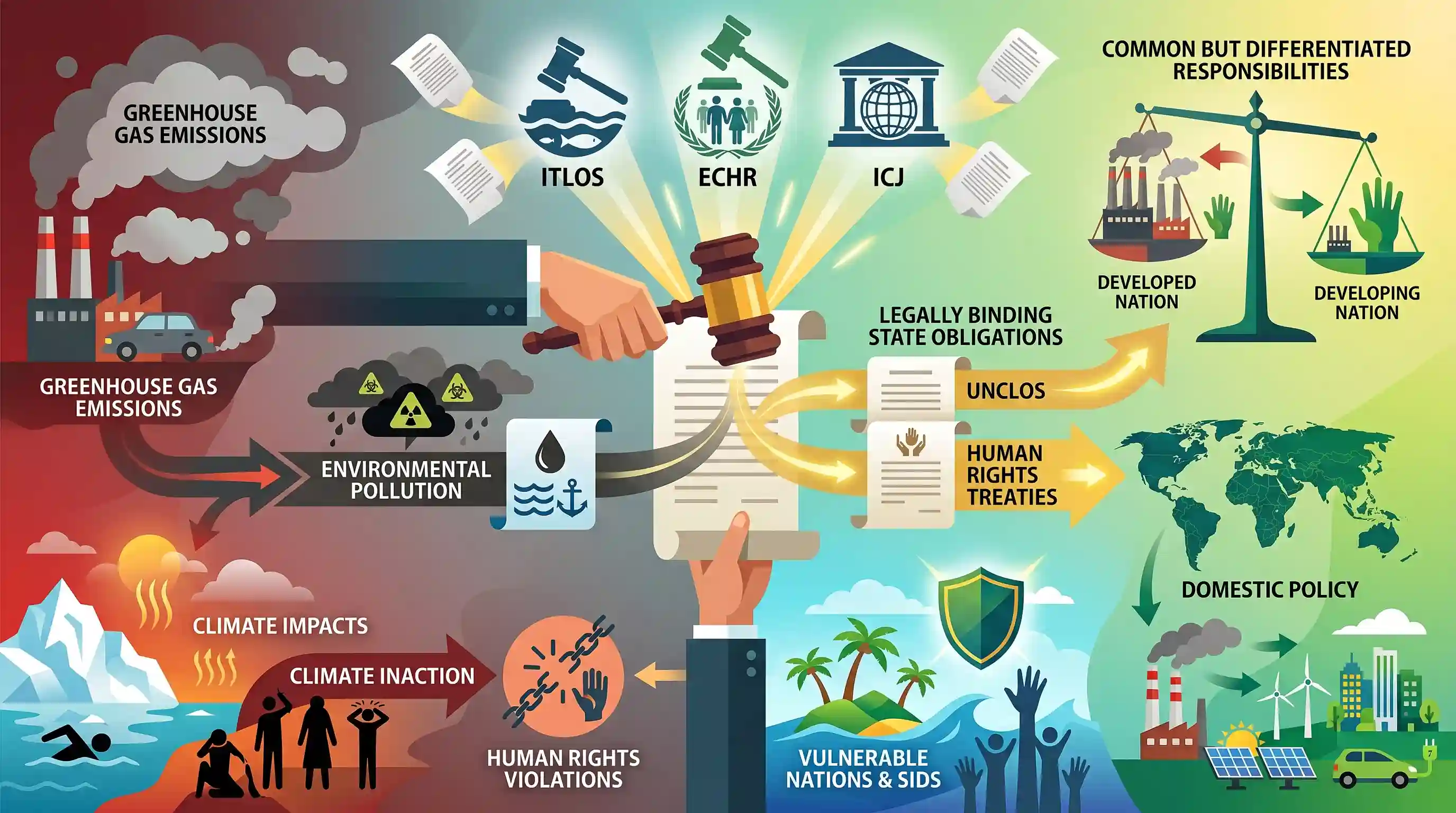
Recent advisory opinions and rulings by international tribunals—including the International Tribunal for the Law of the Sea (ITLOS), the European Court of Human Rights (ECHR), and the anticipated pronouncements from the International Court of Justice (ICJ)—mark a watershed moment in global climate jurisprudence. These legal milestones explicitly recognize that greenhouse gas (GHG) emissions constitute environmental pollution, triggering legally binding state obligations under existing frameworks like the UN Convention on the Law of the Sea (UNCLOS) and human rights treaties. By establishing a direct nexus between state inaction on climate change and human rights violations, these rulings reinforce the principle of common but differentiated responsibilities, strengthen the legal standing of vulnerable nations (such as Small Island Developing States), and set a precedent that could compel more aggressive domestic climate policies worldwide.
Key Points
- Evolving Climate Jurisprudence: Rulings from international bodies like ITLOS and ECHR are transitioning climate change from a purely diplomatic issue to a matter of binding legal obligation.
- GHG as Marine Pollution: The ITLOS advisory opinion explicitly classified greenhouse gas emissions as pollution of the marine environment under UNCLOS, obligating states to take specific measures to prevent, reduce, and control them.
- Human Rights Nexus: Landmark decisions establish that a state's failure to meet climate targets constitutes a violation of fundamental human rights, creating actionable claims for citizens against their governments.
- Protection for Vulnerable Nations: Advisory opinions sought by coalitions of Small Island Developing States highlight their existential threats and strengthen their legal recourse under international law.
- Synergy with UNFCCC: While these international court rulings do not replace the Paris Agreement, they complement it by providing an independent legal interpretation and a potential enforcement mechanism for state climate commitments.
Important Terms
International Tribunal for the Law of the Sea (ITLOS)

An independent judicial body established by UNCLOS to adjudicate maritime disputes; it recently ruled that greenhouse gas emissions constitute marine pollution.
UPSC context
GS II/III; tests knowledge of international maritime institutions and their expanding jurisdiction over environmental and climate-related issues.
UN Convention on the Law of the Sea (UNCLOS)
The 1982 "Constitution for the Oceans" treaty; its Part XII obligates states to protect and preserve the marine environment from all sources of pollution.
UPSC context
GS II; essential for understanding international maritime law and India's rights and responsibilities in the Indian Ocean region.
International Court of Justice (ICJ)
The principal UN judicial organ; its 2025 advisory opinion clarified that states have binding legal obligations to prevent climate harm for future generations.
UPSC context
GS II; tests understanding of the ICJ's advisory role and its influence on setting global legal precedents for state accountability.
European Court of Human Rights (ECHR)
A regional human rights court that set a global precedent in 2024 by ruling that state failure to mitigate climate change violates human rights.
UPSC context
GS II; tests awareness of the "greening" of human rights law and its impact on domestic climate litigation worldwide.
Commission of Small Island States on Climate Change and International Law (COSIS)
An organization of small island nations formed to use international legal tribunals to define state obligations for climate mitigation and ocean protection.
UPSC context
GS II; demonstrates how vulnerable nations (SIDS) utilize international law to seek environmental justice against major emitters.
United Nations Framework Convention on Climate Change (UNFCCC)
The foundational 1992 global treaty to stabilize greenhouse gas concentrations; it established the principle of "common but differentiated responsibilities" (CBDR).
UPSC context
GS III; the core framework for international climate negotiations and a frequent reference for domestic and international climate policies.
Paris Agreement
A 2015 treaty under the UNFCCC aiming to limit global warming; its 1.5°C goal is increasingly viewed as a legally binding benchmark by tribunals.
UPSC context
GS III; tests knowledge of international climate commitments and the legal status of temperature targets in global jurisprudence.
Prelims Trap
"Anthropogenic greenhouse gas emissions are regulated solely by the UNFCCC and exclude the UNCLOS framework."
The ITLOS advisory opinion explicitly classifies GHG emissions as "marine pollution" under UNCLOS, obligating states to curb emissions to prevent ocean warming, distinct from Paris pledges.
Static Concepts Connected
What is the mandate and structure of ITLOS?
- Establishment: Created under Annex VI of UNCLOS to adjudicate disputes arising from the interpretation and application of the Convention.
- Jurisdiction: Hears disputes between state parties and issues advisory opinions on legal questions regarding marine environments.
- Location: Headquartered in Hamburg, Germany, it operates as an independent judicial body.
How does the ICJ's Advisory Jurisdiction differ from Contentious cases?
- Contentious cases: Settles legal disputes exclusively between sovereign States. The judgments are legally binding on the parties involved.
- Advisory opinions: Given only to authorized UN organs and specialized agencies (not States). They carry high legal/moral weight but aren't binding.
Cross-Topic Patterns
Climate Action as Fundamental Human Right
The ECHR ruling parallels the Indian Supreme Court's recent recognition of a fundamental right against the adverse effects of climate change under Articles 14 and 21 (M.K. Ranjitsinh case).
SIDS weaponizing International Law
Small Island Developing States (like Vanuatu and Tuvalu via COSIS) are bypassing stalled UNFCCC diplomatic negotiations to force legal climate obligations through tribunals like ITLOS and ICJ.

Expect a 2026 Prelims multi-statement question linking UNCLOS/ITLOS jurisdiction specifically to GHG emissions as marine pollution.
Linked PYQs · 4
Linked PYQs · 4
- 2022MainsGS3
Discuss global warming and mention its effects on the global climate. Explain the control measures to bring down the level of greenhouse gases which cause global warming, in the light of the Kyoto Protocol, 1997.
- 2025MainsGS3
Write a review on India's climate commitments under the Paris Agreement (2015) and mention how these have been further strengthened in COP26 (2021). In this direction, how has the first Nationally Determined Contribution intended by India been updated in 2022?
- 2021MainsGS3
Describe the major outcomes of the 26th session of the Conference of the Parties (COP) to the United Nations Framework Convention on Climate Change (UNFCCC). What are the commitments made by India in this conference?
- 2021PrelimsGS1
Consider the following statements : 1. The Global Ocean Commission grants licences for seabed exploration and mining in international waters. 2. India has received licences for seabed mineral exploration in international waters. 3. 'Rare earth minerals' are present on seafloor in international waters. Which of the statements given above are correct?
