Molecular Signalling Conference at CUK Focuses on Biotech Research
Source:The Hindu ↗
Why It Matters
Highlights the ongoing importance of fundamental scientific research in driving biotechnology applications and achieving self-reliance (Atmanirbhar Bharat). It provides current examples of R&D achievements relevant to GS3 (Biotechnology and indigenous technology) and GS2 (Higher Education).
Summary
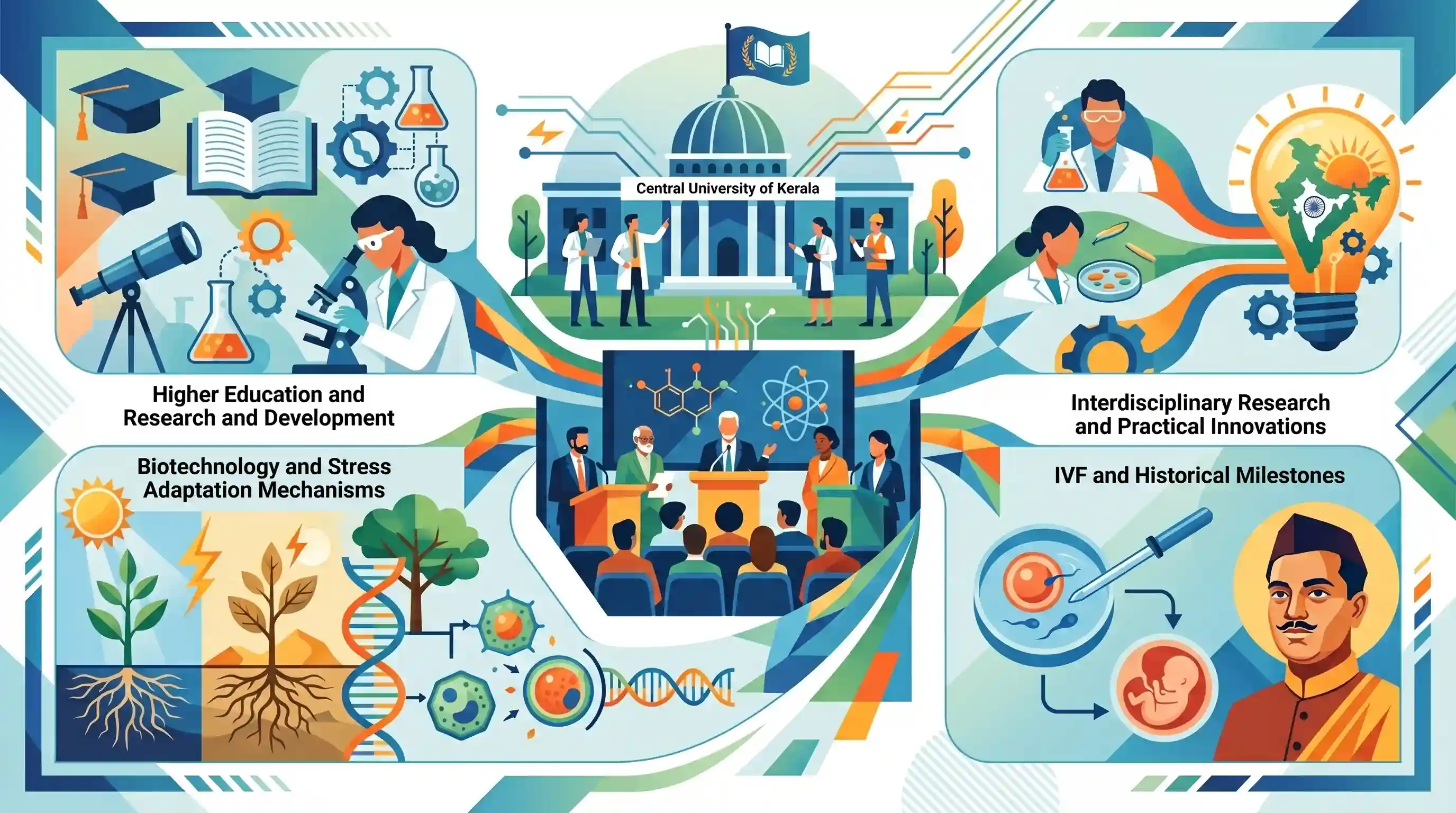
The International Conference on Molecular Signalling (ICMS 2026), hosted by the Central University of Kerala, underscores the critical role of interdisciplinary research in the life sciences. Emphasizing the chemical foundations of biological processes, the event aims to bridge the gap between basic research and practical innovations, resonating with the 'Atmanirbhar Bharat' vision of self-reliance. Key scientific discussions covered topics ranging from stress adaptation mechanisms to the historical milestones of Dr. Subhas Mukherjee in India's IVF research.
Key Points
- The International Conference on Molecular Signalling (ICMS 2026) is being held at the Central University of Kerala, emphasizing the profound connection between biology and chemistry.
- The conference aligns with the 'Atmanirbhar Bharat' vision, urging universities to evolve into engines of indigenous innovation through robust foundational research.
- Key sessions explored novel insights into corticosteroid receptors in stress adaptation and honored Dr. Subhas Mukherjee, India's visionary pioneer in In Vitro Fertilization (IVF).
Important Terms
Atmanirbhar Bharat

A vision and mission launched by the Government of India in 2020 to make the country self-reliant through five pillars: Economy, Infrastructure, Systems, Vibrant Demography, and Demand.
UPSC context
GS Paper III: Indian Economy and development. Relevant for questions on industrial policy, self-sufficiency, and economic reforms.
National Centre for Biological Sciences (NCBS)
A premier biological research center in Bengaluru, part of the Tata Institute of Fundamental Research (TIFR), focused on basic and interdisciplinary research in the frontier areas of biology.
UPSC context
GS Paper III: Science and Technology. Important for institutional frameworks in biological sciences and R&D in India.
ICMR-National Institute for Research in Reproductive and Child Health (NIRRCH)
A premier Mumbai-based ICMR institute dedicated to research in reproductive health, including maternal and child health, infertility, and emerging areas like stem cell biology.
UPSC context
GS Paper II & III: Health and S&T. Relevant for maternal health, IVF research, and biomedical advancements.
Molecular Signalling
The fundamental process by which cells communicate with their environment and each other through chemical and physical signals to regulate biological functions.
UPSC context
GS Paper III: Science and Technology. Tests understanding of basic biological processes and their applications in biotechnology and medicine.
In Vitro Fertilization (IVF)
A medical procedure where an egg is fertilized by sperm outside the body; in India, Dr. Subhas Mukherjee is credited with creating the first IVF baby in 1978.
UPSC context
GS Paper III: Science and Technology. Relevant for biotechnology developments and ethical/legal issues in reproductive technologies.
Society for Molecular Signalling (India)
A professional scientific body in India that promotes research and collaboration in the field of molecular signaling across diverse life science disciplines.
UPSC context
GS Paper III: Science and Technology. Important as a specialized professional organization fostering R&D collaborations.
Central University of Kerala (CUK)
A statutory central university established in 2009 in Kasaragod, Kerala, aimed at providing high-quality education and fostering interdisciplinary research in underserved regions.
UPSC context
GS Paper II: Issues relating to Education. Relevant for discussions on the role of central universities in regional development and research.
Prelims Trap
"In Vitro Fertilization (IVF) procedures and clinics are governed strictly under the Surrogacy (Regulation) Act, 2021."
IVF clinics and procedures are specifically regulated by the Assisted Reproductive Technology (ART) Regulation Act, 2021, which operates parallel to, but distinct from, the Surrogacy Act.
Static Concepts Connected
What are the biological mechanisms and applications of Molecular Signalling?
- Core Mechanism: A complex communication network where signaling molecules (ligands) bind to specific cell receptors (like corticosteroids) to trigger physiological responses or gene expression.
- Medical Applications: Crucial for developing targeted cancer therapies, understanding endocrine functions, managing stress adaptation, and advancing pharmacogenomics.
What are the key regulatory features of the ART (Regulation) Act, 2021?
- Institutional Framework: Establishes a National Board and a National Registry to regulate, register, and supervise all ART clinics and gamete banks in India.
- Donor Regulations: An oocyte donor must be a married woman with at least one living child, and is permitted to donate only once in her lifetime.
- Ethical Safeguards: Strictly prohibits pre-implantation sex selection, the commercial sale of human embryos, and mandates insurance coverage for the oocyte donor.
Cross-Topic Patterns
IVF + Bioethics & Legal Frameworks
UPSC frequently bridges reproductive biotechnology advances (GS3 S&T) with the legal definitions and bioethical debates (GS2 Governance, GS4 Ethics) surrounding the ART and Surrogacy Acts.
Higher Education + Indigenous R&D
Integrating 'Atmanirbhar Bharat' with fundamental university research highlights the shift envisioned by NEP 2020 and the mandate of the Anusandhan National Research Foundation (ANRF).

Expect a Prelims statement mixing basic IVF biology (ex-vivo fertilization) with the specific regulatory limits of the ART Act 2021.
Linked PYQs · 3
Linked PYQs · 3
- 2021MainsGS3
What are the research and developmental achievements in applied biotechnology? How will these achievements help to uplift the poorer sections of the society?
- 2017MainsGS3
Stem cell therapy is gaining popularity in India to treat a wide variety of medical conditions including Leukaemia, Thalassemia, damaged cornea and severe burns. Describe briefly what stem cell therapy is and what advantages it has over other treatments?
- 2015MainsGS2
The quality of higher education in India requires major improvements to make it internationally competitive. Do you think that the entry of foreign educational institutions would help improve the quality of higher and technical education in the country? Discuss.
