Karnataka SC Sub-Categorisation and Implementation Framework
Source:The Hindu ↗
Why It Matters
The sub-categorisation (internal reservation) within Scheduled Castes is a critical constitutional and social justice issue. Recent Supreme Court guidelines on the validity of sub-classification make this highly relevant for UPSC GS2 (Polity and Social Justice), specifically concerning the equitable distribution of affirmative action benefits, the necessity of empirical data gathered by commissions, and federal implementation dynamics.
Summary
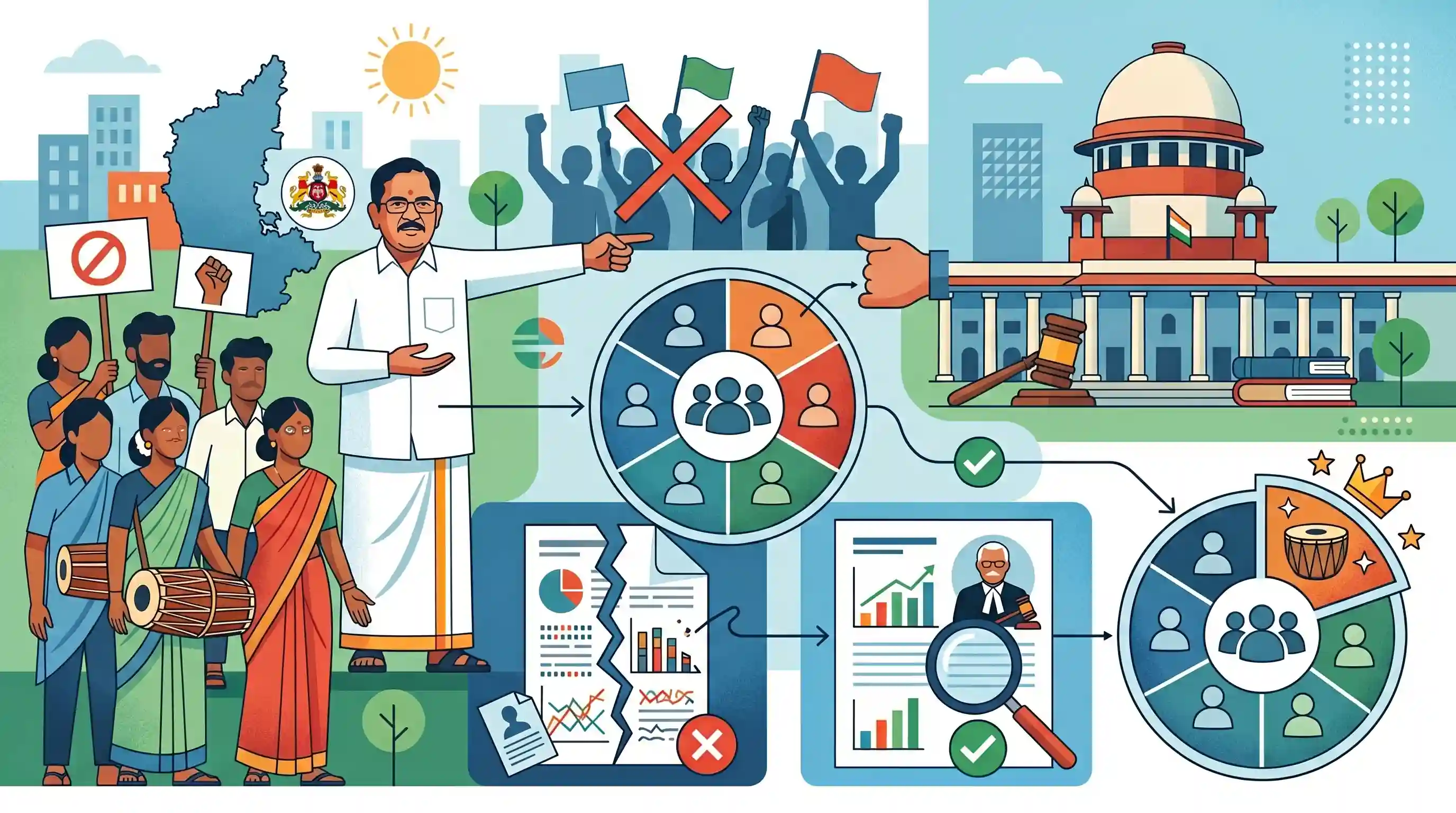
Karnataka Home Minister G. Parameshwara has appealed to Dalit groups, specifically the Madigas, to withhold protests demanding internal reservation for Scheduled Castes. The minister affirmed the state government's commitment to implementing the quota but stressed the necessity of adhering to Supreme Court guidelines. The government awaits a forthcoming report from a commission led by retired judge H.N. Nagamohan Das to finalize the administrative framework, noting that a previous report by the A.J. Sadashiva Commission was rejected due to data inadequacies.
Key Points
- The Karnataka government has reiterated its commitment to implementing internal reservations for Scheduled Castes (SCs), adhering to Supreme Court guidelines.
- The State is awaiting a comprehensive report from the H.N. Nagamohan Das Commission to establish the policy's implementation framework.
- A previous report by the A.J. Sadashiva Commission regarding internal quotas was rejected due to inadequacies in empirical data.
- The push for sub-categorisation within SCs aims to ensure an equitable distribution of reservation benefits among the most marginalized groups, such as the Madiga community in Karnataka.
Important Terms
Internal Reservation for Scheduled Castes

The sub-division of the total Scheduled Caste quota into specific percentages for various sub-castes based on their varying degrees of backwardness and representation.
UPSC context
GS-II: Social Justice & Polity. Relates to Article 14-16 and recent 2024 landmark judgments on sub-classification.
H.N. Nagamohan Das Commission
The current Karnataka-appointed body tasked with collecting empirical data to finalize the administrative framework and quota distribution for SC sub-groups.
UPSC context
GS-II: Statutory/Quasi-judicial bodies. Tests understanding of commissions' roles in policy formulation for vulnerable sections.
A.J. Sadashiva Commission
A previous commission (2005–2012) that proposed a sub-matrix for SC quotas in Karnataka but was set aside due to data disputes.
UPSC context
GS-II: Historical background of reservation struggles. Tests knowledge of state-level affirmative action precedents.
Madigas
A prominent SC sub-group (Dalit Left) in Karnataka advocating for internal reservation, claiming disproportionately fewer benefits compared to other sub-groups.
UPSC context
GS-I/II: Social empowerment and vulnerable sections. Specific community-based movements for social justice.
Empirical Data (Reservation)
Requirement mandated by the Supreme Court (2024) to justify SC sub-classification based on quantifiable evidence of backwardness and inadequate state representation.
UPSC context
GS-II: Separation of powers and judicial review. Tests administrative requirements for constitutional policy changes.
Prelims Trap
State legislatures have the power to alter the Scheduled Castes list to implement internal quotas.
States can now sub-classify existing SCs for equitable quotas, but ONLY Parliament has the power to add or remove communities from the Presidential SC List under Article 341.
Static Concepts Connected
What is the Constitutional mechanism for notifying and modifying the Scheduled Castes list?
- Presidential Notification: Under Article 341(1), the President notifies the initial list of SCs for a State or UT after consulting the respective Governor.
- Parliamentary Power: Under Article 341(2), only Parliament can enact a law to include or exclude any caste from this Presidential list. State legislatures entirely lack this power.
What are the prerequisites for States to legally implement sub-classifications within quotas?
- Empirical Data: States cannot act on political whims; they must gather quantifiable empirical data proving the relative backwardness of the targeted sub-castes.
- Inadequate Representation: The data must demonstrate that the specific sub-group is inadequately represented in public services compared to dominant groups within the same category.
- Administrative Efficiency: Any sub-classification or reservation policy must not compromise the overall efficiency of administration as mandated under Article 335.
Cross-Topic Patterns
SC sub-classification mirrors OBC debates
The demand for SC internal quotas strongly parallels the Justice Rohini Commission's mandate to sub-categorize Other Backward Classes (OBCs) for equitable distribution of Central reservation benefits.
Evolution of Article 341 jurisprudence
The 2024 Davinder Singh verdict overruling the 2004 Chinnaiah judgment provides a classic Mains case study on how the Supreme Court dynamically interprets Fundamental Rights to achieve substantive equality.

Sub-categorisation under Art 341 vs state powers in Art 16(4) will likely form a paired multi-statement Polity question in Prelims 2026.
Linked PYQs · 3
Linked PYQs · 3
- 2018MainsGS2
Whether National Commission for Scheduled Castes (NCSC) can enforce the implementation of constitutional reservation for the Scheduled Castes in the religious minority institutions? Examine.
- 2023PrelimsGS1
Consider the following statements: Statement-I: The Supreme Court of India has held in some judgements that the reservation policies made under Article 16(4) of the Constitution of India would be limited by Article 335 for maintenance of efficiency of administration. Statement-II: Article 335 of the Constitution of India defines the term 'efficiency of administration'. Which one of the following is correct in respect of the above statements?
- 2022MainsGS2
Discuss the role of the National Commission for Backward Classes in the wake of its transformation from a statutory body to a constitutional body.
