Opposition criticizes terms of interim trade agreement with US
Source:The Hindu ↗
Why It Matters
The debate around the Indo-U.S. trade agreement highlights the persistent tension between globalization/bilateral ties and the protection of domestic interests (agriculture, data sovereignty, and energy security). It also provides a practical context for understanding parliamentary procedures, specifically how a 'privilege motion' is utilized to maintain accountability and decorum when an MP is accused of misleading the House.
Summary
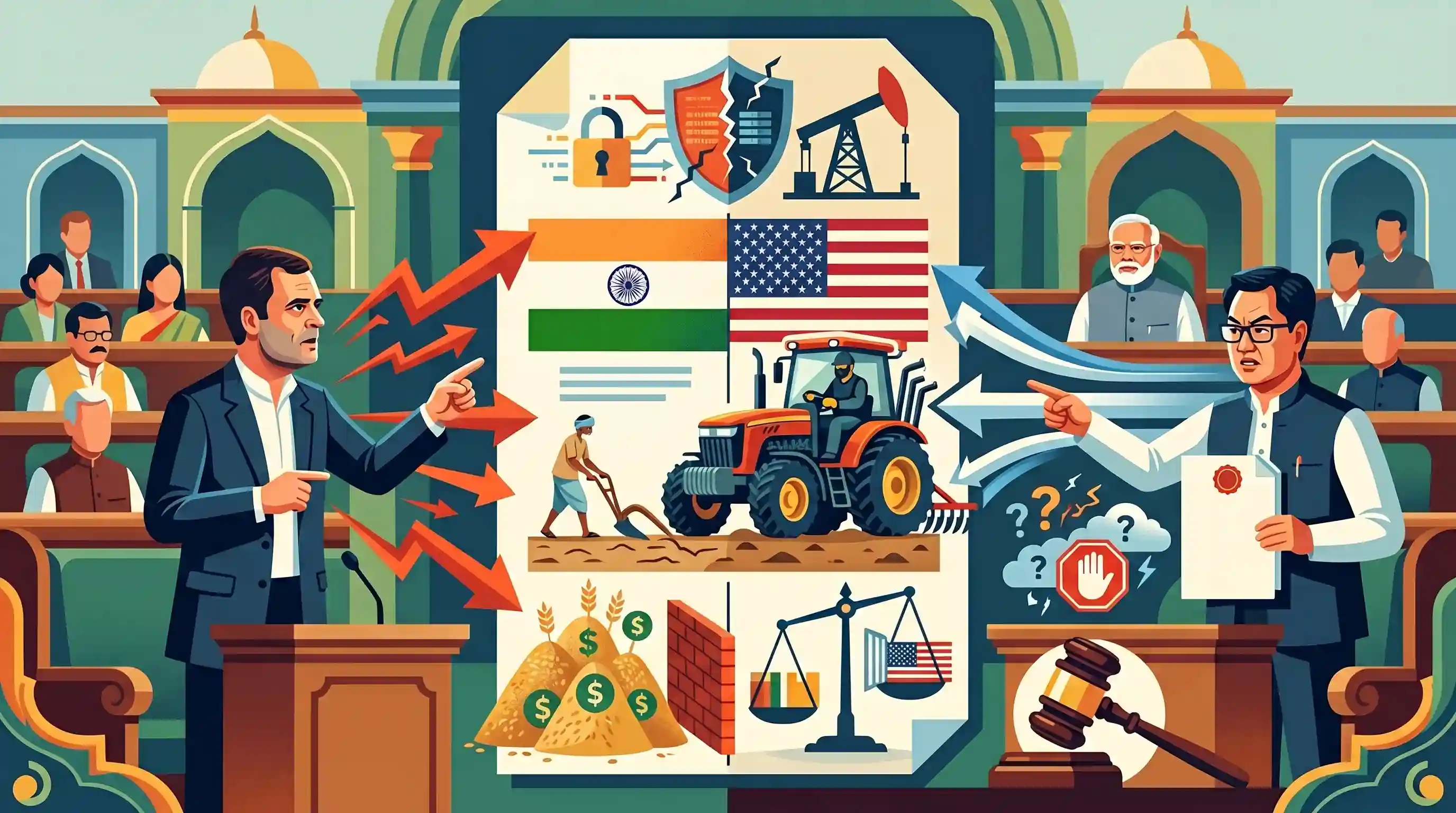
During a Lok Sabha session, Leader of the Opposition Rahul Gandhi launched a severe attack on the NDA government regarding the newly signed Indo-U.S. interim trade agreement. He alleged that the deal compromises India's energy and data security, and opens the door for heavily subsidized, mechanized American agriculture to devastate small Indian farmers. Gandhi further highlighted severe tariff asymmetries, claiming Indian import duties were reduced to zero while U.S. tariffs on Indian goods rose to 18%. In response, Parliamentary Affairs Minister Kiren Rijiju stated the government would move a privilege motion against Gandhi, accusing him of making baseless and derogatory allegations against the Prime Minister and misleading the Parliament.
Key Points
- Leader of Opposition Rahul Gandhi strongly criticized the Indo-U.S. interim trade agreement in the Lok Sabha, labeling it a 'one-sided' deal that harms national interests.
- He alleged the agreement compromises India's strategic autonomy by allowing the U.S. to dictate India's oil purchases, threatening energy security.
- Gandhi claimed that the deal endangers data privacy by handing over Indian citizens' data to American entities.
- He argued that zeroing Indian tariffs while U.S. tariffs rise to 18% will allow mechanized American agriculture to crush small Indian farmers.
- In response, Parliamentary Affairs Minister Kiren Rijiju announced the government's intent to move a privilege motion against Gandhi for allegedly making false and derogatory statements against Prime Minister Narendra Modi.
Important Terms
Indo-U.S. Interim Trade Agreement (2026)

A February 2026 pact where the U.S. reduced effective tariffs on Indian goods to 18% in exchange for energy/tech purchases and agricultural market access.
UPSC context
GS Paper II (Bilateral Agreements); tests understanding of trade diplomacy, tariff negotiations, and strategic economic partnerships.
Privilege Motion
A formal notice moved by a legislator against a member or minister for allegedly breaching the rights and immunities of the House.
UPSC context
GS Paper II (Parliamentary Functioning); tests knowledge of Articles 105/194 and the accountability of representatives.
Strategic Autonomy
The policy of maintaining independent decision-making in foreign affairs to protect national interests without exclusive alignment with any single power bloc.
UPSC context
GS Paper II (Foreign Policy); central to India's "multi-aligned" stance and balancing U.S.-Russia relations.
Data Sovereignty
The principle that digital data generated within a country is subject to its laws and should be stored locally for security.
UPSC context
GS Paper III (Cyber Security/Economy); tests debates on data localization and the DPDP Act.
Tariff Asymmetry
A situation where trading partners impose vastly different import duties on each other's goods, often used to protect domestic industry.
UPSC context
GS Paper III (External Trade); key to analyzing trade deficits and WTO compliance.
Leader of the Opposition (LoP)
Statutory head of the largest opposition party in the House, responsible for providing alternative perspectives on government policy.
UPSC context
GS Paper II (Legislature); tests institutional roles and democratic checks on executive power.
Prelims Trap
"A Privilege Motion can only be moved against a Minister for withholding facts or misleading the House."
A Privilege Motion can be moved against ANY Member of Parliament (including private members or the Leader of the Opposition), not just Ministers.
Static Concepts Connected
What is the framework governing a Privilege Motion in the Lok Sabha?
- Article 105: Grants specific powers, privileges, and immunities to Members of Parliament and its various committees.
- Rule 222: Governs the procedural framework in the Lok Sabha, requiring the Speaker's consent to raise a question of privilege.
- Speaker's Discretion: The Speaker acts as the first scrutiny level, deciding on the motion directly or referring the matter to the Privileges Committee.
Why do developed country agricultural models threaten Indian farmers in FTAs?
- Subsidy Disparity: Developed nations extensively use WTO-permissible 'Green Box' subsidies, providing massive, untargeted financial support to their highly mechanized agriculture sector.
- Tariff Asymmetry: Eliminating import duties (zeroing tariffs) exposes vulnerable, small-scale Indian farmers to floods of cheaper, heavily subsidized foreign produce, worsening trade deficits.
Cross-Topic Patterns
FTAs vs Data Sovereignty
Modern trade deals often push for unrestricted cross-border data flows, clashing directly with India's domestic data localization mandates and the Digital Personal Data Protection (DPDP) Act.
Energy imports and Strategic Autonomy
Conceding oil purchase decisions in trade agreements threatens strategic autonomy, a theme frequently highlighted by India's defiance of Western sanctions to purchase discounted Russian crude.

Expect a 2026 Prelims question merging Article 105 (Privileges), Speaker's discretionary powers, and the Privileges Committee's mandate.
Linked PYQs · 4
Linked PYQs · 4
- 2025MainsGS2
"Energy security constitutes the dominant kingpin of India's foreign policy, and is linked with India's overarching influence in Middle Eastern countries.” How would you integrate energy security with India's foreign policy trajectories in the coming years?
- 2024MainsGS3
Describe the context and salient features of the Digital Personal Data Protection Act, 2023.
- 2023MainsGS3
What are the direct and indirect subsidies provided to farm sector in India? Discuss the issues raised by the World Trade Organization (WTO) in relation to agricultural subsidies.
- 2020MainsGS2
Once a Speaker, Always a Speaker' ! Do you think this practice should be adopted to impart objectivity to the office of the Speaker of Lok Sabha ? What could be its implications for the robust functioning of parliamentary business in India?
