Indo US trade framework fully protects domestic agricultural interests
Source:The Hindu ↗
Why It Matters
Trade agreements directly impact domestic agricultural prices, food security, and farmer incomes. The Indo-US trade dynamic is crucial for GS2 (Bilateral Relations) and GS3 (Economy/Agriculture), highlighting the balance between securing export markets and protecting domestic producers.
Summary
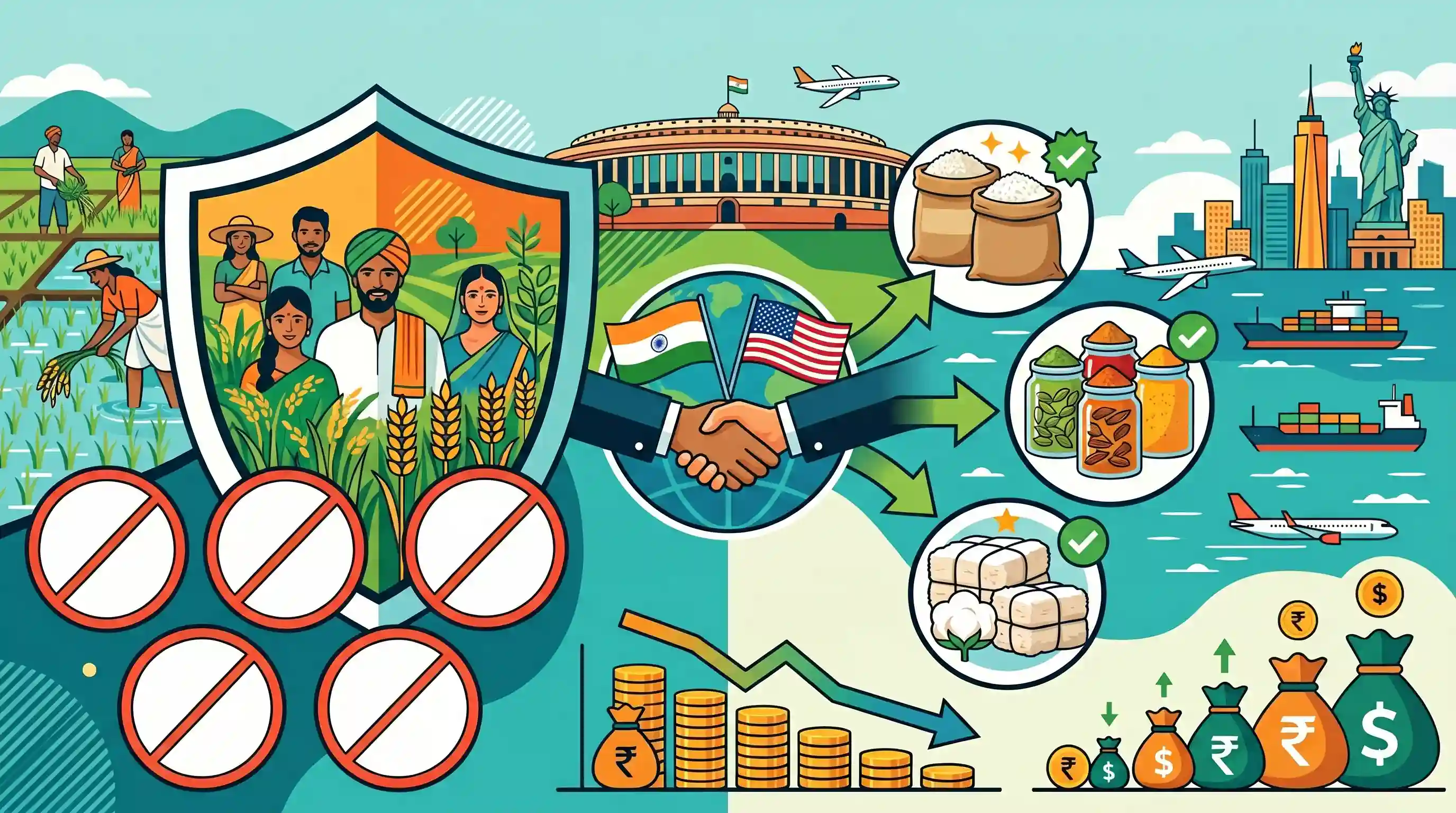
Agriculture Minister Shivraj Singh Chouhan has assured Parliament that the newly proposed Indo-U.S. interim trade framework fully protects the interests of Indian farmers. Responding to Opposition concerns regarding the potential influx of foreign agricultural goods, he clarified that sensitive items like wheat, rice, corn, dairy products, and soya will not be allowed for import. Conversely, the pact will secure larger market access in the U.S. for Indian agricultural exports, particularly basmati rice, spices, and cotton. Additionally, U.S. tariffs on Indian goods are set to decrease from 50% to 18%, presenting a significant economic opportunity for the domestic farm sector.
Key Points
- Agriculture Minister Shivraj Singh Chouhan assured the Rajya Sabha that the Indo-US trade framework completely safeguards the interests of Indian farmers.
- The trade deal prohibits the import of sensitive agricultural commodities that could harm domestic farmers, such as wheat, rice, corn, milk, cheese, and soya bean.
- The agreement focuses on expanding market access for key Indian agricultural exports like basmati rice, spices, and cotton in the United States.
- As part of the interim framework, the US has agreed to lower tariffs on Indian imports significantly, from an average of 50% to around 18%.
- The Opposition raised concerns about the lack of consultation with farmer organizations and potential adverse impacts on domestic prices.
Important Terms
Indo-US Interim Trade Framework

A 2026 pact reducing US tariffs on Indian goods from 50% to 18% while granting zero-tariff access for certain Indian agri-exports.
UPSC context
GS II/III: Strategic partnerships and trade diplomacy.
Sensitive Products (Agriculture)
Commodities like wheat, dairy, and rice excluded from trade concessions to safeguard domestic small farmers and national food security.
UPSC context
GS III: Agricultural marketing and food security.
Market Access
The ability of a company or country to sell goods and services across borders by overcoming tariff and non-tariff barriers.
UPSC context
GS III: Trade policy and export-led growth.
Bilateral Trade Agreement (BTA)
A trade arrangement between two nations to reduce barriers and foster economic cooperation, distinct from multilateral or regional blocs.
UPSC context
GS II: International relations and bilateral groupings.
Reciprocal Tariff
A tariff imposed by one country in response to a similar tariff or trade barrier imposed by a trading partner.
UPSC context
GS III: External sector and trade tensions.
Viksit Bharat
The roadmap to make India a developed nation by 2047, emphasizing economic self-reliance, modern infrastructure, and global competitiveness.
UPSC context
GS III/Essay: Long-term economic planning and vision.
Prelims Trap
The Indo-US trade framework allows reciprocal tariff-free import of dairy and staple grains to boost bilateral trade.
India strictly places sensitive agricultural commodities like dairy, wheat, and soya on the 'exclusion list' during FTA negotiations to shield domestic farmers from volatility.
Static Concepts Connected
What is the 'Exclusion List' (Negative List) in Free Trade Agreements?
- Definition: Products deliberately excluded from tariff reduction or elimination commitments in an FTA to protect vulnerable domestic sectors.
- Agriculture Focus: India consistently places sensitive commodities like dairy, wheat, and soya bean on these lists to safeguard rural livelihoods.
- WTO Compliance: Permitted under WTO rules provided the FTA still covers and liberalizes "substantially all the trade" between partners.
How does an FTA differ from the Generalized System of Preferences (GSP)?
- Unilateral vs Reciprocal: GSP is a non-reciprocal, unilateral tariff exemption granted by developed nations, whereas FTAs require mutual tariff concessions.
- US-India Context: The US revoked India's GSP status in 2019; the new interim trade framework helps regain lost market access through negotiated, reciprocal cuts.
Cross-Topic Patterns
FTAs vs. WTO Peace Clause
While FTAs negotiate bilateral tariff cuts, India's broader agricultural protections, particularly MSP, are concurrently scrutinized at the WTO under the Agreement on Agriculture.
GI Tags & Agri Export Policy
Enhanced US market access for Basmati rice and spices leverages India's GI-tag framework, aligning directly with the Agriculture Export Policy's mandate to boost high-value exports.

Expect a multi-statement Prelims question testing FTA 'Negative Lists' alongside US GSP revocation and India's agri-export profile.
Linked PYQs · 3
Linked PYQs · 3
- 2023MainsGS3
What are the direct and indirect subsidies provided to farm sector in India? Discuss the issues raised by the World Trade Organization (WTO) in relation to agricultural subsidies.
- 2014MainsGS2
The aim of Information Technology Agreements (ITAs) is to lower all taxes and tariffs on information technology products by signatories to zero. What impact would such agreements have on India's interests?
- 2020PrelimsGS1
With reference to the international trade of India at present, which of the following statements is/are correct? 1. India's merchandise exports are less than its merchandise imports. 2. India's imports of iron and steel, chemicals, fertilisers and machinery have decreased in recent years. 3. India's exports of services are more than its imports of services. 4. India suffers from an overall trade/current account deficit. Select the correct answer using the code given below:
