Punjab Faces Fiscal Stress Over Grain Procurement Interest Burden
Source:Indian Express ↗
Why It Matters
This issue perfectly illustrates the complex financing mechanisms behind India's MSP regime. Aspirants must understand the 'economic cost' of food grains, which includes procurement incidentals and interest on working capital (Cash Credit Limit). Furthermore, it provides a strong real-world case study for Mains answers on fiscal federalism, demonstrating how state governments can accumulate debt and fiscal stress while implementing centralized welfare and food security policies.
Summary
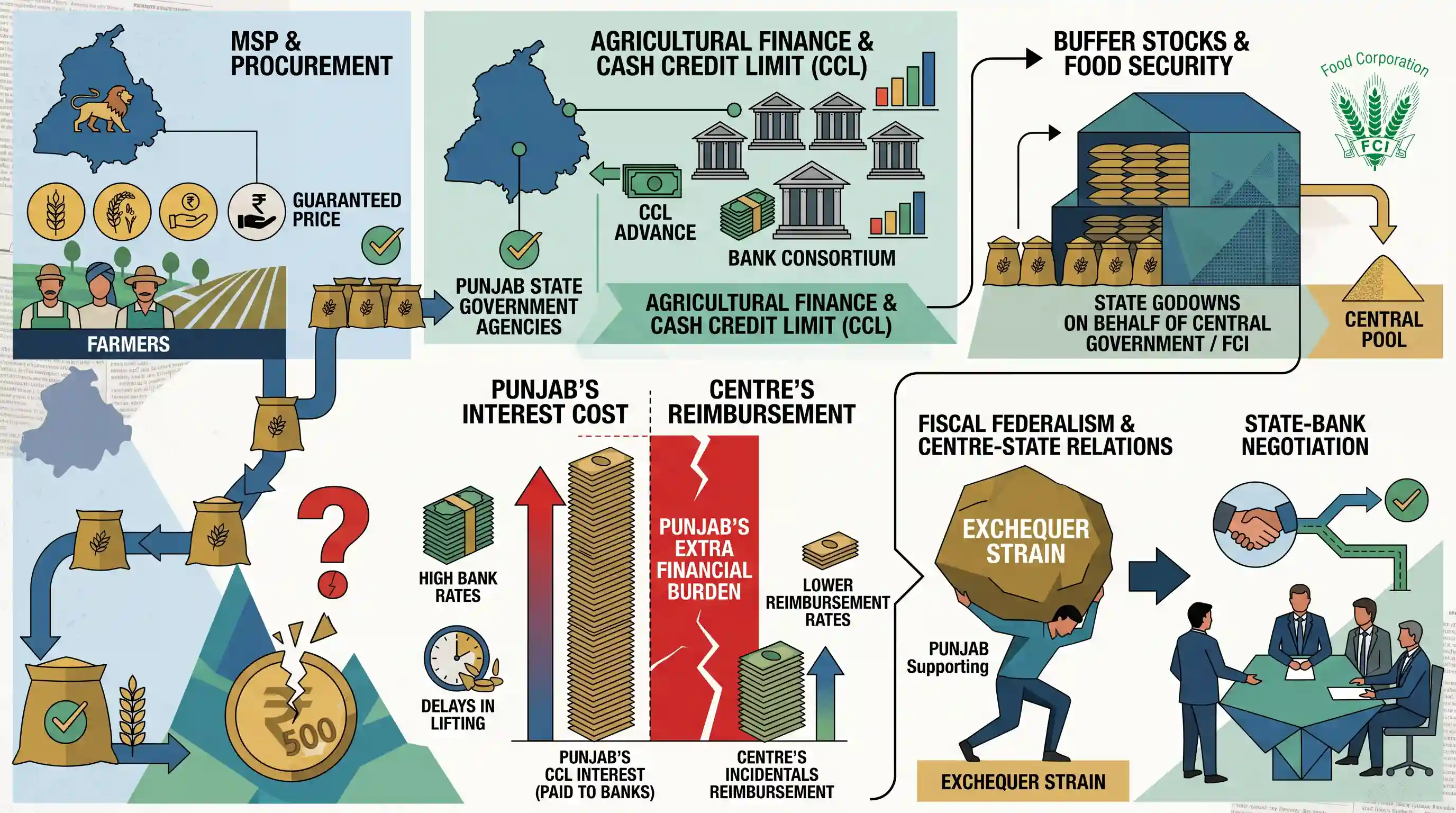
Punjab is facing a significant financial burden of Rs 500 crore due to extra interest accrued on advances taken for food grain procurement. The state procures wheat and paddy on behalf of the central government's Food Corporation of India (FCI) by availing a Cash Credit Limit (CCL) from a consortium of banks. However, discrepancies between the interest rates charged by the banks and the reimbursement rates for incidentals provided by the Centre, coupled with delays in the lifting of food grains, have resulted in a severe fiscal strain on the state exchequer. The Punjab government has scheduled a crucial meeting with the bank consortium to negotiate a resolution. This situation highlights the hidden costs states bear in executing national food security operations and underscores ongoing friction in Centre-State financial relations.
Key Points
- Punjab acts as a primary procurement agent for the Centre, buying food grains at Minimum Support Price (MSP) using bank advances known as the Cash Credit Limit (CCL).
- The state is burdened with an extra Rs 500 crore in interest due to the gap between the interest rates charged by banks and the reimbursement rates (procurement incidentals) provided by the Centre.
- Delays in the lifting of grain stocks by the FCI and accounting discrepancies further exacerbate the fiscal strain on the state exchequer.
- The Punjab government is negotiating with a consortium of banks in an April 10 meeting to seek a resolution to these ballooning interest liabilities.
- The dispute highlights structural issues in India's food grain procurement financing and points to friction in Centre-State financial relations regarding centralized food security schemes.
Important Terms
Cash Credit Limit (CCL)

Short-term credit facility provided by a bank consortium to state governments to finance the immediate payment of Minimum Support Price (MSP) to farmers during grain procurement seasons.
UPSC context
GS Paper III: Agricultural Finance. Relevant for understanding state debt, food subsidy mechanisms, and the financial logistics of the procurement system.
Food Corporation of India (FCI)
Statutory body under the Ministry of Consumer Affairs, Food and Public Distribution, responsible for procuring, storing, and distributing food grains to ensure national food security.
UPSC context
GS Paper III: Public Distribution System (PDS). Crucial for questions on buffer stock management, food security, and agricultural marketing reforms.
Minimum Support Price (MSP)
The price at which the government purchases crops from farmers to provide a safety net against price volatility, determined based on CACP recommendations.
UPSC context
GS Paper III: Agriculture. Core topic for debates on farmer welfare, crop diversification, and WTO-related agricultural subsidies.
Procurement Incidentals
Costs incurred during the procurement process beyond the grain price, including mandi fees, labor, gunny bags, and interest, which the Centre reimburses to states.
UPSC context
GS Paper III: Food Security. Important for calculating the 'Economic Cost' of food grains and understanding central-state financial transfers in agriculture.
Consortium of Banks
A collaborative arrangement where multiple banks jointly provide a large loan (like the CCL) to a single borrower to spread credit risk.
UPSC context
GS Paper III: Banking/Economy. Relevant for understanding debt management and institutional credit flow to the agricultural sector.
Fiscal Federalism
The financial and administrative relationship between the Union and State governments, specifically regarding the sharing of revenues and expenditures.
UPSC context
GS Paper II: Polity/Governance. Tests knowledge of Centre-State friction over funds, cooperative federalism, and the constitutional division of financial powers.
Prelims Trap
"The Centre bears 100% of the financial liability and interest costs when states procure food grains for FCI."
While the Centre reimburses states, it uses normative rates. States absorb the gap between actual bank interest (CCL) and central reimbursement, bearing significant fiscal risk.
Static Concepts Connected
What constitutes the 'Economic Cost' of food grains for the FCI?
- MSP & Bonus: The base Minimum Support Price (MSP) plus any state bonus paid directly to farmers.
- Procurement Incidentals: Costs incurred until grain reaches the first storage point: mandi taxes, labor, packing material, and interest on working capital.
- Distribution Costs: Freight, handling charges, storage costs, and transit losses incurred while moving grains to targeted PDS outlets.
How does the Decentralised Procurement Scheme (DCP) function?
- State-led Mechanism: State governments procure, store, and distribute food grains under PDS locally, bypassing direct FCI operations.
- Subsidy Reimbursement: The Centre reimburses states for the entire difference between their economic cost of procurement and the Central Issue Price (CIP) as a food subsidy.
- Primary Objective: Designed to reduce transport costs, minimize transit losses, and encourage crop diversification and local procurement.
Cross-Topic Patterns
Fiscal federalism and hidden state debt
State guarantees for Cash Credit Limits (CCL) add to contingent liabilities. UPSC increasingly links these agricultural financing gaps to broader macro-debates on state debt burdens and Article 293 borrowing limits.
Logistics bottlenecks in food security
FCI's delay in lifting grains spikes interest costs for Punjab and exacerbates storage shortages. This directly links procurement logistics to systemic food security and inflation management challenges.

FCI's 'Economic Cost' components (especially procurement incidentals and working capital interest) are highly probable for a 2026 Prelims MCQ.
Linked PYQs · 4
Linked PYQs · 4
- 2019PrelimsGS1
The economic cost of food grains to the Food Corporation of India is Minimum Support Price and bonus (if any) paid to the farmers plus
- 2020PrelimsGS1
Which of the following factors/policies were affecting the price of rice in India in the recent past? 1. Minimum Support Price 2. Government's trading 3. Government's stockpiling 4. Consumer subsidies Select the correct answer using the code given below:
- 2019MainsGS3
What are the reformative steps taken by the Government to make food grain distribution system more effective?
- 2025MainsGS2
Examine the evolving pattern of Centre-State financial relations in the context of planned development in India. How far have the recent reforms impacted the fiscal federalism in India?
