Bengaluru Police Bust Inter-State Drug Trafficking Racket
Source:The Hindu ↗
Why It Matters
The exploitation of student and tourist visas by foreign nationals for organized drug trafficking highlights the transnational dimensions of internal security threats. It underscores the need for stringent visa monitoring, inter-state police coordination, and effective community policing frameworks to counter urban narco-syndicates.
Summary
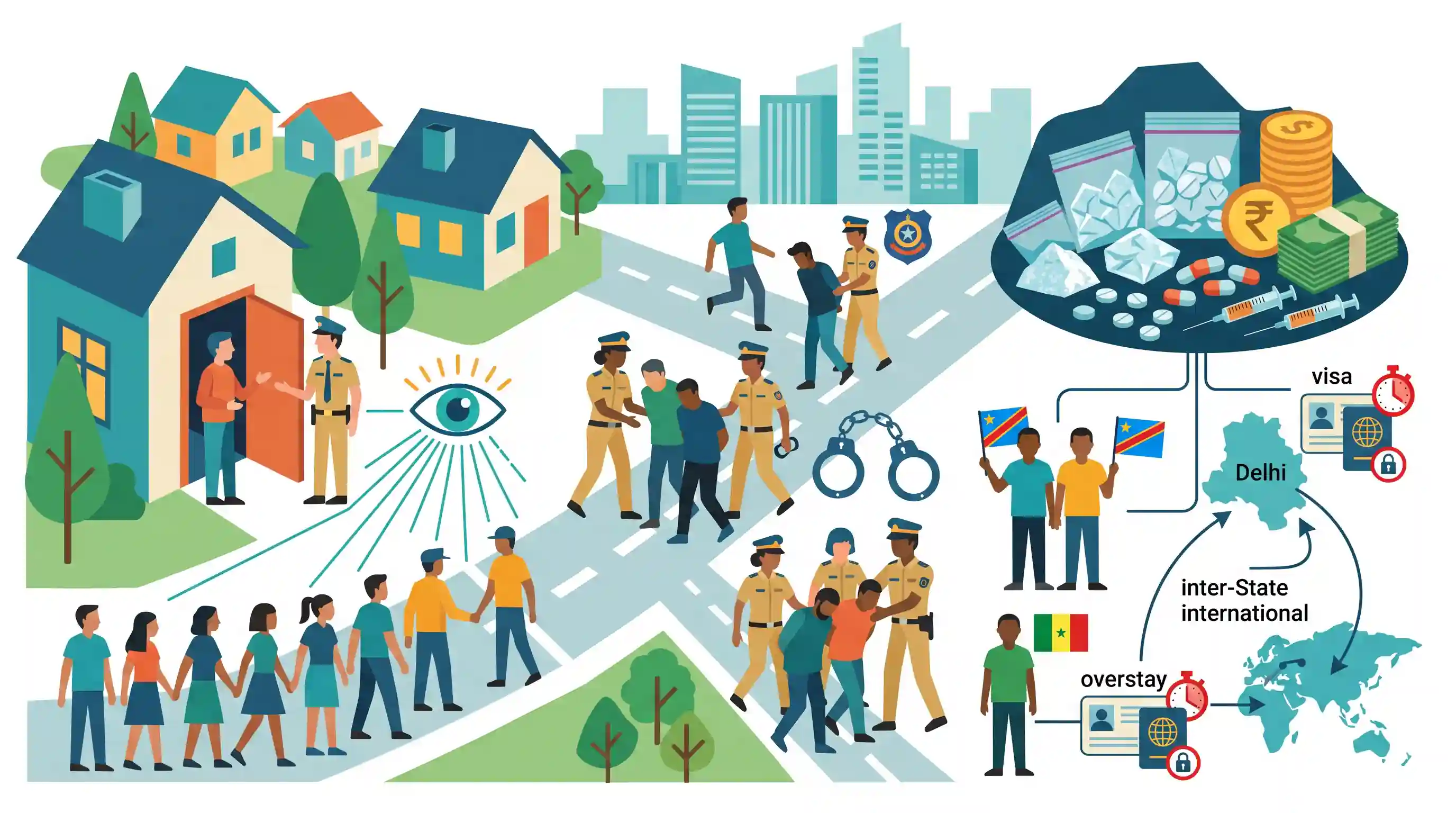
The Bengaluru Police, leveraging the 'Mane Manege' community policing initiative, busted an inter-State drug racket and seized 2.15 kg of MDMA worth ₹5 crore. The operation resulted in the arrest of two Congolese nationals and uncovered links to a Delhi-based supply network. In a related case, a Senegalese national on a tourist visa was apprehended by the Central Crime Branch for drug peddling. These incidents underscore the critical role of grassroots intelligence gathering and highlight vulnerabilities associated with long-term visa overstays by foreign nationals engaging in organized crime.
Key Points
- Bengaluru's Electronics City police dismantled an inter-State drug syndicate through the 'Mane Manege' local intelligence initiative, recovering 2.15 kg of MDMA worth ₹5 crore.
- Two Congolese nationals, one of whom originally arrived on a student visa 12 years ago, were arrested for operating the racket with links to a Delhi-based supply network.
- In a separate incident, the Central Crime Branch arrested a Senegalese national who arrived in 2024 on a tourist visa and was found peddling MDMA.
- The cases underscore the vulnerabilities in visa monitoring systems and the effectiveness of grassroots community policing in tackling urban organized crime.
Important Terms
Mane Manege Initiative

A community policing program by Karnataka Police where beat constables visit households to build trust, address grievances, and gather intelligence on local crimes like drug trafficking.
UPSC context
GS III (Internal Security); tests knowledge of grassroots intelligence mechanisms and public-police partnership models.
Central Crime Branch (CCB)
A specialized investigative wing of the Bengaluru City Police dedicated to handling complex cases involving organized crime, narcotics, cybercrime, and high-profile economic offenses.
UPSC context
GS III (Internal Security); relevant for institutional frameworks tackling specialized and inter-state criminal networks.
NDPS Act, 1985
The primary Indian legislation regulating narcotic drugs and psychotropic substances; it prohibits unauthorized production, trade, and consumption while providing for stringent penalties and property forfeiture.
UPSC context
GS III (Security/Social Justice); core law for drug menace, law enforcement, and border management topics.
Community Policing
A policing philosophy emphasizing proactive public-police cooperation to identify safety concerns and solve community problems through mutual trust and engagement.
UPSC context
GS III (Internal Security); frequently tested in the context of police reforms and security strategy.
Organized Crime
Structured criminal activities conducted by groups across jurisdictional boundaries, often involving high-value contraband like synthetic drugs and international smuggling links.
UPSC context
GS III (Internal Security); examines the link between local syndicates, international trafficking, and national security threats.
MDMA
A synthetic psychotropic drug (commonly called Ecstasy) that acts as both a stimulant and hallucinogen, frequently seized in large-scale inter-state drug racket busts.
UPSC context
GS III (Security); relates to the emerging threat of synthetic drugs and narcotics trafficking routes.
Prelims Trap
The NDPS Act strictly applies only to plant-based narcotics and excludes synthetic drugs like MDMA.
The NDPS Act (1985) covers both natural narcotics and manufactured synthetic psychotropic substances. The grading of punishment depends on the quantity seized (small vs. commercial), not just its origin.
Static Concepts Connected
How does the NDPS Act, 1985 regulate synthetic drugs like MDMA?
- Broad Scope: Regulates both traditional natural narcotics (like cannabis and opium) and manufactured synthetic psychotropic substances (like MDMA and Meth).
- Graded Punishment: Penalties and prison terms are determined by the quantity seized (small, intermediate, or commercial) rather than solely the drug's origin.
- Asset Forfeiture: Allows the tracing, freezing, and forfeiture of properties derived from illicit drug trafficking, crippling syndicates financially.
What is the mandate of the FRRO in India?
- Primary Role: Tracks the registration, movement, visa extensions, and departure of foreigners staying in India for more than 180 days.
- Central Authority: Operates under the Bureau of Immigration (BoI), which functions under the Union Ministry of Home Affairs.
- e-FRRO Portal: A digital framework enabling online visa and immigration services, crucial for monitoring potential visa overstays and tracking foreign nationals.
Cross-Topic Patterns
Shift to synthetic urban drugs
While border states combat heroin from the Golden Crescent/Triangle, urban centers face a rising threat from lab-made synthetic drugs (MDMA/Meth) distributed by decentralized, localized networks.
Community policing vs organized crime
Initiatives like 'Mane Manege' bridge trust deficits, providing vital grassroots human intelligence (HUMINT) that formal surveillance cannot capture, effectively disrupting localized criminal syndicates.

Expect a Mains 2026 question linking state-specific community policing models to the disruption of decentralized synthetic drug syndicates.
Linked PYQs · 4
Linked PYQs · 4
- 2024MainsGS3
Explain how narco-terrorism has emerged as a serious threat across the country. Suggest suitable measures to counter narco-terrorism.
- 2022MainsGS3
Discuss the types of organised crimes. Describe the linkages between terrorists and organised crime that exist at the national and transnational levels.
- 2020MainsGS3
For effective border area management, discuss the steps required to be taken to deny local support to militants and also suggest ways to manage favourable perception among locals.
- 2024MainsGS2
Public charitable trusts have the potential to make India's development more inclusive as they relate to certain vital public issues. Comment.
