Intercaste Marriages and Constitutional Protection of Freedoms
Source:Indian Express ↗
Why It Matters
The issue is directly relevant to the UPSC syllabus under GS Paper 1 (features of Indian Society, caste system) and GS Paper 2 (Fundamental Rights, role of the judiciary). It serves as a practical example for answers regarding the right to choose a partner (Article 21) and the societal challenges of inter-caste marriages.
Summary
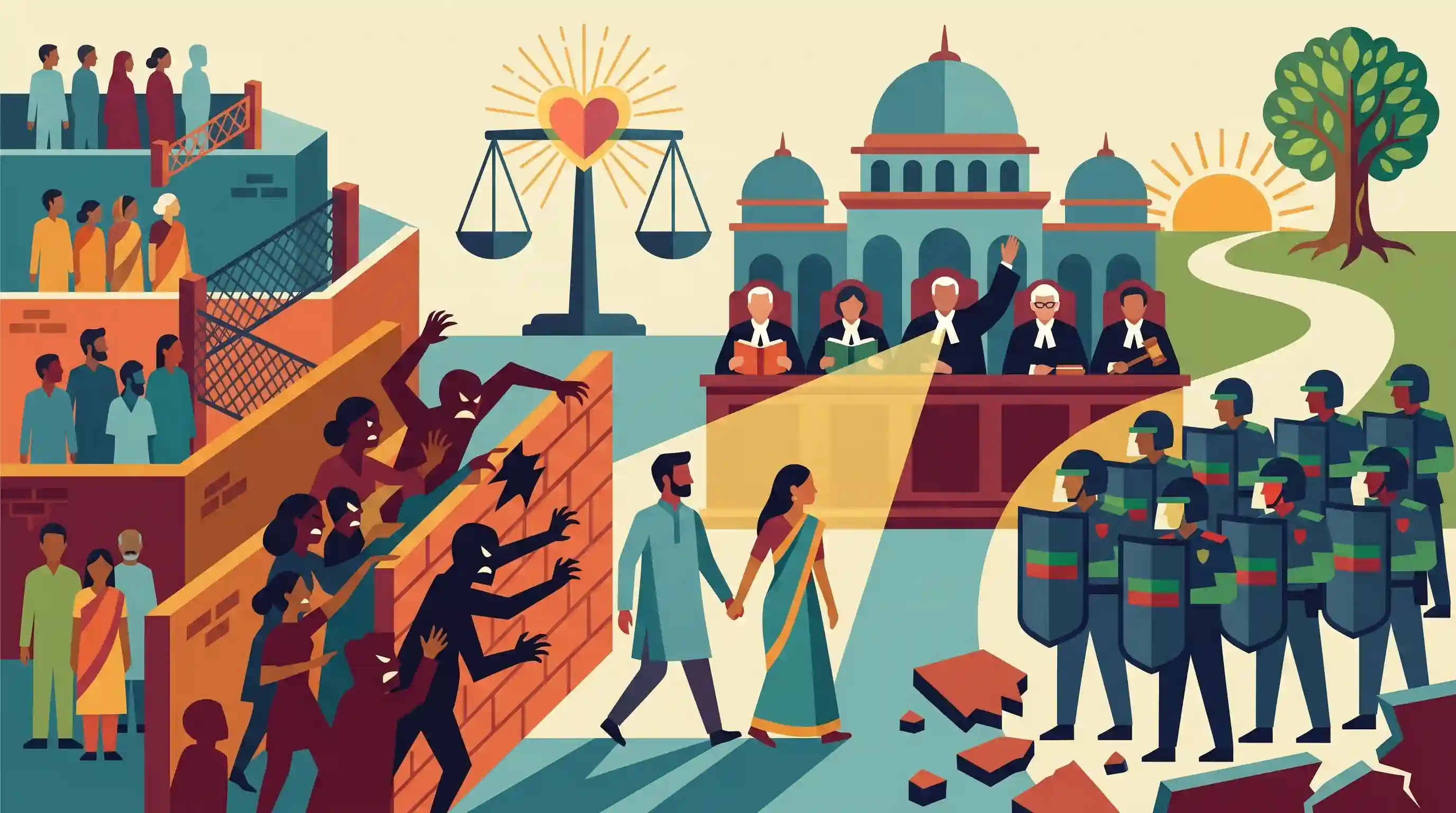
The article highlights an incident in Bhopal where an inter-caste couple had to seek the court's intervention to secure police protection against familial and societal threats. This case reflects the ongoing tension between constitutionally guaranteed fundamental rights and deeply entrenched social prejudices associated with the caste system. While the Supreme Court has unequivocally recognized the right to choose one's life partner as a fundamental right under Article 21 (Right to Life and Personal Liberty), the persistent need for judicial intervention to ensure physical safety indicates the slow pace of social reform. The incident underscores the critical role of the judiciary and law enforcement in protecting individual autonomy against majoritarian societal norms and enforcing constitutional morality over traditional customs.
Key Points
- Inter-caste couples continue to face severe familial and societal backlash, highlighting the persistent relevance and rigid nature of the caste system in India.
- The Right to choose a life partner is recognized as an intrinsic part of the Right to Life and Personal Liberty guaranteed under Article 21 of the Indian Constitution.
- Constitutional courts frequently have to intervene to direct the police administration to protect couples from honor-based violence, underscoring the gap between constitutional rights and social realities.
- The incident highlights the struggle to instil 'constitutional morality' in a society heavily influenced by traditional social prejudices.
Important Terms
Article 21

A fundamental right in the Indian Constitution stating that no person shall be deprived of their life or personal liberty except according to procedure established by law.
UPSC context
GS Paper 2 (Polity); central to judicial expansions regarding privacy, dignity, and the right to choose a life partner.
Constitutional Morality
A judicial principle prioritizing core constitutional values like equality and liberty over traditional societal norms or 'social morality' to protect individual rights from majoritarian pressure.
UPSC context
GS Paper 2 (Polity) and GS Paper 4 (Ethics); vital for understanding judicial review and legal social transformation.
Special Marriage Act, 1954
A secular Indian law providing a legal framework for marriages between individuals of different religions or castes, allowing civil registration without requiring religious conversion.
UPSC context
GS Paper 1 (Social Issues) and GS Paper 2; relevant for debates on secularism and the Uniform Civil Code.
Shakti Vahini v. Union of India (2018)
A landmark Supreme Court ruling that mandated state protection for couples against 'honour' crimes and affirmed that consenting adults have the right to marry across caste/faith lines.
UPSC context
GS Paper 2 (Social Justice/Judiciary); specific case law for topics on honour killings and fundamental rights protection.
Right to Choose a Life Partner
A legal doctrine established by the Supreme Court holding that the freedom of an adult to marry a person of their choice is intrinsic to personal liberty.
UPSC context
GS Paper 2 (Fundamental Rights); tests the intersection of personal autonomy with traditional social institutions like caste.
Majoritarianism
The practice of governing or making societal decisions based on the will of the majority, which can lead to the suppression of individual or minority rights.
UPSC context
GS Paper 1 (Society) and GS Paper 2 (Governance); critical for analyzing tensions between individual liberty and societal pressures.
Prelims Trap
The Right to choose a life partner is explicitly enshrined under Article 21 of the Indian Constitution.
The Constitution does not explicitly mention the "Right to Marry." It is an implied right deduced by the Supreme Court (Shafin Jahan case) as intrinsic to the Right to Life and Personal Liberty.
Static Concepts Connected
What is "Constitutional Morality" and how does it protect individual rights?
- Core Philosophy: It refers to adherence to core constitutional principles like liberty, equality, and fraternity, ensuring they prevail over traditional, popular, or societal morality.
- Dr. Ambedkar's View: He famously noted that public morality in India is largely anti-democratic, making constitutional morality an essential, cultivated trait to protect vulnerable individuals.
- Judicial Application: Courts use it to strike down regressive customs and protect personal autonomy against majoritarian backlash, as seen in the Sabarimala and Navtej Singh Johar verdicts.
Which landmark Supreme Court judgments shield the right to choose a life partner?
- Shafin Jahan (2018): The Supreme Court ruled that the right to choose a life partner is absolutely protected as a fundamental right under Article 21.
- Shakti Vahini (2018): Declared that any attempt by families or Khap Panchayats to prevent consenting adults from marrying is illegal, directing state police to provide protection against honour violence.
Cross-Topic Patterns
Special Marriage Act + UCC debates
The necessity of court protection for inter-caste couples highlights administrative hurdles in the Special Marriage Act (like the 30-day notice) which intersect with current debates on enacting a Uniform Civil Code.
Social Welfare + Abolition of Untouchability
The Dr. Ambedkar Scheme for inter-caste marriages links Article 17 (abolition of untouchability) with administrative incentives, shifting the State's role from merely providing legal protection to actively promoting social assimilation.

Expect a GS2 mains question evaluating how 'Constitutional Morality' acts as a shield against rigid societal norms like caste endogamy.
Linked PYQs · 3
Linked PYQs · 3
- 2019PrelimsGS1
Which Article of the Constitution of India safeguards one's right to marry the person of one's choice?
- 2024MainsGS1
Intercaste marriages between castes which have socio-economic parity have increased, to some extent, but this is less true of interreligious marriages. Discuss.
- 2023MainsGS2
“The Constitution of India is a living instrument with capabilities of enormous dynamism. It is a constitution made for a progressive society.” Illustrate with special reference to the expanding horizons of the right to life and personal liberty.
