India Climate Budget Decarbonisation and Export Competitiveness
Source:The Hindu ↗
Why It Matters
The article highlights the intersection of climate action and economic strategy, a core theme in GS3. Concepts like CBAM and CCUS are crucial as decarbonization is increasingly linked to India's export competitiveness. The sustained emphasis on decentralized renewable energy (rooftop solar, PM-KUSUM) connects to energy security and sustainable development, topics frequently tested by UPSC.
Summary
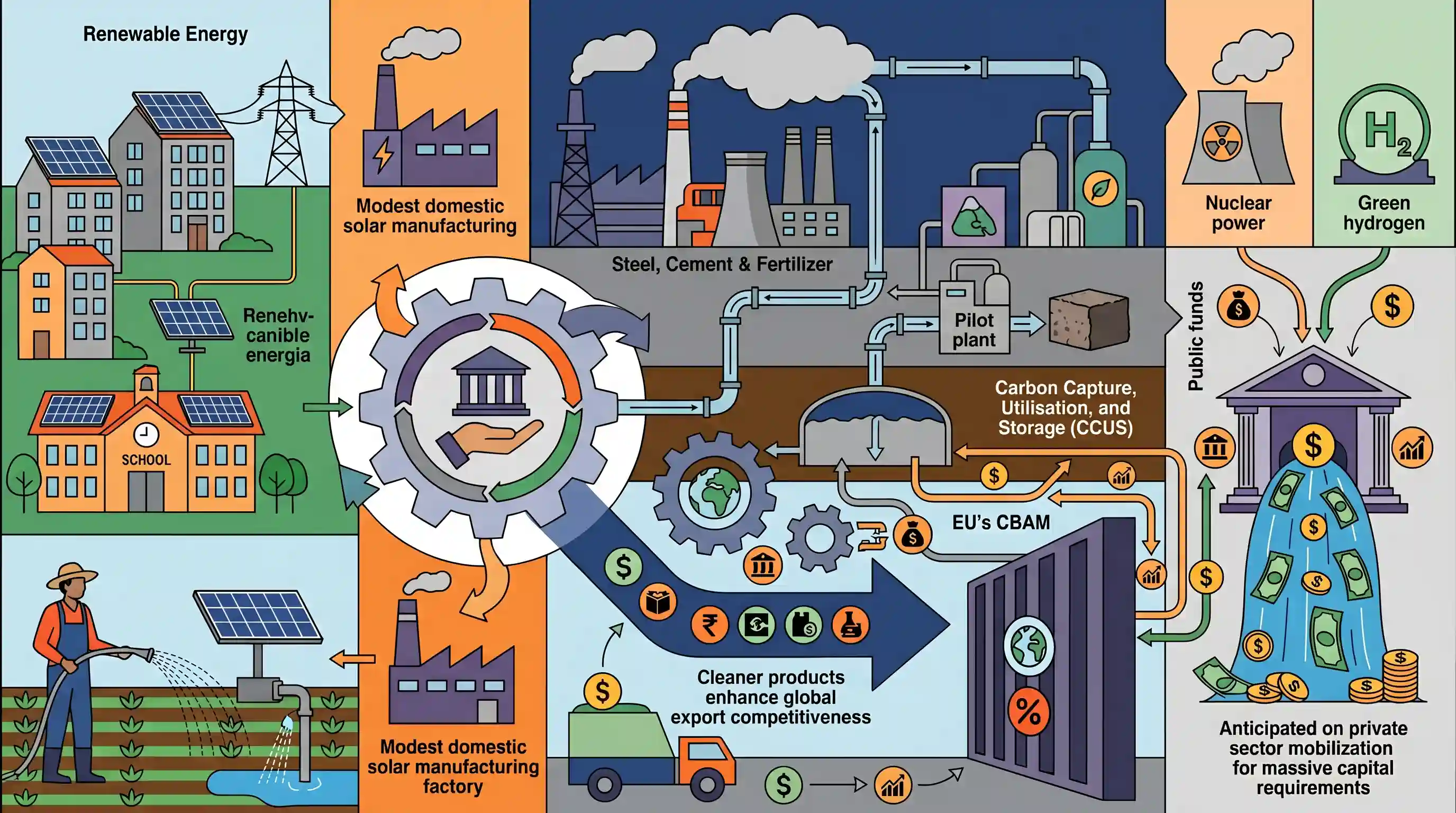
The 2026-27 Union Budget reflects a focused intent on decarbonizing the Indian economy, targeting critical sectors like steel, cement, fertilizers, and energy. It allocates enhanced funds for decentralized renewable energy generation through the PM Surya Ghar Muft Bijli Yojana (₹22,000 crore) and sustains the PM-KUSUM scheme, while providing modest support for domestic solar PV manufacturing to cut reliance on Chinese imports. A notable addition is a ₹20,000 crore pilot for Carbon Capture, Utilisation, and Storage (CCUS) aimed at hard-to-abate sectors, a move driven by global pressures such as the EU's impending Carbon Border Adjustment Mechanism (CBAM), which threatens the export competitiveness of high-emission products. Despite clear policy directions on green hydrogen and nuclear energy, actual financial allocations remain cautious, leaning heavily on anticipated private sector mobilization to meet the massive capital requirements of the climate transition.
Key Points
- The 2026-27 climate budget allocates ₹4,500 crore to scale up domestic solar PV production, aiming to reduce dependence on Chinese imports.
- Funding for the PM Surya Ghar Muft Bijli Yojana has been increased to ₹22,000 crore to promote rooftop solar, fostering decentralized power generation.
- A five-year outlay of ₹20,000 crore has been introduced for a pilot phase of Carbon Capture, Utilisation and Storage (CCUS) targeting hard-to-abate sectors like cement, steel, and fertilizers.
- The European Union's impending Carbon Border Adjustment Mechanism (CBAM) shifts decarbonization from merely a climate imperative to an urgent issue of export competitiveness for India.
- Despite clear policy intent on green hydrogen and nuclear energy, actual budget allocations remain cautious, relying heavily on private sector capital to bridge financing gaps.
Important Terms
PM Surya Ghar Muft Bijli Yojana

Central scheme launched in 2024 providing 300 units of free monthly electricity to 1 crore households via rooftop solar. It offers tiered subsidies (up to 60%) to promote decentralized renewable energy.
UPSC context
GS3/Energy. Tests knowledge of solar energy adoption, household subsidies, and India’s target for decentralized renewable power generation.
PM-KUSUM
A flagship initiative (launched 2019) aiming to solarize India’s agricultural sector. It provides subsidies for solar pumps and grid-connected solar plants to replace diesel, increase farmer income, and ensure energy security.
UPSC context
GS3/Agriculture & Energy. Evaluates understanding of renewable energy integration in farming, farmer income diversification, and irrigation sustainability.
Carbon Border Adjustment Mechanism (CBAM)
An EU climate policy effective from 2026 that taxes carbon-intensive imports like steel and cement. It aims to prevent "carbon leakage" by equalizing carbon prices between domestic and imported goods.
UPSC context
GS3/Economy & Environment. Tests awareness of trade-climate conflicts, international environmental standards, and their impact on India’s export competitiveness.
Discoms
Electricity Distribution Companies; utilities responsible for last-mile power delivery. Their financial health is a critical UPSC focus due to high AT&C losses and gaps between supply costs and revenue realization.
UPSC context
GS3/Infrastructure. Examines power sector reforms, the financial viability of energy distribution, and challenges like AT&C losses and tariff regulation.
Prelims Trap
The Carbon Border Adjustment Mechanism (CBAM) is a global carbon pricing framework introduced by the UNFCCC.
CBAM is a unilateral trade policy by the European Union, not a global framework. It acts as an import tax, not a consensus-based UNFCCC treaty.
Static Concepts Connected
What characterizes "hard-to-abate" sectors in climate economics?
- Process Emissions: Industries like cement release CO2 as an inherent part of chemical reactions (e.g., calcination), making emissions unavoidable regardless of the energy source used.
- High Heat Needs: Metallurgy, glass, and ceramics require extremely high temperatures that are difficult or impossible to achieve efficiently with current electrical heating technologies.
- Energy Density: Sectors like aviation and heavy marine transport require fuels with immense energy density, where current battery technologies still fall drastically short of fossil fuels.
How does the EU's Carbon Border Adjustment Mechanism (CBAM) function?
- Carbon Leakage Prevention: It aims to equalize the price of carbon between EU domestic products and imports to prevent "carbon leakage" (industries relocating to lax regulatory regimes).
- Certificate Mechanism: EU importers must buy CBAM certificates corresponding to the carbon price that would have been paid had the goods been produced under EU carbon pricing rules.
- Target Sectors: Initially targets high-risk, carbon-intensive imports including cement, iron and steel, aluminium, fertilizers, electricity, and hydrogen.
Cross-Topic Patterns
Climate Action as Trade Defense
Decarbonization is no longer just an environmental NDC target; it is an economic imperative to maintain export competitiveness against emerging unilateral non-tariff barriers like the EU's CBAM.
Solar Supply Chains & China De-risking
Allocations for domestic solar PV manufacturing link India's renewable energy transition directly to geopolitical de-risking from Chinese supply chains and the broader Atmanirbhar Bharat (PLI) strategy.

Expect a 2026 Prelims question linking the EU's CBAM with India's CCUS investments and export competitiveness in hard-to-abate sectors.
Linked PYQs · 5
Linked PYQs · 5
- 2025MainsGS3
What is Carbon Capture, Utilization and Storage (CCUS)? What is the potential role of CCUS in tackling climate change?
- 2020MainsGS3
Describe the benefits of deriving electric energy from sunlight in contrast to the conventional energy generation. What are the initiatives offered by our Government for this purpose?
- 2022MainsGS3
Do you think India will meet 50 percent of its energy needs from renewable energy by 2030 ? Justify your answer. How will the shift of subsidies from fossil fuels to renewables help achieve the above objective ? Explain.
- 2025PrelimsGS1
Consider the following statements about 'PM Surya Ghar Muft Bijli Yojana': I. It targets installation of one crore solar rooftop panels in the residential sector. II. The Ministry of New and Renewable Energy aims to impart training on installation, operation, maintenance and repairs of solar rooftop systems at grassroot levels. III. It aims to create more than three lakhs skilled manpower through fresh skilling, and up-skilling, under scheme component of capacity building. Which of the statements given above are correct?
- 2024PrelimsGS1
Consider the following: 1. Battery storage 2. Biomass generators 3. Fuel cells 4. Rooftop solar photovoltaic units How many of the above are considered "Distributed Energy Resources"?
