Andhra Pradesh Horticulture Logistics: Agricultural Supply Chain
Source:The Hindu ↗
Why It Matters
High logistics costs and inadequate post-harvest infrastructure are systemic bottlenecks in Indian agriculture. Andhra Pradesh's targeted approach to integrating logistics and bolstering food processing capacity serves as a practical case study for GS3 topics encompassing agricultural supply chains, infrastructure development, and doubling farmers' income.
Summary
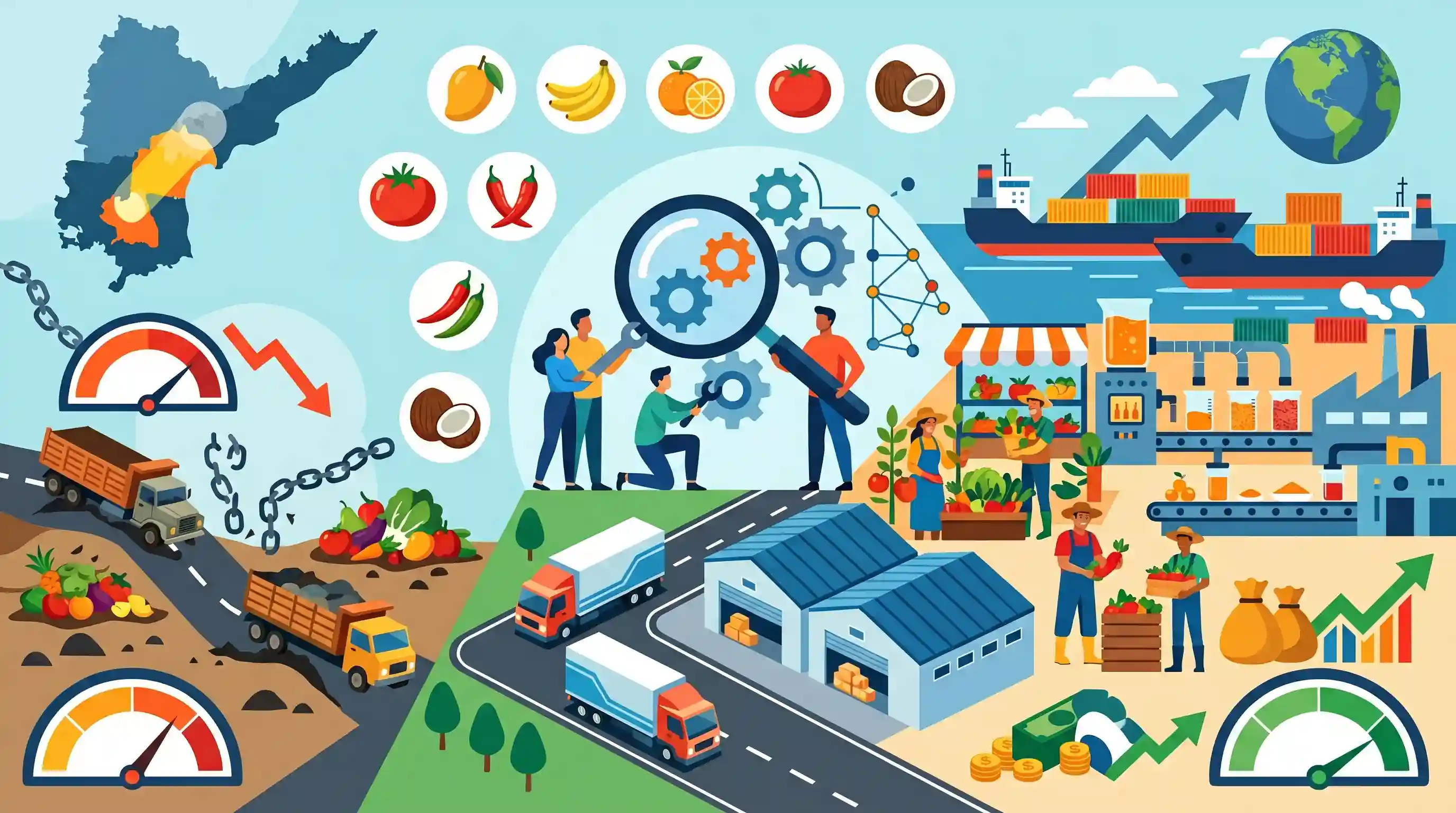
To boost its economy and maximize farmer returns, Andhra Pradesh has undertaken an integrated logistics planning exercise targeting six major horticulture crops. By assessing value chains, market linkages, and infrastructure gaps such as cold storage and rural roads, the state aims to bring down its logistics costs from 14% to 8-9% of GSDP. With a focus on the horticulture-rich Rayalaseema region, the initiative seeks to reduce post-harvest losses, address price volatility, and enhance export competitiveness. Consequently, significant investments are being directed toward establishing food processing industries across various districts.
Key Points
- Andhra Pradesh has initiated integrated logistics planning to promote six key horticulture crops: mango, banana, tomato, pomegranate, sweet lime, and papaya.
- The state aims to reduce overall logistics costs from the current 14% to 8-9% of the Gross State Domestic Product (GSDP).
- The exercise identifies critical infrastructure gaps, including limited cold storage, poor rural roads, lack of reefer trucks, and insufficient processing units, which contribute to post-harvest losses.
- The state has approved 19 food processing industries with an investment of ₹7,600 crore for 2025-26 and facilitated MoUs for another 32 projects worth ₹8,350 crore to improve supply chain efficiencies.
Important Terms
Infrastructure & Investment Department (Andhra Pradesh)

A key nodal body in Andhra Pradesh responsible for the state's logistical infrastructure, including the Andhra Pradesh Logistics Infrastructure Corporation (AP-LInC). It spearheads the integrated planning to reduce logistics costs.
UPSC context
Relevant for GS Paper III (Infrastructure) and GS Paper II (State Governance/Policies). Tests knowledge of institutional frameworks for regional economic development.
Food Processing (FP) Sector
The transformation of raw agricultural products into consumable items. It is a 'sunrise sector' in India, linking agriculture to manufacturing to enhance shelf life and farmer income.
UPSC context
Core GS Paper III topic. Tests understanding of value addition, upstream/downstream requirements, and supply chain management in the agricultural economy.
Logistics Costs
The total expenditure incurred in moving goods from origin to consumption. Andhra Pradesh aims to reduce this from 14% to 8-9% of GSDP to improve competitiveness.
UPSC context
Crucial for GS Paper III (Economy/Infrastructure). Relates to National Logistics Policy and PM Gati Shakti, testing awareness of ease of doing business.
Rayalaseema Region
A drought-prone region in southern Andhra Pradesh that has emerged as a major horticulture hub. It produces significant volumes of mango, banana, and pomegranate.
UPSC context
Relevant for GS Paper I (Geography) and Paper III (Agriculture). Illustrates regional development strategies and crop-specific economic zones in semi-arid regions.
GSDP (Gross State Domestic Product)
The total monetary value of all goods and services produced within a state's boundaries in a year. It measures the size and growth of a state's economy.
UPSC context
Standard term for GS Paper III (Economy). Tests ability to analyze sub-national fiscal health and sector-specific contributions to growth.
Supply Chain Management
The sequence of processes involved in the production and distribution of a commodity, from farm to consumer. In agriculture, it aims to minimize post-harvest losses.
UPSC context
Directly mentioned in GS Paper III syllabus under 'Transport and Marketing of Agricultural Produce.' Focuses on efficiency and infrastructure gaps.
Prelims Trap
India's logistics cost is currently around 8% of GDP, aligning with global benchmarks.
India's logistics cost is traditionally 13-14% of GDP. The National Logistics Policy aims to reduce this to the global benchmark of 8% by 2030, a target states are currently striving toward.
Static Concepts Connected
What are the upstream and downstream requirements for the food processing industry?
- Upstream Requirements: Includes raw material procurement, farm-gate primary processing, aggregation centers, and adequate cold storage facilities.
- Downstream Requirements: Focuses on market linkages, including continuous cold chain transport (reefer trucks), retail networks, and export infrastructure.
What are the primary targets of the National Logistics Policy (NLP) 2022?
- Cost Reduction: Bring down the logistics cost in India from current 13-14% of GDP to global benchmarks (around 8%) by 2030.
- Global Ranking: Elevate India’s position in the World Bank’s Logistics Performance Index (LPI) to the top 25 by 2030.
- Digital Integration: Implement the Unified Logistics Interface Platform (ULIP) to streamline cross-sectoral supply chain data and reduce transit delays.
Cross-Topic Patterns
PM Gati Shakti + Agri-Supply Chains
Integrating agricultural zones with multimodal transport networks under PM Gati Shakti is increasingly framed as a vital solution for reducing India's 15-20% post-harvest loss in perishable horticulture crops.
Cold Storage + e-NWR Integration
Expanding rural cold storage linked to the WDRA enables farmers to pledge perishables via Electronic Negotiable Warehouse Receipts (e-NWRs), securing credit and mitigating seasonal price volatility.

A GS3 mains question linking the National Logistics Policy to agricultural supply chains and post-harvest loss reduction is highly likely.
Linked PYQs · 4
Linked PYQs · 4
- 2025MainsGS3
Elaborate the scope and significance of supply chain management of agricultural commodities in India.
- 2022MainsGS3
Elaborate the scope and significance of the food processing industry in India.
- 2020MainsGS3
What are the challenges and opportunities of food processing sector in the country? How can income of the farmers be substantially increased by encouraging food processing?
- 2021MainsGS3
“Investment in infrastructure is essential for more rapid and inclusive economic growth.” Discuss in the light of India's experience.
