Navika Sagar Parikrama and Women Empowerment in Indian Navy
Source:The Hindu ↗
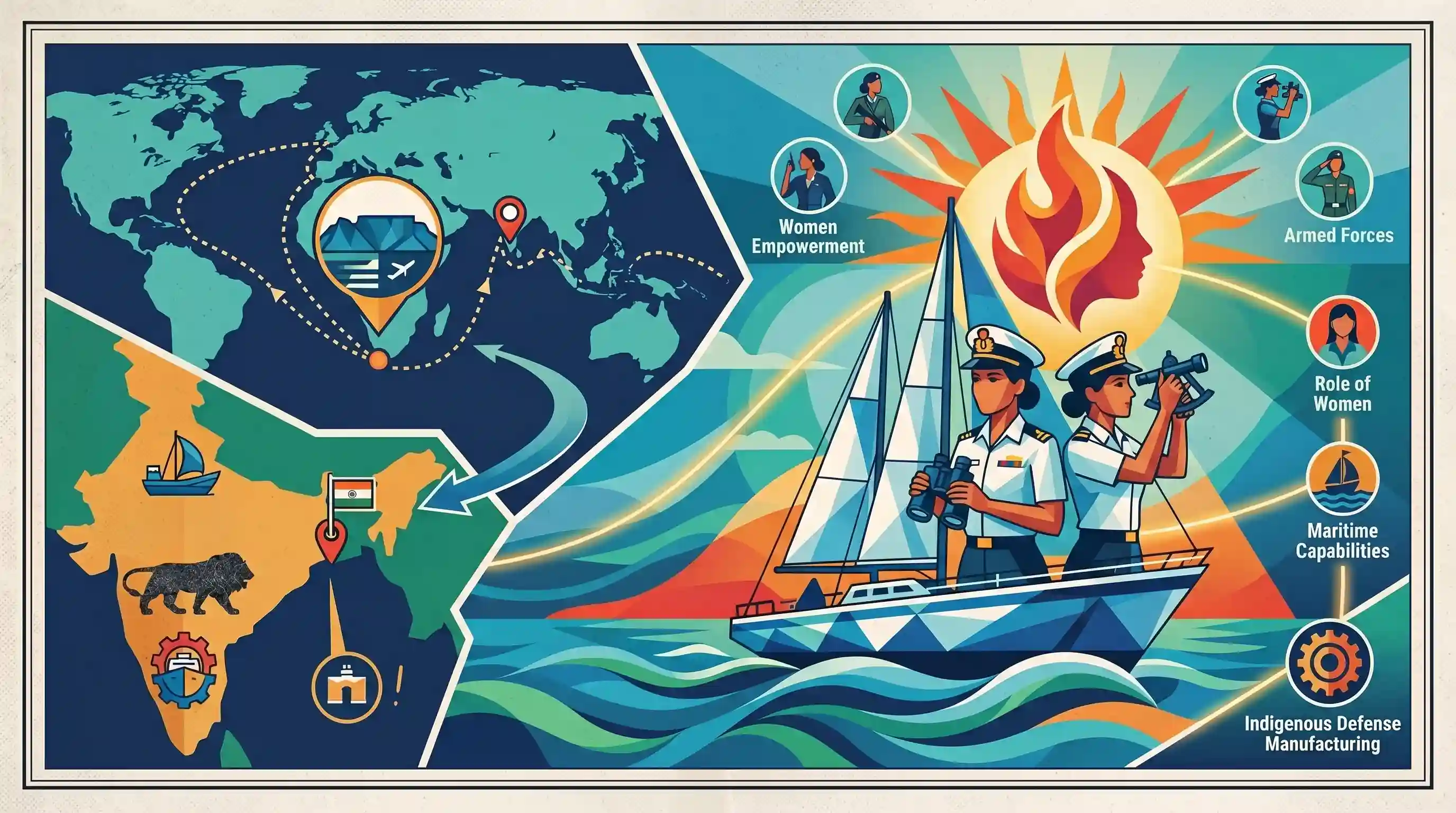
Why It Matters
The expedition represents a critical intersection of gender empowerment (GS1) and indigenous defense technology (GS3). It serves as an excellent case study of Nari Shakti for essay and ethics papers, while also highlighting the practical successes of India's maritime self-reliance and indigenous shipbuilding initiatives.
Summary
The Indian Naval Sailing Vessel (INSV) Tarini, crewed by two women officers, Lieutenant Commander Dilna K. and Lieutenant Commander Roopa A., has departed from Cape Town, South Africa, on the final leg of its global circumnavigation. This voyage, part of the Navika Sagar Parikrama-II expedition, is a testament to Nari Shakti (women's empowerment) within the Armed Forces. It also highlights India's indigenous boat-building capabilities, as INSV Tarini is an indigenously built vessel, promoting the 'Make in India' initiative on a global maritime platform.
Key Points
- Navika Sagar Parikrama-II is a global circumnavigation mission undertaken by two women officers of the Indian Navy.
- The INSV Tarini departed Cape Town on its final leg toward Goa, demonstrating immense endurance and navigational skill over a 23,400-nautical-mile journey.
- The expedition serves as a powerful symbol of Nari Shakti (women's empowerment) and gender equality in traditionally male-dominated domains like the armed forces.
- The use of INSV Tarini, a domestically constructed vessel, underscores India's advancing indigenous shipbuilding capabilities and maritime self-reliance.
- The voyage builds diplomatic and maritime ties, having been flagged off by the Royal Cape Yacht Club in South Africa alongside Indian consular officials.
Important Terms
Navika Sagar Parikrama-II

The Indian Navy's second all-women global circumnavigation expedition, conducted by two officers in double-handed mode aboard the indigenously-built INSV Tarini.
UPSC context
GS Paper 3: Indigenization of technology and gender inclusion in defense forces. Tests knowledge of significant maritime milestones.
INSV Tarini
A 56-foot indigenously built sailing vessel of the Indian Navy, constructed at Goa's Aquarius Shipyard, symbolizing India's self-reliance in maritime manufacturing.
UPSC context
GS Paper 3: Defense indigenization and 'Aatmanirbhar Bharat' initiative in the maritime sector.
Nari Shakti
A government initiative to empower women; in this context, it reflects the increasing leadership and operational roles of women in the Indian Armed Forces.
UPSC context
GS Paper 1: Social issues and women’s empowerment. GS Paper 2: Gender-sensitive government policies.
Make in India (Defense)
A flagship national program aimed at transforming India into a global manufacturing hub, exemplified here by the indigenous construction of naval sailing vessels.
UPSC context
GS Paper 3: Economic development and indigenization of defense equipment. Tests understanding of industrial policy.
Double-handed circumnavigation
The act of sailing around the world with only two crew members on board, representing an advanced level of maritime skill and endurance.
UPSC context
GS Paper 3: Maritime security and professional excellence in the Armed Forces. Tests awareness of specialized naval operations.
Prelims Trap
"Navika Sagar Parikrama-II marks the first-ever Indian circumnavigation of the globe by an all-women naval crew."
False. Navika Sagar Parikrama-I (2017-18) was the first (with a six-women crew). Parikrama-II is a double-handed (two-women) expedition. Examiners will swap facts between the two missions.
Static Concepts Connected
What is the legal basis for granting Permanent Commission to women in the Armed Forces?
- Babita Puniya Case: In 2020, the Supreme Court mandated Permanent Commission for women short-service commission officers, ensuring parity with their male counterparts.
- Command Roles: The judgment struck down the absolute bar on women seeking command appointments, citing Articles 14 and 16 (Right to Equality).
- Constitutional Morality: The Court ruled that physiological features and societal norms cannot be used as legally valid arguments to deny equal opportunity in the armed forces.
How does indigenous shipbuilding integrate with India's defense procurement policy?
- Buy (Indian-IDDM): The Defence Acquisition Procedure (DAP) prioritizes 'Buy (Indian-IDDM)', mandating a minimum of 50% Indigenous Content to boost self-reliance.
- Economic Multiplier: Domestic construction of vessels like INSV Tarini stimulates MSMEs, creates high backward linkages, and reduces vulnerability to global supply-chain shocks.
Cross-Topic Patterns
Nari Shakti meets Aatmanirbhar Bharat
INSV Tarini’s indigenous construction seamlessly bridges gender equality narratives with India's defense indigenization, showcasing domestic MSME capabilities (Aquarius Shipyard, Goa).
Maritime Soft Power & IOR Diplomacy
Flag-offs by foreign yacht clubs and consular officials in Cape Town showcase how individual naval expeditions act as soft-power tools, complementing India's broader SAGAR doctrine.

Expect a Prelims pair-matching item on Navika Sagar Parikrama-II, or use it as a prime case study for Mains essays on Nari Shakti.
Linked PYQs · 3
Linked PYQs · 3
- 2021MainsGS1
Examine the role of 'Gig Economy' in the process of empowerment of women in India.
- 2019MainsGS1
“Empowering women is the key to control population growth.” Discuss.
- 2025MainsGS3
Why is maritime security vital to protect India's sea trade? Discuss maritime and coastal security challenges and the way forward.
