उपभोक्ता पैनल ने बीमा कंपनियों द्वारा दावों को खारिज करने की प्रथा की आलोचना की
स्रोत:इंडियन एक्सप्रेस ↗
क्यों मायने रखता है
The consistent mis-selling and denial of claims in the insurance sector highlights the intersection of consumer rights, corporate ethics, and financial regulation. It is highly relevant for GS2 (Consumer Protection Act and redressal bodies) and GS4 (ethics in business and corporate governance).
सारांश
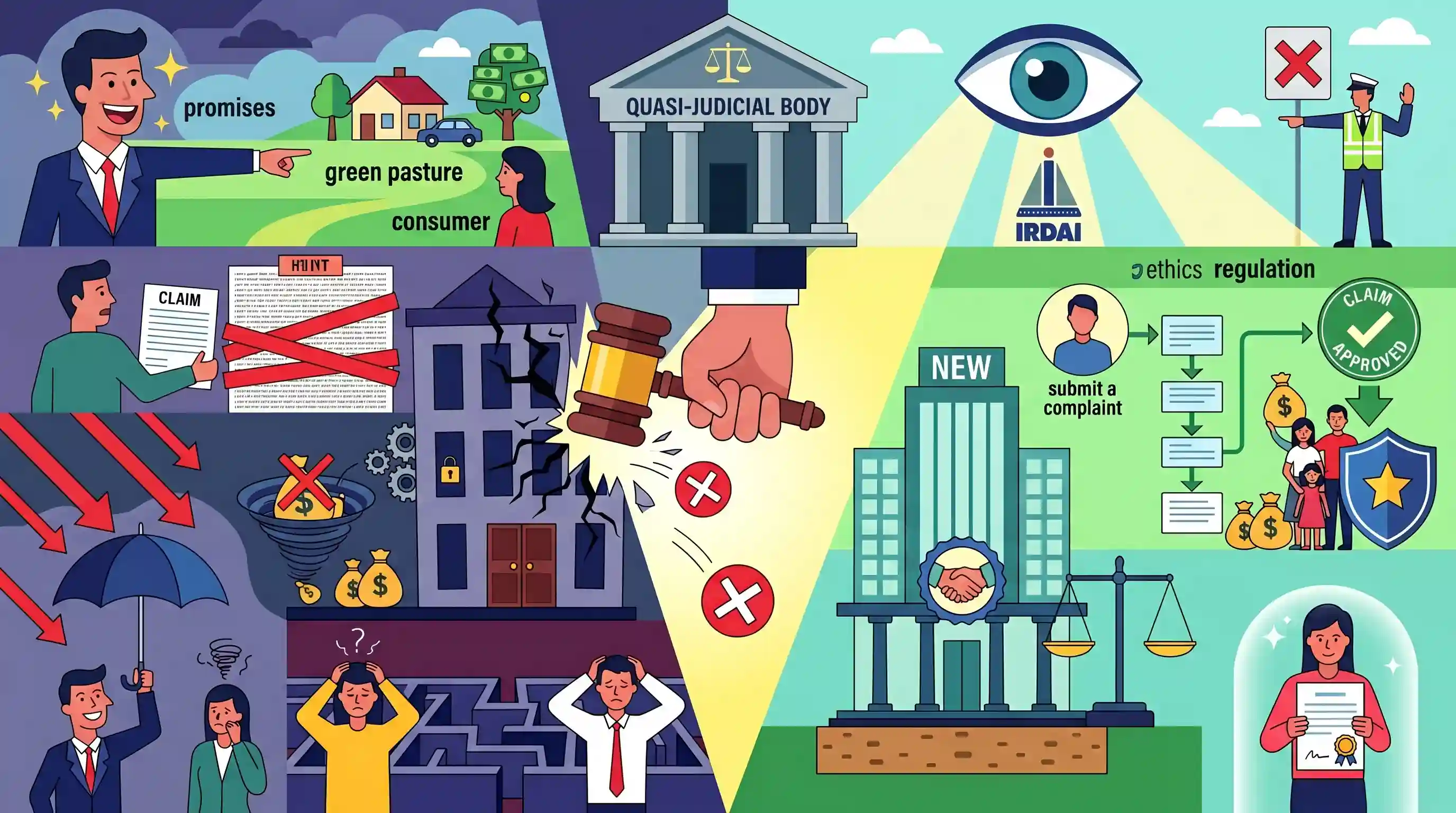
A Chandigarh Consumer Disputes Redressal Commission heavily criticized insurance companies for engaging in deceptive practices, noting that they present a rosy picture ("green pastures") to lure customers but devise baseless excuses to deny legitimate claims. This ruling spotlights the ongoing issue of unfair trade practices within the financial sector, which causes undue harassment to policyholders. From a UPSC perspective, the issue underscores the importance of the Consumer Protection Act, 2019, and active grievance redressal mechanisms in safeguarding consumer rights (GS2). It also highlights a critical deficit in corporate ethics and governance (GS4), calling for stricter regulatory oversight by the IRDAI to enforce transparency and protect consumers against mis-selling.
मुख्य बिंदु
- A Chandigarh consumer panel severely criticized insurance companies for deceptive practices, observing that they show "green pastures" to lure customers but invent frivolous excuses to deny valid claims.
- The commission highlighted that such unfair trade practices cause significant financial distress and harassment to bona fide policyholders when they need the funds the most.
- The ruling underscores the critical role of Consumer Disputes Redressal Commissions in holding powerful corporate entities accountable under the Consumer Protection Act.
- The recurring issue of claim denial points to a broader deficit in business ethics and necessitates stricter regulatory oversight by the IRDAI to uphold the principle of utmost good faith (Uberrimae Fidei).
महत्वपूर्ण शब्द
Consumer Protection Act, 2019

A landmark legislation replacing the 1986 Act, aimed at strengthening consumer rights in the digital age through provisions like product liability, e-commerce regulation, and a simplified dispute resolution process.
UPSC context
GS2: Governance/Polity; essential for questions on statutory bodies and citizens' charters. Tests understanding of modern regulatory frameworks.
Consumer Disputes Redressal Commission (CDRC)
A three-tier quasi-judicial machinery (District, State, and National levels) established to provide inexpensive and speedy redressal for consumer grievances regarding defective goods and deficient services.
UPSC context
GS2: Statutory bodies; specifically tests the hierarchical structure and pecuniary jurisdiction of consumer courts.
Insurance Regulatory and Development Authority of India (IRDAI)
The apex statutory body established under the IRDA Act, 1999, to regulate, promote, and ensure the orderly growth of the insurance industry while protecting policyholders' interests.
UPSC context
GS3: Economy/Financial Sector Regulation; important for understanding institutional oversight in the financial services sector.
Central Consumer Protection Authority (CCPA)
An executive regulatory body introduced by the 2019 Act with powers to investigate consumer rights violations, recall unsafe products, and file class-action suits on behalf of consumers.
UPSC context
GS2: Governance; a key institutional reform under the 2019 Act. Tests knowledge of proactive regulatory mechanisms.
Unfair Trade Practice
Defined under Section 2(47) as any deceptive or unethical method used to promote sales, such as misleading advertisements, false claims about quality, or misrepresentation of service terms.
UPSC context
GS4: Business Ethics; highlights ethical lapses in corporate governance and the legal safeguards against exploitation.
Deficiency in Service
Any shortcoming, imperfection, or inadequacy in the quality, nature, or manner of performance of a service required to be maintained by law or contract.
UPSC context
GS2: Social Justice; focuses on the legal accountability of service providers (like insurers) toward citizens.
प्रारंभिक ट्रैप
"Grievances regarding insurance claim denials can only be adjudicated by the Insurance Ombudsman or IRDAI."
Policyholders can also approach Consumer Disputes Redressal Commissions under the Consumer Protection Act for "deficiency in service," providing a concurrent quasi-judicial route.
संबंधित अवधारणाएँ
What are the key consumer protection bodies under the 2019 Act?
- CCPA: The Central Consumer Protection Authority regulates consumer rights violations, unfair trade practices, and misleading ads, equipped with suo-moto and class-action powers.
- Redressal Commissions: A 3-tier quasi-judicial system (District, State, National) that adjudicates specific consumer disputes and monetary claims, distinct from the CCPA's regulatory role.
What is 'Uberrimae Fidei' in the context of insurance?
- Utmost Good Faith: A foundational legal doctrine obligating both the insurer and insured to transparently disclose all material facts before signing the contract.
- Vs. Caveat Emptor: Unlike standard commercial contracts governed by "Buyer Beware", insurance demands absolute transparency, making frivolous post-facto claim denials an ethical and legal violation.
अंतर-विषय पैटर्न
Financial literacy + GS4 Corporate Governance
The information asymmetry in complex financial products makes mis-selling a frequent GS4 case study theme, emphasizing corporate accountability and the fiduciary duty of financial institutions.
Multi-nodal grievance redressal architecture
Claim denials sit at the intersection of sector-specific regulators (IRDAI), alternate dispute mechanisms (Insurance Ombudsman), and broader quasi-judicial bodies (Consumer Commissions), highlighting India's multi-nodal grievance architecture.

A Prelims question contrasting the suo-moto powers of the CCPA against the adjudicatory role of Consumer Commissions is highly likely.
संबद्ध PYQ · 3
संबद्ध PYQ · 3
- 2024MainsGS4
“Ethics encompasses several key dimensions that are crucial in guiding individuals and organizations towards morally responsible behaviour.” Explain the key dimensions of ethics that influence human actions. Discuss how these dimensions shape ethical decision-making in the professional context.
- 2020PrelimsGS1
In India, under cyber insurance for individuals, which of the following benefits are generally covered, in addition to payment for the loss of funds and other benefits? 1. Cost of restoration of the computer system in case of malware disrupting access to one's computer 2. Cost of a new computer if some miscreant wilfully damages it, if proved so 3. Cost of hiring a specialized consultant to minimize the loss in case of cyber extortion 4. Cost of defence in the Court of Law if any third party files a suit Select the correct answer using the code given below:
- 2024PrelimsGS1
In India, which of the following can trade in Corporate Bonds and Government Securities? 1. Insurance Companies 2. Pension Funds 3. Retail Investors Select the correct answer using the code given below:
