Ethanol Blending Programme and Consumer Welfare Impact
Source:The Hindu ↗
Why It Matters
The debate over ethanol pricing and feedstock choice intersects key UPSC pillars: agricultural reforms, water-resource management, food security (food-vs-fuel), and clean energy transitions. It illustrates the challenge of balancing farmer welfare, consumer interests, and fiscal/ecological sustainability.
Summary
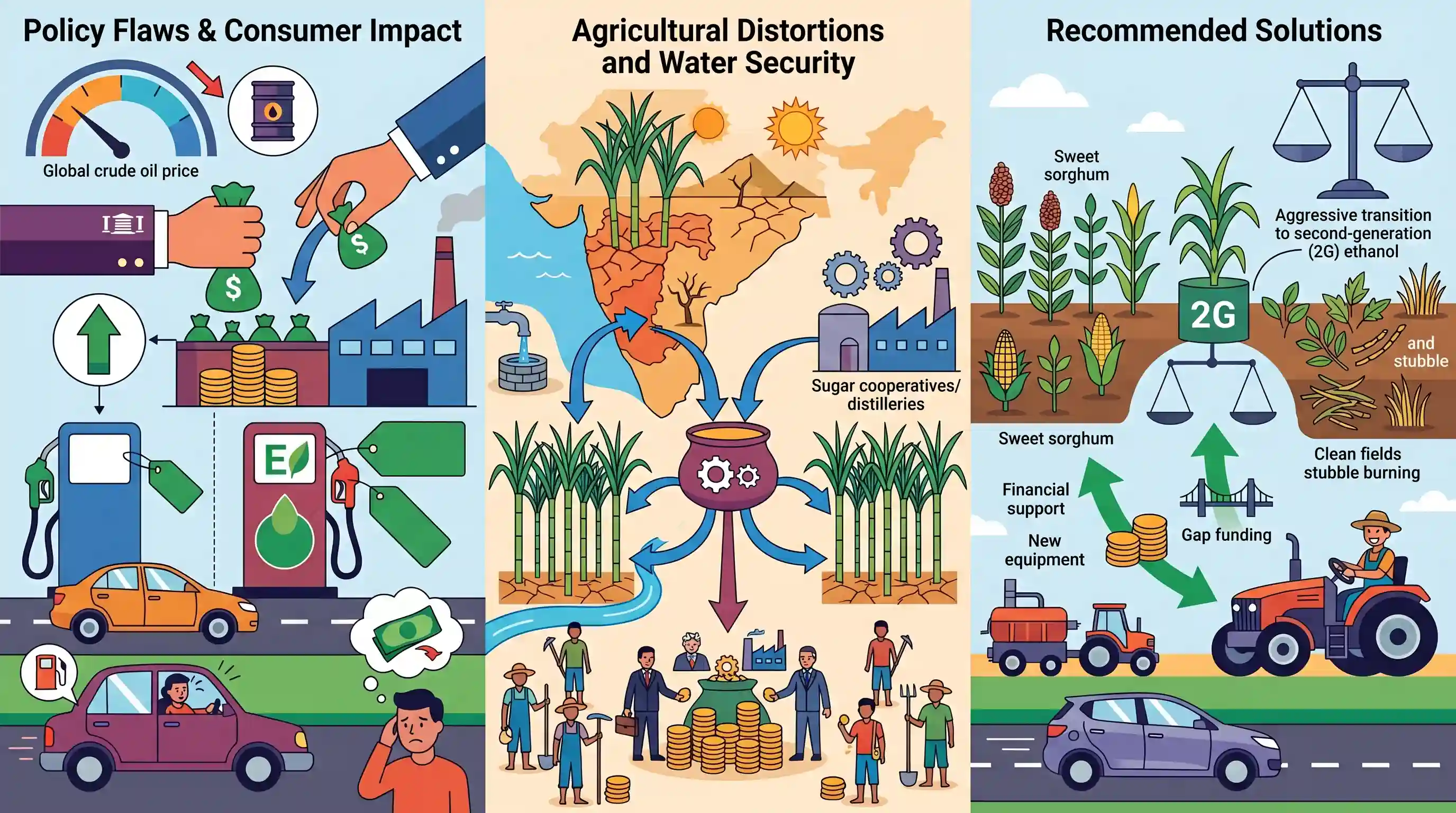
The article critically examines India's Ethanol Blending Programme (EBP), particularly the government's choice to maintain E20 petrol production incentives when international crude oil prices drop below $70 per barrel. While designed as a farmer compensation mechanism, this policy creates regressive pricing for consumers, who pay a premium for lower-mileage fuel. Environmentally, the policy distorts agricultural practices by subsidizing water-intensive sugarcane cultivation in drought-prone regions of Maharashtra and Karnataka. The editorial highlights that the economic benefits of these subsidies are heavily concentrated among distilleries and sugar cooperatives rather than trickling down to farmers. To align energy security with environmental and consumer interests, the editorial advocates for diversifying 1G feedstocks to less water-intensive options like sweet sorghum, and aggressively transitioning to second-generation (2G) ethanol derived from agricultural residue. This would avoid the food-vs-fuel conflict, tackle stubble burning, and require supportive measures like viability gap funding and equipment subsidies rather than punishing the consumer at the pump.
Key Points
- Maintaining E20 fuel mandates when crude prices fall below $70 per barrel imposes a premium on the consumer, who pays more at the pump for a fuel with lower mileage.
- Over-reliance on sugarcane for first-generation (1G) ethanol production incentivizes a highly water- and fertilizer-intensive crop in ecologically stressed states like Maharashtra and Karnataka.
- The trickle-down efficiency of the ethanol premium to farmers is questionable, with distilleries and sugar cooperatives capturing much of the value, while not addressing systemic issues like post-harvest losses.
- Using food grains (such as maize, millets, and Food Corporation of India rice) for fuel distillation introduces food-versus-fuel conflicts, with crop-specific drawbacks such as high fertilizer requirements for maize and low starch yields for millets.
- Second-generation (2G) ethanol from crop residues (like wheat/paddy straw and groundnut shells) offers an ideal alternative that avoids land-use conflict and addresses seasonal stubble burning.
- Policy recommendations include paying a premium for 2G ethanol, providing viability gap funding (VGF), subsidizing crop-residue collection equipment, and aligning energy goals with broader consumer and agricultural welfare.
Important Terms
Ethanol Blending Programme

A Ministry of Petroleum and Natural Gas initiative that blends renewable, plant-derived ethanol with petrol to reduce India's crude oil imports, cut vehicular carbon emissions, and boost farmers' incomes.
UPSC context
GS Paper III (Energy Security & Agriculture); tests strategies to enhance green fuel utilization and reduce fossil fuel import dependencies.
National Policy on Biofuels
A policy framework, introduced in 2018 and amended in 2022, designed to promote domestic biofuel production, expand eligible feedstock, and accelerate national target deadlines for ethanol blending in transportation.
UPSC context
GS Paper III (Infrastructure & Environment); tests understanding of policy frameworks governing clean energy, sustainable agriculture, and ecological impacts.
E20 Target
The government mandate to blend 20% ethanol with 80% petrol, successfully achieved nationwide in 2025—five years ahead of schedule—significantly reducing carbon emissions and forex spending.
UPSC context
GS Paper III (Environment & Infrastructure); evaluates milestones in sustainable development, transport sector emissions, and technical challenges of vehicle compatibility.
Food Corporation of India
A statutory body established in 1965 to secure national food security by procuring grains at minimum support prices, maintaining buffer stocks, and distributing food grains nationwide under the PDS.
UPSC context
GS Paper III (Food Security & Agriculture); tests critical mechanisms of price stabilization, public distribution, and crop diversification policies.
Oil Marketing Companies
Public and private entities, primarily IOCL, HPCL, and BPCL, that refine, transport, and distribute petroleum products and execute the blending and distribution of ethanol-blended fuels across India.
UPSC context
GS Paper III (Indian Economy & Energy Security); tests role of public undertakings in fuel pricing, distribution logistics, and energy transitions.
Prelims Trap
Under the National Policy on Biofuels, ethanol produced from damaged food grains and surplus maize is classified as a Second-Generation (2G) biofuel.
Grains are starch/food-based, making them 1G feedstocks. 2G strictly uses non-food lignocellulosic biomass (e.g., crop residues) to avoid food-vs-fuel conflicts.
Static Concepts Connected
What are the classifications of Biofuels (1G to 4G) under India's policy?
- First Generation (1G): Produced directly from food-grade crops containing sugar or starch, such as sugarcane molasses, maize, and broken rice.
- Second Generation (2G): Derived from non-food agricultural residues, lignocellulosic biomass (e.g., wheat straw, bagasse), and municipal solid waste.
- Third Generation (3G): Utilizes specialized micro-organisms and algae cultivation, which can be grown on non-arable land to avoid agricultural displacement.
- Fourth Generation (4G): Combines genetically engineered organisms with carbon capture and storage (CCS) technologies to ensure carbon-negative fuel production.
How do cropping patterns affect water footprint and regional resource depletion?
- Water Footprint concept: Measures the total freshwater volume consumed to produce agricultural commodities; sugarcane requires highly intensive blue water (surface/groundwater extraction).
- Regional disparity: Growing sugarcane in drought-prone Maharashtra requires over double the irrigation cycles and water volume compared to alluvial, water-rich Uttar Pradesh.
- Sorghum resilience: C4 crops like sweet sorghum require 50% less water, mature in half the time, and satisfy the 6Fs (Food, Feed, Fuel, Fiber, Ferment, Fertilizer) model.
Cross-Topic Patterns
Biofuels + Poultry feed inflation
Diverting maize to meet E20 targets turned India into a net maize importer, raising feed costs for livestock and poultry sectors, illustrating the food-versus-feed trade-off.
Air Quality + 2G Biofuels
2G ethanol plants provide an economic market for paddy straw in Northwest India, directly addressing the seasonal air pollution crisis caused by crop residue burning.
Water Governance + Crop Subsidies
High state-advised prices for sugarcane distort agricultural choice, driving water-intensive farming in drought-prone Deccan aquifers, which directly conflicts with national micro-irrigation and water conservation targets.

E20 feedstock diversification (maize/sorghum) and its ecological trade-offs on poultry feed and water stress will dominate 2026 Agri-GS3.
Linked PYQs · 3
Linked PYQs · 3
- 2024PrelimsGS1
Consider the following materials: 1. Agricultural residues 2. Corn grain 3. Wastewater treatment sludge 4. Wood mill waste Which of the above can be used as feedstock for producing Sustainable Aviation Fuel?
- 2025PrelimsGS1
Consider the following statements : Statement I: Of the two major ethanol producers in the world, i.e., Brazil and the United States of America, the former produces more ethanol than the latter. Statement II: Unlike in the United States of America where corn is the principal feedstock for ethanol production, sugarcane is the principal feedstock for ethanol production in Brazil. Which one of the following is correct in respect of the above statements?
- 2023MainsGS3
Discuss several ways in which microorganisms can help in meeting the current fuel shortage.
