Delhi cloud seeding trial paused due to low atmospheric moisture
Source:The Hindu ↗
Why It Matters
The use of cloud seeding highlights a critical Science and Technology application designed to mitigate severe environmental hazards (air pollution/smog). Understanding its mechanics, requirements (e.g., moisture levels, seeding agents like silver iodide), and limitations is highly relevant for both GS3 (Science & Technology and Environment) and Prelims.
Summary
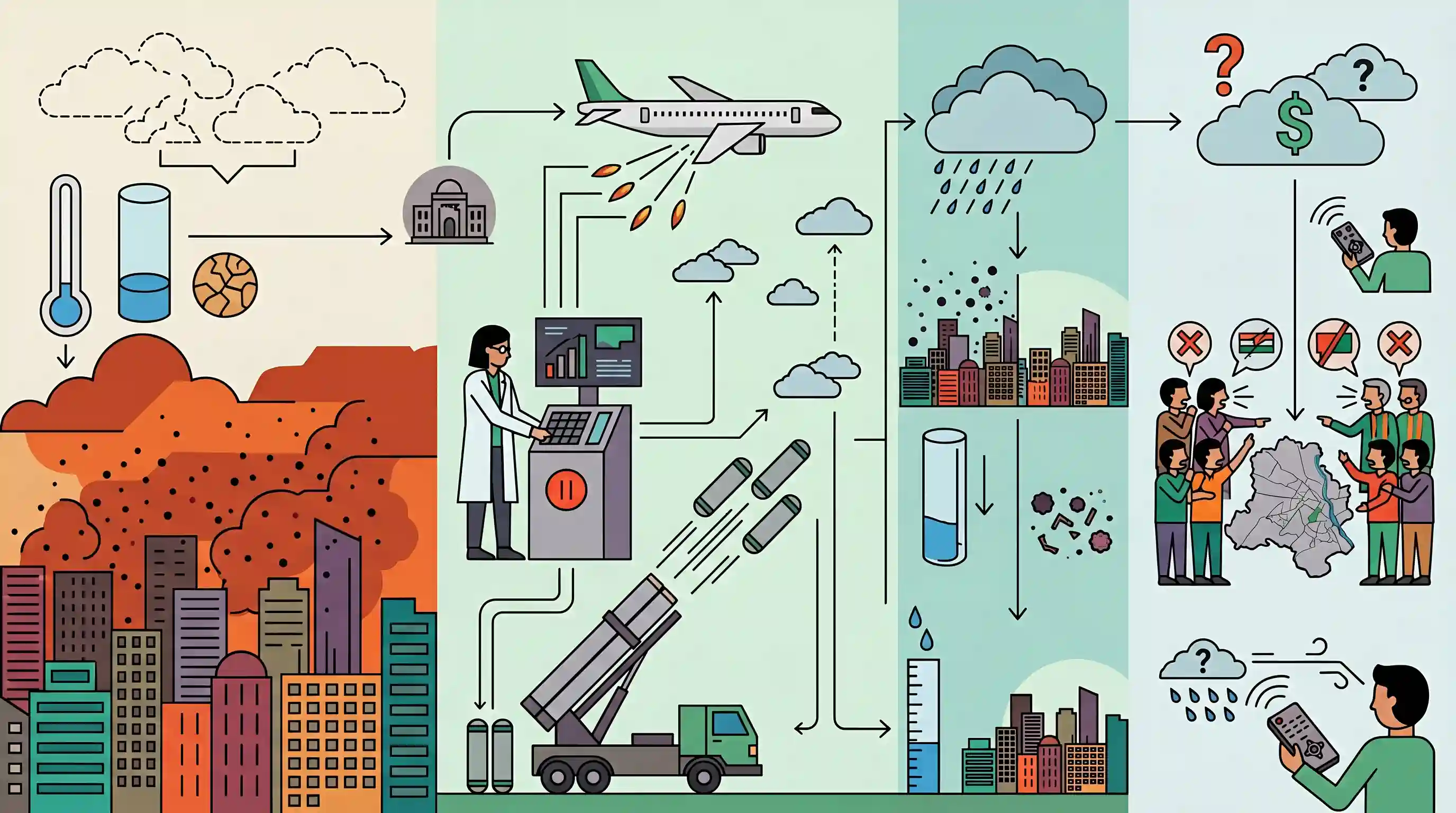
Delhi's upcoming cloud-seeding trial, scheduled to combat hazardous air pollution levels, was put on hold due to inadequate atmospheric moisture, which was recorded at just 15% to 20% by IIT-Kanpur. Although a prior trial failed to induce significant rainfall across the capital, it still achieved a measurable 6% to 10% decrease in particulate matter (PM2.5 and PM10). The technological intervention highlights the growing reliance on weather modification to handle urban pollution emergencies, though its limitations underscore the challenge of relying solely on artificial rain. The experiment also triggered political crossfire between the ruling BJP-led government and the opposition AAP over the feasibility and success of the trials.
Key Points
- A cloud-seeding trial intended to induce artificial rain in Delhi for October 29, 2025, was paused because cloud moisture levels were insufficient (15-20%).
- The trials, conducted in collaboration with IIT-Kanpur, aim to combat Delhi's severe air pollution, which consistently records 'poor' to 'very poor' Air Quality Index (AQI) levels.
- Despite no precipitation from the October 28 trials, real-time data showed a 6% to 10% reduction in PM2.5 and PM10 concentrations, indicating partial air quality improvement.
- The initiative sparked political debate, with the AAP questioning its efficacy due to lack of rainfall, while Delhi Environment Minister Manjinder Singh Sirsa defended the trial's success.
Important Terms
Cloud Seeding

A weather modification technique that enhances precipitation by dispersing substances like silver iodide or dry ice into clouds to serve as condensation nuclei, encouraging raindrops to form and fall.
UPSC context
GS Paper 3 (Environment/Science & Tech); tests understanding of technological interventions for pollution and water scarcity.
Central Pollution Control Board (CPCB)
A statutory organization established under the Water Act (1974) and Air Act (1981) responsible for monitoring air quality, setting emission standards, and coordinating pollution control efforts nationwide.
UPSC context
GS Paper 2 (Statutory Bodies) and Paper 3 (Environmental Governance); tests knowledge of institutional frameworks.
Particulate Matter (PM2.5 & PM10)
Microscopic solid or liquid droplets suspended in air; PM2.5 (diameter <2.5μm) can penetrate deep into the bloodstream, while PM10 (diameter <10μm) primarily affects the lungs.
UPSC context
GS Paper 3 (Environmental Pollution); tests understanding of air pollutants, health impacts, and WHO guidelines.
Weather Modification
The deliberate act of manipulating atmospheric processes to alter weather conditions, such as inducing rain, suppressing hail, or dispersing fog, often categorized under geoengineering.
UPSC context
GS Paper 3 (S&T/Environment); tests awareness of scientific feasibility, ethics, and international environmental treaties.
IIT-Kanpur
The technical lead for Delhi's cloud-seeding trials, providing the specialized aircraft, seeding flares, and atmospheric data analysis required for the artificial rain experiment.
UPSC context
GS Paper 3 (S&T); highlights the role of premier academic institutions in solving urban policy and environmental challenges.
Atmospheric Moisture
The amount of water vapor present in the atmosphere; for cloud seeding to succeed, a minimum threshold (typically >40%) is necessary to facilitate condensation and rain.
UPSC context
GS Paper 1 (Physical Geography) and Paper 3 (S&T); tests understanding of meteorological prerequisites for artificial rain.
Prelims Trap
"Cloud seeding technology can generate artificial clouds during clear-sky conditions to induce emergency rainfall."
Cloud seeding cannot create clouds out of thin air; it strictly requires pre-existing clouds with adequate atmospheric moisture and vertical thickness to function.
Static Concepts Connected
What are the primary chemicals used in cloud seeding?
- Silver Iodide (AgI): Acts as a condensation nucleus in glaciogenic seeding, inducing ice crystal formation in supercooled cold clouds.
- Sodium Chloride: Used in hygroscopic seeding for warmer clouds, utilizing its hygroscopic salt properties to attract water vapor and form heavier, precipitable droplets.
- Dry Ice: Solid carbon dioxide rapidly cools the surrounding air upon release, forcing atmospheric moisture to condense into water droplets.
How do PM2.5 and PM10 differ in their physiological impacts?
- PM 2.5: Ultra-fine particles (≤2.5 micrometers) that can bypass the lung barrier, directly entering the human bloodstream and causing severe cardiovascular and systemic issues.
- PM 10: Coarse particulate matter (≤10 micrometers) that typically gets lodged in the upper respiratory tract, triggering localized respiratory conditions like asthma and bronchitis.
Cross-Topic Patterns
Weather modification & GRAP interventions
As conventional CAQM measures under GRAP face systemic enforcement hurdles, technological fixes like cloud seeding are emerging as supplementary—though highly conditional—emergency responses for the NCR air pollution crisis.
Geoengineering and ecological risks
Local weather modification ties into the broader UPSC theme of geoengineering, raising ethical questions about localized micro-climate disruption and potential heavy metal toxicity from repeated atmospheric seeding.

Expect a multi-statement Prelims question testing the specific chemical agents (AgI vs NaCl) used in cloud seeding and their limitations.
Linked PYQs · 2
Linked PYQs · 2
- 2025PrelimsGS1
Artificial way of causing rainfall to reduce air pollution makes use of
- 2022PrelimsGS1
In the context of WHO Air Quality Guidelines, consider the following statements: 1. The 24-hour mean of PM2.5 should not exceed 15 µg/m³ and annual mean of PM2.5 should not exceed 5 µg/m³. 2. In a year, the highest levels of ozone pollution occur during the periods of inclement weather. 3. PM10 can penetrate the lung barrier and enter the bloodstream. 4. Excessive ozone in the air can trigger asthma. Which of the statements given above are correct?
