Judicial Self Correction and Constitutional Checks on Executive Power
Source:The Hindu ↗
Why It Matters
The article reinforces core UPSC GS2 concepts surrounding judicial independence, checks and balances, and the practical application of fundamental rights against state excesses. It also bridges GS2 and GS3 by highlighting the ethical and governance challenges of integrating Artificial Intelligence into the legal system.
Summary
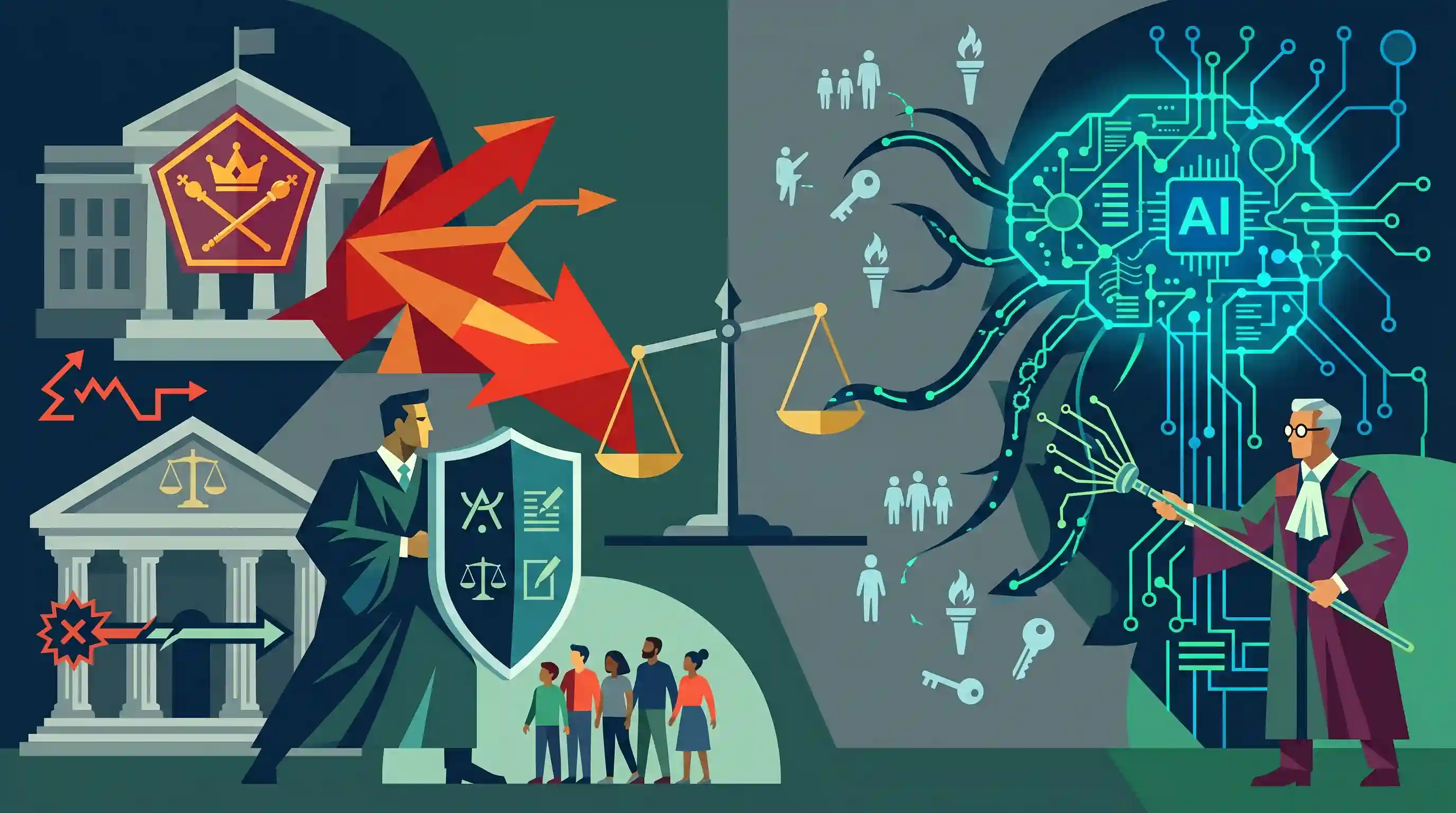
Speaking at the 'Justice Unplugged' conclave, Senior Advocate A.M. Singhvi emphasized the importance of judicial self-correction and courage in acknowledging institutional errors. He stressed that as executive authority expands globally, the judiciary's role as a constitutional safeguard becomes indispensable. Singhvi urged the application of constitutional principles to protect common citizens from arbitrary state excesses, such as preventive detention, highlighting that a legal system's true measure is its defense of the vulnerable. Furthermore, he addressed the integration of Artificial Intelligence in the legal field, describing it as a powerful tool that must be guided by human practitioners to prevent invasive technological overreach and protect individual rights.
Key Points
- Institutions, particularly the judiciary, must possess the courage to acknowledge their errors, as the capacity for self-correction is a fundamental strength of constitutional systems.
- The continuous expansion of executive authority requires the judiciary to be highly vigilant and critical in its role as the protector of the Constitution.
- Constitutional jurisprudence must be practically applied to defend ordinary citizens from arbitrary state actions, including preventive detention, ensuring access to justice for the vulnerable.
- While Artificial Intelligence (AI) offers remarkable utility in the legal profession, legal practitioners must act as a protective barrier against the invasive and unethical use of such technologies.
Important Terms
Judicial Review

The power of the judiciary to examine the constitutionality of legislative acts and executive orders. In India, it is considered a part of the 'Basic Structure' of the Constitution.
UPSC context
GS Paper II (Polity/Judiciary); essential for checks and balances and protecting Fundamental Rights under Articles 13, 32, and 226.
Preventive Detention
Detention without trial to prevent future offenses rather than punish past ones. Article 22 provides safeguards, including a three-month limit unless approved by an Advisory Board.
UPSC context
GS Paper II (Fundamental Rights); tests the balance between state security and individual liberty under Articles 21 and 22.
Separation of Powers
The doctrine dividing government into the Legislature, Executive, and Judiciary. India follows a system of 'checks and balances' with Article 50 requiring the separation of the judiciary from the executive.
UPSC context
GS Paper II (Polity); a foundational concept for understanding institutional roles and preventing the concentration of power.
Executive Overreach
Occurs when the executive branch exceeds its constitutional authority, encroaching on the mandates of the legislature or judiciary or infringing upon individual civil liberties.
UPSC context
GS Paper II (Separation of Powers); critical for questions on institutional friction and the role of the judiciary as a safeguard.
Constitutional Morality
Adherence to the core values and spirit of the Constitution (like liberty and equality) beyond its literal text to ensure justice and prevent majoritarianism.
UPSC context
GS Paper II (Governance/Judiciary); a recurring theme in landmark judgments and ethics (GS IV) regarding the interpretation of rights.
Constitution of India
The supreme law of the land that establishes the political framework, procedures, and powers of government while guaranteeing fundamental rights to citizens.
UPSC context
GS Paper II (Polity); the fundamental source for all legal and political questions in the UPSC syllabus.
Prelims Trap
"The Constitution explicitly provides for Curative Petitions under Article 137 to prevent miscarriage of justice."
Article 137 only grants the Supreme Court power to review its judgments. Curative petitions are not constitutional; they were judicially created in 2002.
Static Concepts Connected
What mechanisms allow the Supreme Court to correct its own judgments?
- Review Petition: Under Article 137, the Supreme Court can review its own judgments to correct errors apparent on the face of the record.
- Curative Petition: A judicial innovation from the Rupa Ashok Hurra case (2002), used as a final safeguard against gross miscarriage of justice after a review petition fails.
What are the Article 22 safeguards against Preventive Detention?
- Advisory Board: Detention beyond three months must be authorized by an Advisory Board consisting of persons qualified to be High Court judges.
- Right to Representation: The detaining authority must communicate the grounds of detention and afford the detainee the earliest opportunity to make a representation against the order.
Cross-Topic Patterns
AI Governance & Article 21 Privacy
The deployment of generative AI in legal and executive domains links emerging technology governance directly to the Right to Privacy (Puttaswamy) and algorithmic bias.
Article 50 & Executive Overreach
The global expansion of executive authority tests the practical enforcement of Article 50 (Separation of Judiciary from Executive), linking DPSP implementation with judicial independence.

Expect a 2026 multi-statement prelims question contrasting Article 137 Review Petitions with judicially innovated Curative Petitions.
Linked PYQs · 3
Linked PYQs · 3
- 2023MainsGS2
“Constitutionally guaranteed judicial independence is a prerequisite of democracy.” Comment.
- 2020MainsGS2
Judicial Legislation is antithetical to the doctrine of separation of powers as envisaged in the Indian Constitution. In this context justify the filing of large number of public interest petitions praying for issuing guidelines to executive authorities.
- 2023MainsGS3
Introduce the concept of Artificial Intelligence (AI). How does Al help clinical diagnosis? Do you perceive any threat to privacy of the individual in the use of Al in healthcare?
