Congress Criticizes Government Over Declining Household Savings
Source:The Hindu ↗
Why It Matters
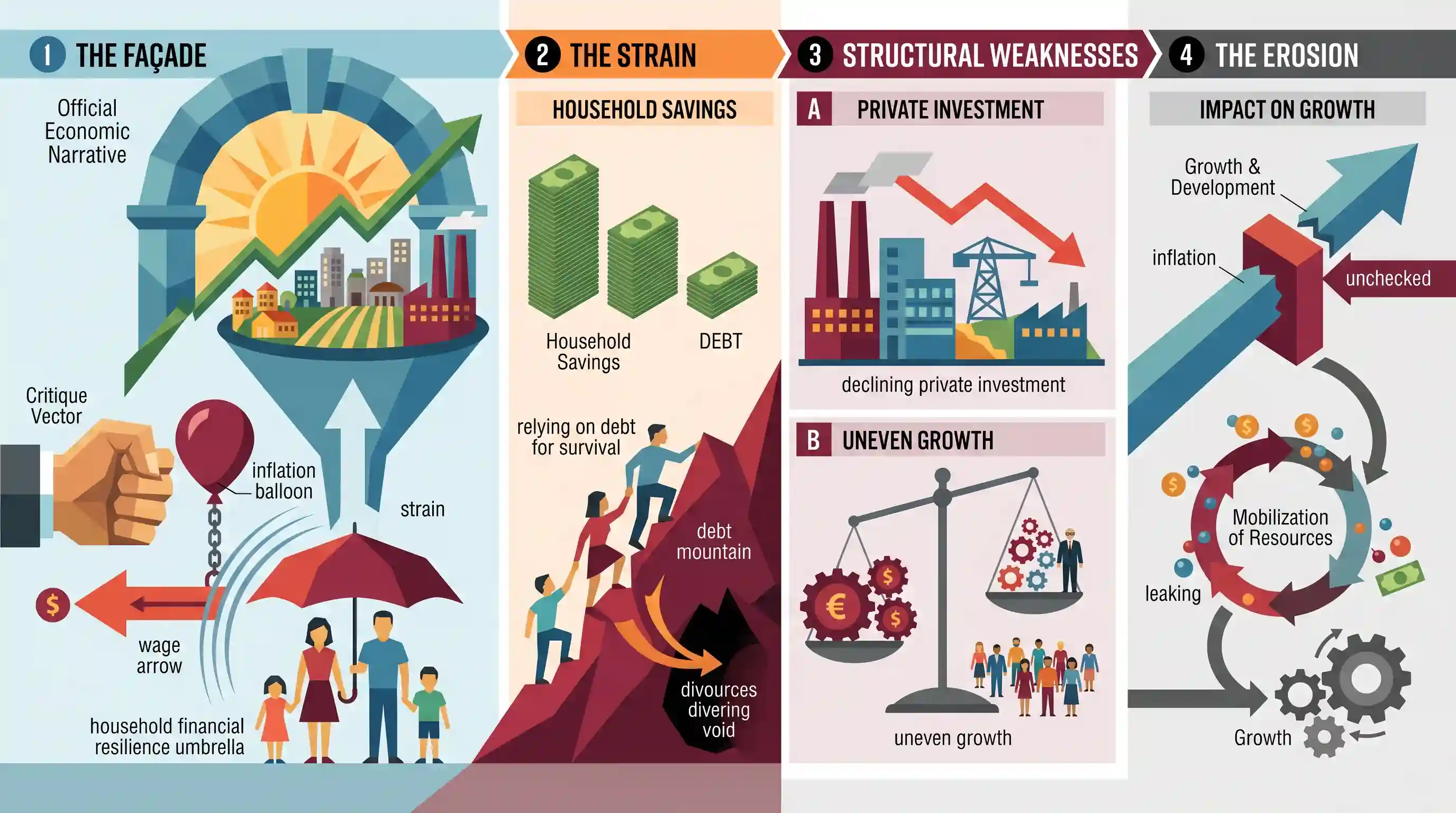
Household savings are a critical domestic resource for capital formation. A continuous decline in net household savings, coupled with a rise in consumer debt, signals stress in household finances and can negatively impact private investment, macroeconomic stability, and long-term economic growth.
Summary
Congress leader Jairam Ramesh criticized the Union government's economic record, alleging that stagnant wages and unchecked inflation have severely eroded household financial resilience. Pointing out that household savings have declined for the third consecutive year, he argued that citizens are increasingly forced to rely on debt for basic survival. This trend contradicts official narratives of economic prosperity and highlights underlying structural weaknesses, such as declining private investment and uneven economic growth.
Key Points
- The Congress party criticized the Union government's economic performance, highlighting that household savings have declined for the third consecutive year.
- Opposition leaders argued that stagnant wages combined with inflation have forced citizens to deplete savings and take on debt to meet survival needs.
- The critique emphasized a disconnect between reports of controlled inflation or rising incomes and the ground reality of decreasing private investment and rising household financial stress.
Important Terms
Household Savings

The portion of disposable income not spent on consumption. In India, it includes financial assets (bank deposits, stocks) and physical assets (real estate, gold).
UPSC context
GS Paper 3 (Indian Economy); tests knowledge of domestic capital formation and its role in self-reliant economic growth.
Household Debt
Total financial liabilities owed by individuals to creditors like banks and NBFCs, including loans for housing, education, or consumption.
UPSC context
GS Paper 3 (Banking/Economy); critical for analyzing financial stability, household resilience, and risks of a "debt trap."
Real Wages
Wages adjusted for inflation to show actual purchasing power. Stagnant real wages mean earnings are not keeping pace with the rising cost of living.
UPSC context
GS Paper 3 (Growth and Development); tests understanding of inclusive growth, labor markets, and the distribution of GDP gains.
Inflation
A sustained increase in the general price level of goods and services, which reduces the purchasing power of money and erodes household savings.
UPSC context
GS Paper 3 (Economy); fundamental for questions on monetary policy, cost-of-living crises, and macro-economic stability.
Resource Mobilization
The process of gathering funds from various sources—primarily domestic savings and taxes—to finance a country's development and infrastructure projects.
UPSC context
GS Paper 3 (Planning); core topic regarding how the government and private sector fund long-term growth.
Private Investment
Capital expenditure by private companies on productive assets like factories and technology. It is a primary driver of job creation and economic expansion.
UPSC context
GS Paper 3 (Investment Models); key for analyzing the "virtuous cycle" of growth and the role of private capital.
Prelims Trap
"A continuous decline in Net Household Financial Savings indicates a proportional fall in India's Gross Household Savings."
Net savings fall when household borrowings (liabilities) rise, even if gross savings remain stable. The recent NHFS dip is driven by surging retail debt, not just falling gross savings.
Static Concepts Connected
What constitutes Net Household Financial Savings (NHFS) and how does it impact the macroeconomy?
- NHFS Calculation: Calculated as households' gross financial assets (currency, bank deposits, shares, provident funds) minus their financial liabilities (loans and borrowings).
- Deficit Financing: The government relies heavily on this pool of net household savings to finance its fiscal deficit through domestic borrowing.
- Crowding Out Effect: A shrinking NHFS pool restricts available loanable funds, pushing up interest rates and potentially crowding out private sector capital expenditure.
How do inflation dynamics affect wage metrics and consumption patterns?
- Real Wage Erosion: If inflation remains high while nominal wages stagnate, 'real wages' fall, eroding purchasing power and lowering living standards.
- Debt-Funded Consumption: To maintain basic consumption despite falling real wages, low- and middle-income households liquidate financial assets or take on unsecured debt.
Cross-Topic Patterns
NHFS dip + Unsecured Retail Credit boom
The RBI recently increased risk weights on unsecured consumer loans to temper the exact retail credit boom that is actively driving down India's net household financial savings.
Domestic Savings + Current Account Deficit
A structural decline in domestic savings often forces an economy to rely on foreign savings to fund domestic investment, indirectly widening the Current Account Deficit (CAD).

Expect a multi-statement question in 2026 linking falling Net Household Financial Savings to the 'crowding out' of private investment.
Linked PYQs · 4
Linked PYQs · 4
- 2019MainsGS3
Do you agree with the view that steady GDP growth and low inflation have left the Indian economy in good shape? Give reasons in support of your arguments.
- 2017MainsGS3
Among several factors for India's potential growth, savings rate is the most effective one. Do you agree? What are the other factors available for growth potential?
- 2022PrelimsGS1
With reference to the Indian economy, consider the following statements: 1. A share of the household financial savings goes towards government borrowings. 2. Dated securities issued at market-related rates in auctions form a large component of internal debt. Which of the above statements is/are correct?
- 2013PrelimsGS1
Consider the following statements : 1. Inflation benefits the debtors. 2. Inflation benefits the bond-holders. Which of the statements given above is/are correct?
