Political Coalitions and Alliance Building in Indian Democracy
Source:Indian Express ↗
Why It Matters
Understanding the inner workings of political alliances and party dynamics is crucial for questions on Indian polity, federalism, and the functioning of a parliamentary democracy.
Summary
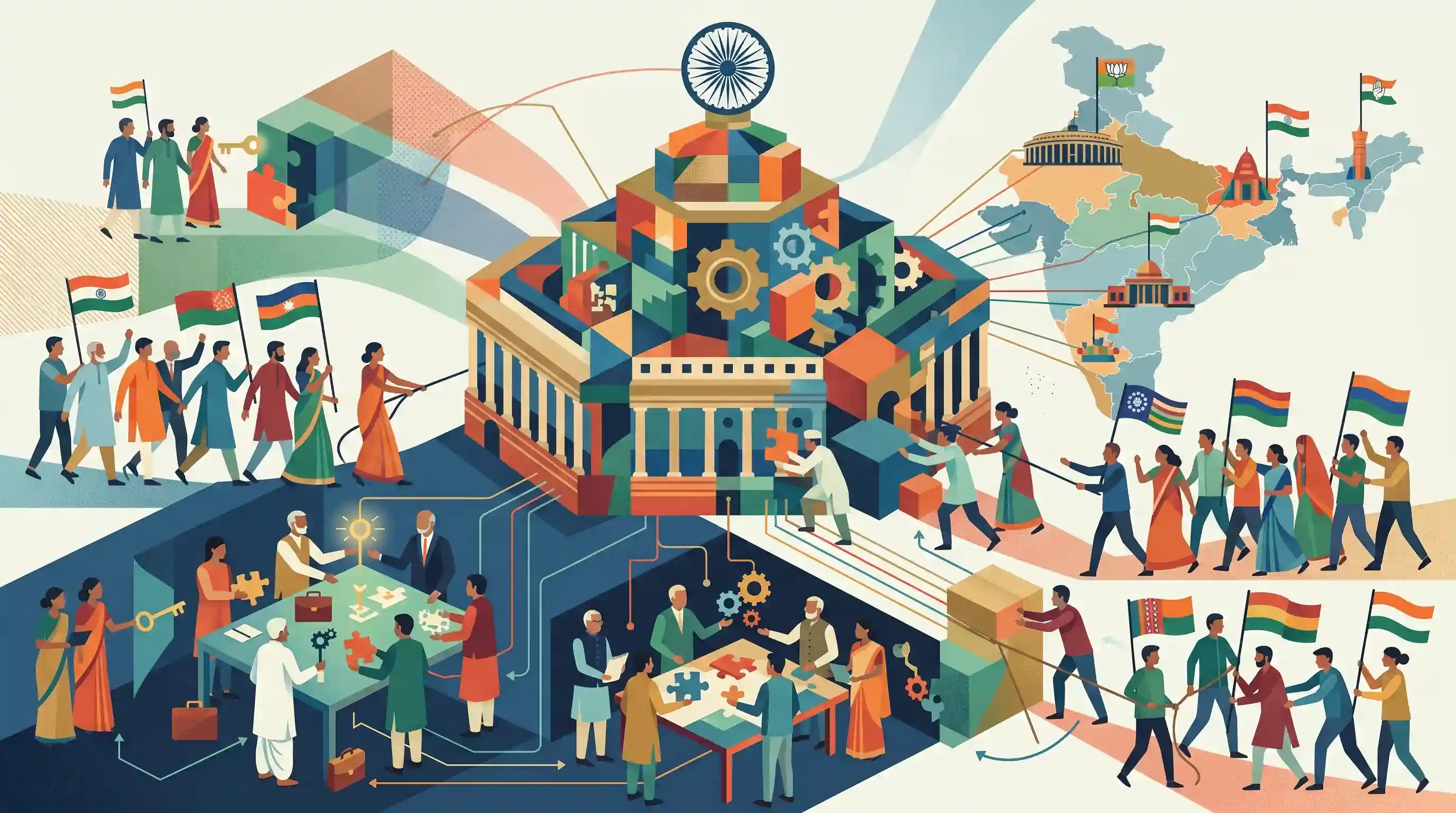
The "Inside Track" column discusses the nuanced political negotiations and strategic alliances shaping the current Indian political landscape. It highlights the behind-the-scenes "art of the deal" among major political parties, underscoring the complexities of coalition building, government formation, and the fluid nature of multi-party democracy in India.
Key Points
- The article provides an inside look at recent political negotiations and alliance-building within the Indian political spectrum.
- Political maneuvering reflects the complexities of federalism and coalition politics in India.
- It highlights the strategic shifts and "art of the deal" necessary to maintain political balance in a multi-party democracy.
Important Terms
Bharatiya Janata Party (BJP)

One of India's two major political parties; it currently leads the ruling National Democratic Alliance (NDA) and promotes an ideology centered on cultural nationalism and economic development.
UPSC context
GS Paper II (Polity). Tests knowledge of party ideologies and their role in parliamentary democracy.
Indian National Congress (INC)
India's oldest political party; it leads the opposition I.N.D.I.A. bloc and traditionally advocates for secularism, social welfare, and a centrist to center-left political platform.
UPSC context
GS Paper II (Polity). Key for understanding opposition dynamics and historical party evolution.
Coalition Government
A cabinet of a parliamentary government in which multiple political parties cooperate, reducing the dominance of any single party, often necessitated when no single party wins an absolute majority.
UPSC context
GS Paper II. Focuses on federalism, executive-legislative relations, and political stability.
Anti-Defection Law
The Tenth Schedule of the Constitution, which penalizes individual Members of Parliament or State Legislatures for leaving one party for another to prevent political instability.
UPSC context
GS Paper II (Polity). Tests understanding of legislative ethics and constitutional safeguards against "horse-trading."
I.N.D.I.A. Alliance
The big-tent opposition alliance formed in 2023 by 28 parties to challenge the ruling NDA in the 2024 general elections.
UPSC context
GS Paper II. Important for analyzing the evolution of multi-party systems and election strategies.
Rajya Sabha
The upper house of India's bicameral Parliament; its composition is frequently impacted by "deals" and cross-party support during the election of members by state legislative assemblies.
UPSC context
GS Paper II (Parliament). Relevant for understanding the representation of states and legislative procedures.
National Democratic Alliance (NDA)
A center-right political alliance in India led by the BJP, formed in 1998 to contest general elections and provide a stable coalition government.
UPSC context
GS Paper II. Essential for studying coalition dynamics and the shift from single-party to alliance-based dominance.
Prelims Trap
Merger of a political party is valid under the Tenth Schedule if supported by one-third of its elected legislators.
The 91st Constitutional Amendment (2003) deleted the provision allowing a one-third split. Now, a valid merger requires the agreement of at least two-thirds of the legislative party's members.
Static Concepts Connected
What are the exceptions to disqualification under the Tenth Schedule?
- Two-thirds Merger: If a political party merges with another and at least two-thirds of its legislative members agree, they are exempt from disqualification.
- Presiding Officers: A member elected as Speaker or Chairman who voluntarily gives up party membership to maintain neutrality is exempt from defection.
How does the ECI recognize a National Political Party?
- Vote Share: Securing at least 6% of valid votes in four or more states in Lok Sabha or Assembly elections, plus winning 4 Lok Sabha seats.
- Lok Sabha Seats: Winning at least 2% of total seats in the Lok Sabha, with candidates elected from at least three different states.
- State Party: Being officially recognized as a State Party in at least four different states.
Cross-Topic Patterns
Coalitions and Asymmetric Federalism
Coalition politics amplify regional parties' bargaining power, frequently reviving demands for Special Category Status and influencing Finance Commission horizontal devolution formulas.
Defections & Governor's Discretion
Fractured mandates and alliance shifts bring the Governor's discretionary powers under Article 163 and the S.R. Bommai guidelines on floor tests into sharp Prelims focus.

Expect a multi-statement Prelims question combining Tenth Schedule merger exceptions with the ECI's powers under the Symbols Order 1968.
Linked PYQs · 2
Linked PYQs · 2
- 2022MainsGS2
“While the national political parties in India favour centralisation, the regional parties are in favour of State autonomy.” Comment.
- 2024MainsGS2
What changes has the Union Government recently introduced in the domain of Centre-State relations ? Suggest measures to be adopted to build the trust between the Centre and the States and for strengthening federalism.
