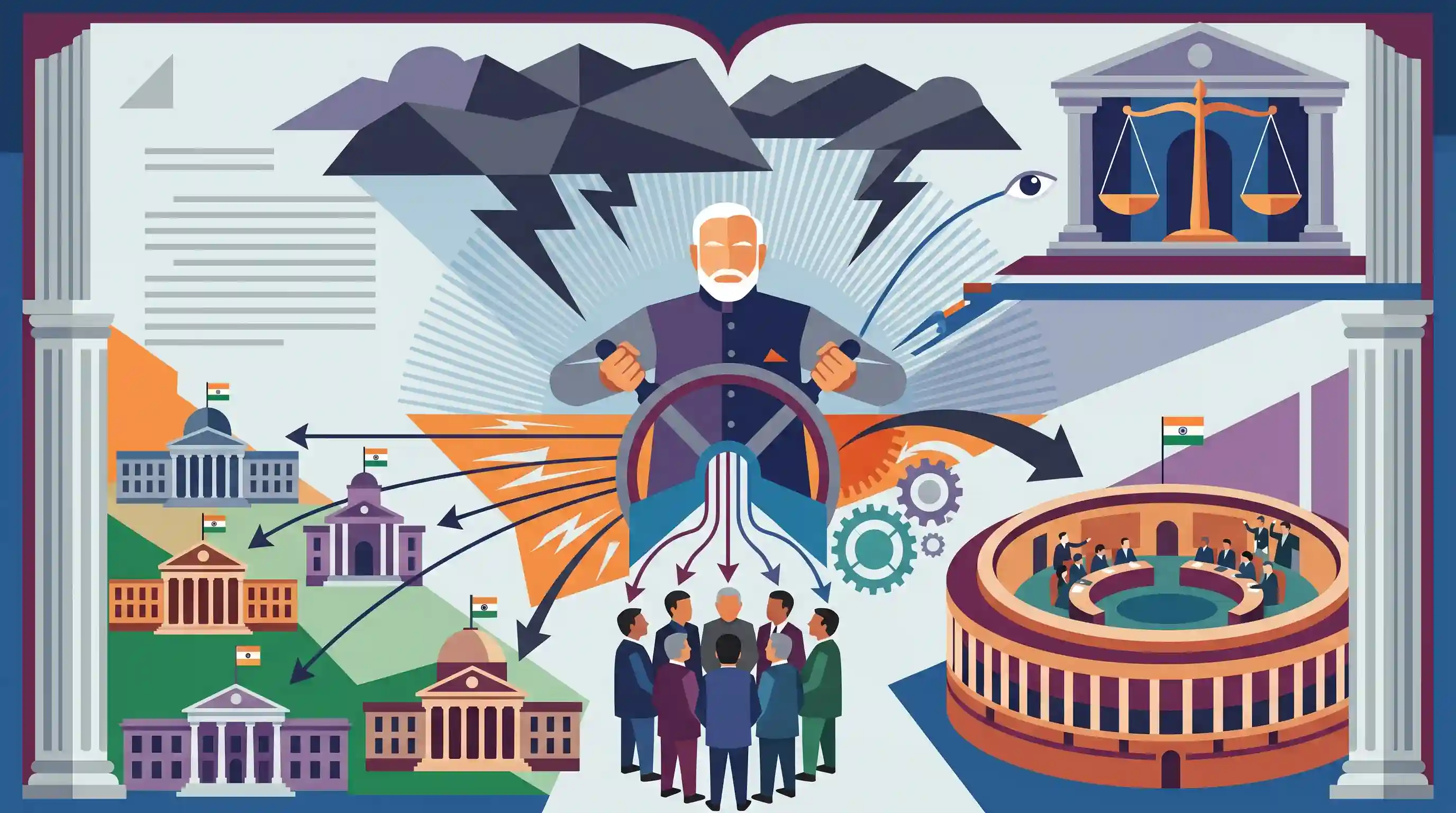
Prime Minister Led Crisis Meetings Highlight Executive Decision Making
Source:Indian Express ↗
Why It Matters
The article provides insight into the practical workings of the Executive, specifically the Prime Minister's role in crisis management and cabinet functioning, which is relevant for GS2 topics concerning governance and constitutional positions.
Summary
An analysis of the political dynamics surrounding crisis management at the highest levels of government. It reflects on the role of the Prime Minister in steering the Cabinet through pressing issues, highlighting the centralized nature of executive decision-making and its impact on democratic governance.
Key Points
- Political crisis management often requires high-level meetings chaired by the Prime Minister to address pressing governance issues.
- The efficacy of the government is deeply tied to the functioning and management of the Cabinet by the Prime Minister.
- Crisis meetings underline the centralization of decision-making within the parliamentary democratic structure.
Important Terms
Cabinet

A core group of senior ministers within the Council of Ministers who hold major portfolios and serve as the supreme decision-making authority in the Indian executive.
UPSC context
GS Paper II (Polity); understanding executive decision-making, Article 352 (post-44th Amendment), and its functional supremacy over the larger Council.
Council of Ministers
The constitutional body comprising all ministers (Cabinet, Ministers of State, and Deputy Ministers) that aids and advises the President under Articles 74 and 75.
UPSC context
GS Paper II; constitutional structure, size limits (91st Amendment), and the theoretical seat of executive power versus practical Cabinet authority.
Prime Minister's Office (PMO)
An extra-constitutional administrative body that provides secretarial assistance and policy advice directly to the Prime Minister, serving as the government's central command hub.
UPSC context
GS Paper II/Public Administration; studies on centralization of power, administrative coordination, and its evolving relationship with the Cabinet Secretariat.
Cabinet Secretariat
The administrative arm of the Union Cabinet, headed by the Cabinet Secretary, which coordinates inter-ministerial business and provides secretarial assistance to Cabinet committees.
UPSC context
GS Paper II; crucial for understanding the 'Rules of Business' and administrative support systems for collective executive deliberation.
Collective Responsibility
A constitutional principle (Article 75) where all ministers are jointly responsible to the Lok Sabha for every decision taken by the Cabinet.
UPSC context
GS Paper II; a foundational pillar of parliamentary democracy, testing the concept of ministerial unity and legislative accountability.
Kitchen Cabinet
An informal circle of 2-4 influential ministers or trusted advisors with whom the Prime Minister discusses critical issues before formal Cabinet deliberation.
UPSC context
GS Paper II; examines informal power dynamics and their impact on traditional democratic decision-making structures.
Prelims Trap
The 'Inner Cabinet' or 'Kitchen Cabinet' is a recognized constitutional body for crisis management.
The 'Kitchen Cabinet' is an informal, extra-constitutional body of trusted aides. Only the 'Council of Ministers' and the 'Cabinet' (via 44th Amendment) have constitutional recognition.
Static Concepts Connected
What is the constitutional relationship between the Prime Minister and the President?
- Article 78: The PM is constitutionally bound to communicate all decisions of the Council of Ministers relating to Union administration to the President.
- Article 74: There shall be a Council of Ministers with the PM at the head to aid and advise the President in the exercise of their functions.
- Article 75: The PM is appointed by the President, and other ministers are appointed by the President on the advice of the PM.
How does the 'Cabinet' legally differ from the 'Council of Ministers'?
- Size and Scope: The Council is a wider body (60-70 ministers); the Cabinet is a smaller nucleus (15-20 senior ministers).
- Constitutional Status: The Council is detailed in original Articles 74 and 75. The 'Cabinet' was inserted later by the 44th Constitutional Amendment in Article 352.
- Decision Making: The Cabinet acts as the supreme decision-making body and directs the Council; the Council rarely meets as a whole.
Cross-Topic Patterns
Centralization & Anti-Defection Law
The strict party whips enforced under the 10th Schedule compound executive centralization, effectively reducing MPs to mere voters and further marginalizing parliamentary supremacy.
Ordinance Raj vs. Legislative Scrutiny
Frequent reliance on Article 123 by a dominant executive to bypass legislative debate is a key indicator of the shift toward a 'Prime Ministerial' form of government.

Questions on the 'Prime Ministerial form of government' linking Article 78 duties, Kitchen Cabinets, and Ordinance routes are highly likely.
Linked PYQs · 2
Linked PYQs · 2
- 2014MainsGS2
The size of the cabinet should be as big as governmental work justifies and as big as the Prime Minister can manage as a team. How far is the efficacy of a government then inversely related to the size of the cabinet? Discuss.
- 2024MainsGS2
“The growth of cabinet system has practically resulted in the marginalisation of the parliamentary supremacy.” Elucidate.
