Punjab protests center power rules over subsidy concerns
Source:Indian Express ↗
Why It Matters
This issue perfectly illustrates the ongoing conflict between market-driven economic reforms (improving efficiency and competition in the power sector) and state-led welfare economics (agricultural subsidies and free power). It is a prime example for Mains answers involving Discom losses, agricultural pricing, and friction in fiscal federalism.
Summary
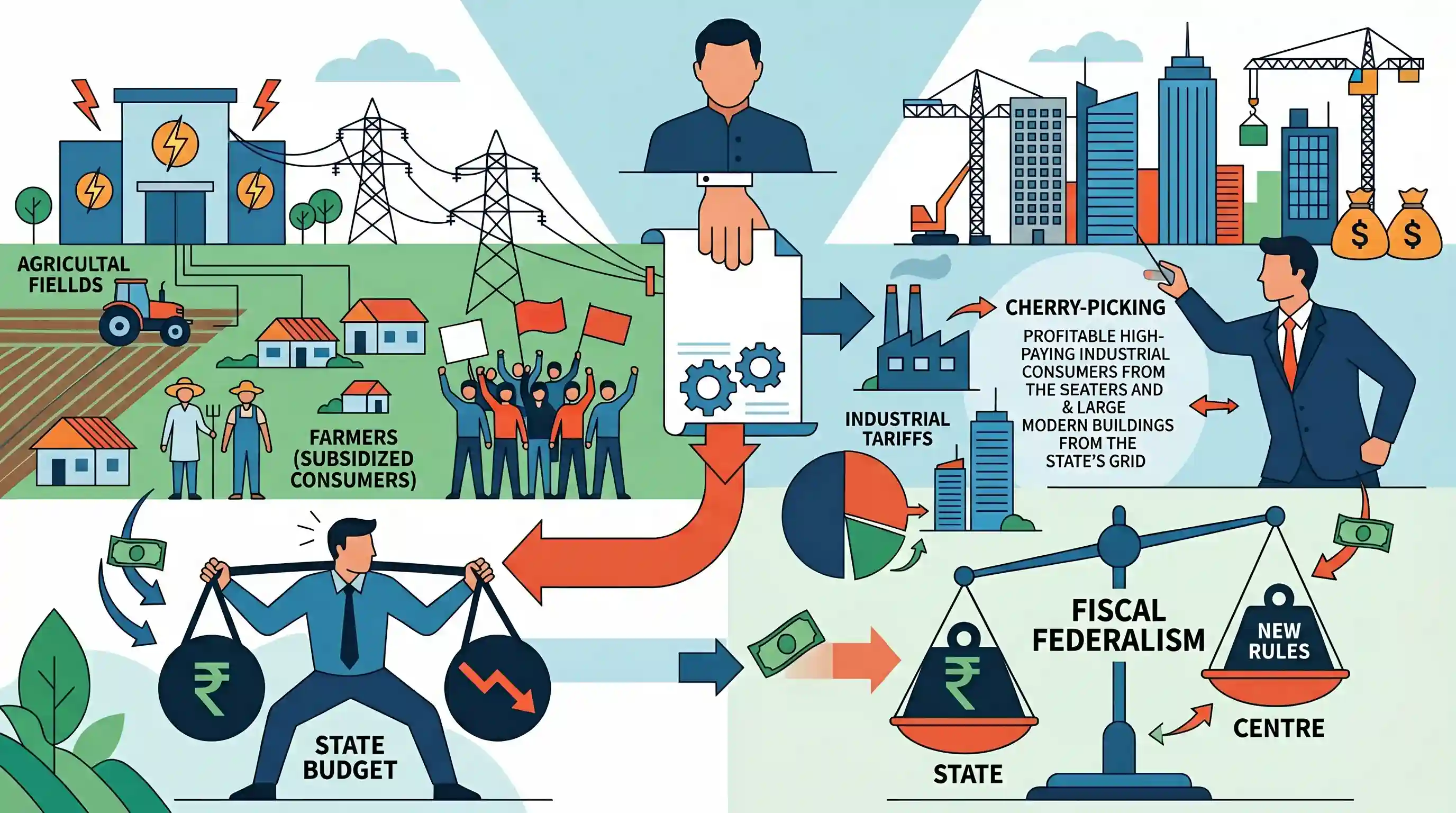
Recent protests in Punjab over the Centre's newly introduced electricity rules highlight significant friction in India's power distribution sector and federal structure. The new framework promotes open access and multi-licensing, allowing private players to use existing distribution networks. State Discoms fear this will lead to 'cherry-picking'—where private companies attract high-paying commercial and industrial users, leaving state entities with subsidized domestic and agricultural consumers. Since state Discoms rely heavily on cross-subsidies from industrial tariffs to fund free power for farmers, losing these profitable consumers could financially cripple them. For a heavily agrarian state like Punjab, this threatens to transfer massive electricity subsidy costs directly to the state budget, sparking concerns over fiscal federalism and the Centre's overarching role in state welfare policies.
Key Points
- The Centre's new power rules facilitate multi-licensing and open access, allowing private distributors to use existing state-owned distribution networks.
- State Discoms fear 'cherry-picking,' where private players lure away lucrative industrial and commercial consumers, leaving Discoms with only subsidized or loss-making consumers.
- State electricity models rely heavily on cross-subsidization: charging higher tariffs to industries to fund free or cheap power for agriculture and domestic households.
- For agrarian states like Punjab, losing high-paying consumers threatens to bankrupt Discoms, potentially shifting massive agricultural subsidy burdens directly onto the state exchequer.
- The issue highlights friction in fiscal federalism, as states view the Centre's unilateral rules on the concurrent subject of electricity as an encroachment on their welfare policies.
Important Terms
Electricity (Amendment) Rules, 2024

Recent rules notified to rationalize open access charges and allow large consumers (>=10MW) to maintain dedicated transmission lines without a license, aiming for cost-reflective tariffs and reduced Discom losses.
UPSC context
GS Paper 3 (Infrastructure: Energy); tests understanding of current legislative reforms and their impact on power sector efficiency.
Electricity Act, 2003
The landmark 2003 legislation that deregulated the Indian power sector, introducing competition, delicensing generation, and mandating the separation of transmission, distribution, and trading entities.
UPSC context
GS Paper 2 & 3; foundational knowledge for governance of energy utilities and legal hurdles in sector reforms.
Distribution Companies (Discoms)
State or private utilities responsible for the last-mile delivery of power to end-users. They are currently the "weakest link" due to high technical and commercial losses.
UPSC context
GS Paper 3; critical for questions on energy security, financial health of states, and infrastructure challenges.
Cross-subsidization
A tariff mechanism where high-paying industrial and commercial consumers are charged above the cost of supply to offset lower tariffs for domestic and agricultural users.
UPSC context
GS Paper 3 (Economy/Energy); tests analytical ability regarding price distortion and its impact on industrial competitiveness.
Open Access
A provision under the Electricity Act 2003 allowing large consumers (usually >1MW) to buy power from any generator or trader, bypassing the local Discom's monopoly.
UPSC context
GS Paper 3; essential for discussing competition in the power sector and its financial impact on state-owned utilities.
Fiscal Federalism
The financial relationship between the Centre and States regarding the distribution of resources, including the state’s autonomy to manage subsidies versus central reform mandates.
UPSC context
GS Paper 2 (Polity); central to discussions on Centre-State friction and the erosion of state autonomy via central laws.
Cherry-picking
A concern where private players target profitable industrial/commercial areas and consumers, leaving state Discoms with high-loss agricultural/rural consumers and a weakened revenue base.
UPSC context
GS Paper 3; tests understanding of the risks associated with privatization and market-led reforms in social sectors.
Prelims Trap
Electricity distribution and generation fall under the exclusive domain of the State List.
Electricity is in the Concurrent List (Entry 38). While states manage Discoms and set end-user tariffs, the Centre can legislate on overarching distribution frameworks.
Static Concepts Connected
What is "cross-subsidization" in India's power sector?
- Definition: Charging higher tariffs to one consumer group to artificially lower the price for another group.
- Mechanism: Industrial and commercial users pay steep premiums to offset cheap or free electricity given to agricultural and domestic users.
- Open Access Risk: Private players targeting only high-paying industrial clients threatens this model, stripping state Discoms of their primary cross-subsidy revenue.
How is power sector governance divided under the 7th Schedule?
- Concurrent List: Electricity is Entry 38 of the Concurrent List, allowing both Parliament and State legislatures to pass laws.
- Central Laws: The Electricity Act, 2003 provides the overarching national statutory framework governing generation, transmission, and distribution.
- State Implementation: States execute distribution via Discoms, while independent State Electricity Regulatory Commissions (SERCs) determine state-level tariffs.
Cross-Topic Patterns
Energy Subsidies + Groundwater Depletion
Free agricultural power disincentivizes water conservation, worsening groundwater crises in NW India. Schemes like PM-KUSUM attempt to solarize agriculture to decouple it from state grids.
Discom Debt + State Borrowing Limits
Shifting Discom losses to state budgets balloons the fiscal deficit. The Centre increasingly uses Article 293 to link extra state borrowing space to mandatory power sector reforms.

Expect a 2026 prelims question on Electricity's Concurrent status, SERC tariff powers, and the exact mechanics of cross-subsidization.
Linked PYQs · 4
Linked PYQs · 4
- 2024MainsGS2
What changes has the Union Government recently introduced in the domain of Centre-State relations ? Suggest measures to be adopted to build the trust between the Centre and the States and for strengthening federalism.
- 2013MainsGS3
What are the different types of agriculture subsidies given to farmers at the national and at state levels ? Critically analyse the agricultural subsidy regime with reference to the distortions created by it.
- 2017MainsGS3
How do subsidies affect the cropping pattern, crop diversity and economy of farmers? What is the significance of crop insurance, minimum support price and food processing for small and marginal farmers?
- 2025MainsGS2
Examine the evolving pattern of Centre-State financial relations in the context of planned development in India. How far have the recent reforms impacted the fiscal federalism in India?
