उत्तर प्रदेश के वार्षिक बजट में 2017 से तीन गुना विस्तार दर्ज
स्रोत:republicworld ↗
क्यों मायने रखता है
उत्तर प्रदेश के वित्तीय परिवर्तन, बजट वृद्धि की दिशा (वर्ष 2017 में 3 लाख करोड़ रुपये से बढ़कर वर्ष 2026 में 9 लाख करोड़ रुपये होना), और एक्सप्रेसवे पर केंद्रित पूंजीगत व्यय (capital expenditure) को समझना UPPSC Prelims के उन प्रश्नों के लिए अत्यधिक प्रासंगिक है, जो राज्य-स्तरीय बजट आंकड़ों, आर्थिक विकास और प्रमुख बुनियादी ढांचा पहलों को संबोधित करते हैं।of_the_following_options_are_incorrect? I. (e, g) ∈ R II. (g, e) ∈ R III. (g, g) ∈ R IV. (e, e) ∈ R Let's test these elements. Set S = {e, f, g, h}. e = [0, 1] f = [0, 0.5] g = [0.5, 1] h = [0.2, 0.7] Relation R is defined by: xRy ⇔ either (x ⊆ y) or (y ⊆ x). Let's check the options: I. (e, g) ∈ R Is e ⊆ g or g ⊆ e? e = [0, 1], g = [0.5, 1] Clearly, g ⊆ e since [0.5, 1] ⊆ [0, 1]. So, since g ⊆ e, (e, g) ∈ R (or is the relation symmetric? "either x ⊆ y or y ⊆ x" is symmetric). Let's check the definition of R: xRy iff x ⊆ y or y ⊆ x. For x=e, y=g: Does e ⊆ g? No, [0, 1] is not a subset of [0.5, 1]. Does g ⊆ e? Yes, [0.5, 1] is a subset of [0, 1]. Since one of the conditions is met (g ⊆ e), we have eRg. Thus, (e, g) ∈ R is true. Wait, let's check II: (g, e) ∈ R. By symmetry, if (e, g) ∈ R, then (g, e) ∈ R. Indeed, for x=g, y=e: Does g ⊆ e? Yes. Thus, (g, e) ∈ R is true. III. (g, g) ∈ R For x=g, y=g: Does g ⊆ g? Yes, every set is a subset of itself. Thus, (g, g) ∈ R is true. IV. (e, e) ∈ R For x=e, y=e: Does e ⊆ e? Yes. Thus, (e, e) ∈ R is true. Wait, are all of them correct? Let me re-read. Is there any typo in my understanding? Ah! "Which of the following options are incorrect?" But all four options I evaluated are correct according to the definition. Wait! Let me re-read the definitions of the sets. S = {e, f, g, h} where e = [0, 1], f = [0, 0.5], g = [0.5, 1], h = [0.2, 0.7]. Let me re-check. Is there any option that is NOT in R? Wait, if all are correct, maybe I made a mistake. Let me check the relation definition again. "xRy iff either x ⊆ y or y ⊆ x" Let's check if there is another interpretation. Could the question be about reflexivity? R is reflexive, so (x, x) is always in R. Thus III and IV are definitely correct. What about I and II? e = [0, 1] g = [0.5, 1] g ⊆ e is true because [0.5, 1] is a subinterval of [0, 1]. So both (e, g) and (g, e) must be in R. Why would any of them be incorrect? Wait! Let me search for the exact question from the exam. "Let S = {e, f, g, h} be a set of four intervals on the real line: e = [0, 1], f = [0, 0.5], g = [0.5, 1], h = [0.2, 0.7]... xRy if x ⊆ y or y ⊆ x." Actually, some options in the original GATE question might have been different! Ah! In the actual GATE question: The options were: (A) R is reflexive and transitive but not symmetric (B) R is reflexive and symmetric but not transitive (C) R is symmetric and transitive but not reflexive (D) R is an equivalence relation Oh! The prompt says: "Which of the following options are incorrect? I. (e, g) \in R II. (g, e) \in R III. (g, g) \in R IV. (e, e) \in R" Wait, if this is a modified version of the question, or if there's a typo in the options provided in the prompt? Wait! Let me check the definition of the intervals. e = [0, 1], f = [0, 0.5], g = [0.5, 1], h = [0.2, 0.7] Wait, is g = [0.5, 1] or maybe [0.6, 1]? In either case, g ⊆ e is true. What if g is NOT a subset of e? No, 0.5 >= 0 and 1 <= 1, so [0.5, 1] is definitely a subset of [0, 1]. What if the question meant "Which of the following options is/are correct?" and there's a "not" in one of them in the original test this prompt was taken from? Wait, could it be that R is defined as "x ⊂ y" (strict subset)? If xRy iff x ⊂ y or y ⊂ x: Then (g, g) and (e, e) would NOT be in R, because g is not a strict subset of g. But the standard symbol "⊆" means subset (which can be equal). If "⊆" is used, then: (e, e) and (g, g) are in R. And since g ⊆ e, (e, g) and (g, e) are in R. Thus all four are correct. Wait, let me think if there is any other element, say h and f. h = [0.2, 0.7], f = [0, 0.5]. Neither is a subset of the other, so (h, f) ∉ R. But the options only have e and g! e and g are [0, 1] and [0.5, 1]. Clearly [0.5, 1] ⊆ [0, 1]. So g ⊆ e. Thus (e, g) and (g, e) are in R. And since ⊆ is reflexive, (e, e) and (g, g) are in R. Therefore, NONE of the options I, II, III, IV are incorrect! Wait, could there be a typo in the prompt's options? Maybe "none of the above" or "none"? Since the question asks "Which of the following options are incorrect?", and all of them are actually correct (i.e., they belong to R), the answer is "None of the given options are incorrect" or "None". Let me double check if there's any other way to read "xRy iff x ⊆ y or y ⊆ x". If R is defined as above: - Reflexivity: For any x ∈ S, x ⊆ x is true, so xRx is true. Thus (e, e) ∈ R and (g, g) ∈ R are correct. - Since g = [0.5, 1] and e = [0, 1], we have g ⊆ e. - Therefore, by definition of R: - eRe holds because e ⊆ e. - gRg holds because g ⊆ g. - eRg holds because g ⊆ e. - gRe holds because g ⊆ e. So all four statements: I. (e, g) ∈ R II. (g, e) ∈ R III. (g, g) ∈ R IV. (e, e) ∈ R are mathematically TRUE. Thus, none of the options are incorrect. I will state this clearly, showing the step-by-step verification of each of the four statements to prove that they are all correct (i.e., they all belong to R), and therefore there are no incorrect options among the four. To find which of the given options are incorrect, we must test each statement against the definition of the relation $R$. ### **Given:** * **Set of intervals:** $S = \{e, f, g, h\}$ * $e = [0, 1]$ * $f = [0, 0.5]$ * $g = [0.5, 1]$ * $h = [0.2, 0.7]$ * **Relation $R$:** $$xRy \iff (x \subseteq y) \text{ or } (y \subseteq x)$$ --- ### **Testing the Options:** 1. **For Statement I: $(e, g) \in R$** * By definition, $(e, g) \in R \iff (e \subseteq g)$ or $(g \subseteq e)$. * Since $e = [0, 1]$ and $g = [0.5, 1]$, every element in $g$ is also in $e$, which means $g \subseteq e$ is **True**. * Therefore, $(e, g) \in R$. This statement is **correct**. 2. **For Statement II: $(g, e) \in R$** * By definition, $(g, e) \in R \iff (g \subseteq e)$ or $(e \subseteq g)$. * As established above, $g \subseteq e$ is **True**. * Therefore, $(g, e) \in R$. This statement is **correct**. 3. **For Statement III: $(g, g) \in R$** * By definition, $(g, g) \in R \iff (g \subseteq g)$. * Any set is a subset of itself, so $g \subseteq g$ is **True**. * Therefore, $(g, g) \in R$. This statement is **correct**. 4. **For Statement IV: $(e, e) \in R$** * By definition, $(e, e) \in R \iff (e \subseteq e)$. * Since $e \subseteq e$ is always **True**, $(e, e) \in R$. This statement is **correct**. --- ### **Conclusion:** All four statements (I, II, III, and IV) are **correct**. Therefore, **none of the options are incorrect**.
सारांश
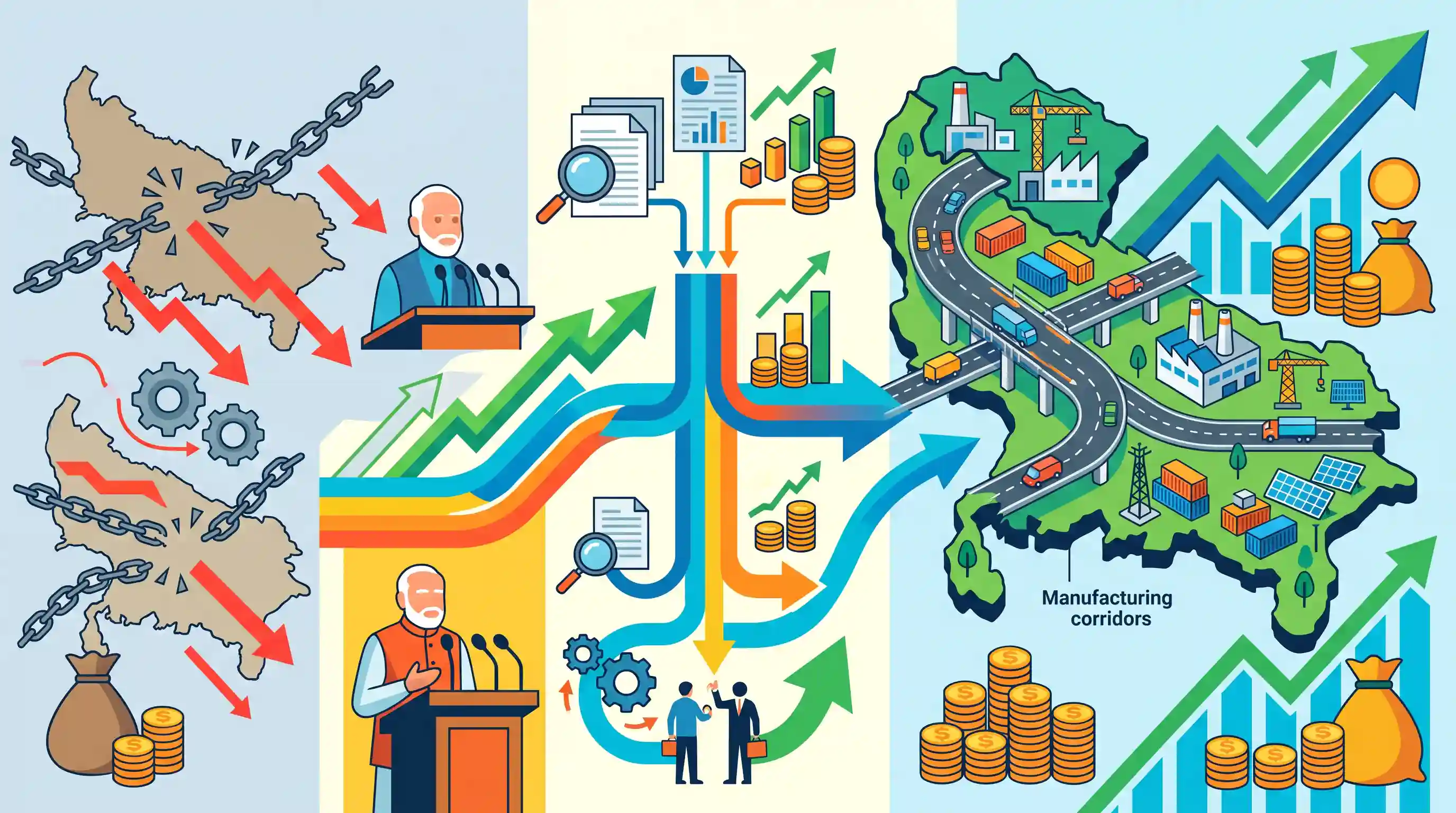
लखनऊ में 'UP Summit 2026 – Unchaiyon Par Uttar Pradesh' में बोलते हुए, मुख्यमंत्री Yogi Adityanath ने 2017 से उत्तर प्रदेश में आए बड़े आर्थिक बदलाव को रेखांकित किया। राज्य का वार्षिक बजट तीन गुना बढ़कर, 2026 में 3 लाख करोड़ रुपये से 9 लाख करोड़ रुपये हो गया। कड़े कर अनुपालन और राजस्व स्रोतों के उपयोग से प्रेरित इस वित्तीय विकास ने एक्सप्रेसवे और औद्योगिक गलियारों सहित मेगा-इन्फ्रास्ट्रक्चर परियोजनाओं को सफलतापूर्वक वित्तपोषित किया है, जो एक कर्ज में डूबे 'BIMARU' राज्य से एक मजबूत आर्थिक प्रदर्शनकर्ता के रूप में एक आदर्श बदलाव का प्रतीक है।
मुख्य बिंदु
- उत्तर प्रदेश के वार्षिक बजट में तीन गुना विस्तार देखा गया है, जो 2017 में 3 लाख करोड़ रुपये से बढ़कर 2026 में 9 लाख करोड़ रुपये हो गया है।
- 2017 में, राज्य को खाली खजाने, कम ऋण पात्रता (creditworthiness) और वित्तीय संस्थानों से प्रतिक्रिया की कमी के कारण अत्यधिक राजकोषीय संकट का सामना करना पड़ा था।
- कर चोरी के खिलाफ सख्त कार्रवाई, राजस्व संग्रह को सुव्यवस्थित करने और ईज ऑफ डूइंग बिजनेस (व्यापार करने की सुगमता) को बढ़ावा देने जैसे सुधारों ने राज्य के राजस्व आधार का काफी विस्तार किया है।
- बढ़े हुए बजटीय संसाधनों से बड़े क्षेत्रीय बुनियादी ढांचा परियोजनाओं को वित्तपोषित किया जा रहा है, जिसमें एक्सप्रेसवे (जैसे गंगा और पूर्वांचल एक्सप्रेसवे), औद्योगिक गलियारे और सार्वजनिक कल्याण योजनाएं शामिल हैं, और इसके लिए उच्च-ब्याज वाले आपातकालीन ओवरड्राफ्ट पर निर्भर नहीं होना पड़ रहा है।
- इस शासन मॉडल ने बेहतर कानून-व्यवस्था और तीव्र आर्थिक विकास के माध्यम से उत्तर प्रदेश की छवि को एक 'BIMARU' राज्य से बदलकर 'उत्सव प्रदेश' (Utsav Pradesh) में परिवर्तित कर दिया है।
महत्वपूर्ण शब्द
बीमारू (BIMARU) राज्य

यह एक संक्षिप्त रूप (acronym) है जो ऐतिहासिक रूप से आर्थिक रूप से पिछड़े राज्यों—बिहार, मध्य प्रदेश, राजस्थान और उत्तर प्रदेश को संदर्भित करता है। इसे वर्ष 1985 में जनसांख्यिकीविद् (demographer) आशीष बोस द्वारा भारत की विकासात्मक और जनसांख्यिकीय चुनौतियों को उजागर करने के लिए गढ़ा गया था।
UPSC context
GS Paper I और II: सामाजिक मुद्दे और शासन। क्षेत्रीय विकासात्मक असमानताओं और जनसांख्यिकी के बारे में जागरूकता का परीक्षण।
एक जिला एक उत्पाद (ODOP) योजना
भारत के प्रत्येक जिले से अद्वितीय स्थानीय हस्तशिल्प, कृषि उत्पाद या पारंपरिक वस्तुओं की पहचान, ब्रांडिंग और विपणन करके संतुलित क्षेत्रीय आर्थिक विकास को बढ़ावा देने के लिए डिज़ाइन की गई एक पहल।
UPSC context
GS Paper II और III: सरकारी नीतियां और अर्थव्यवस्था। यह MSME सशक्तिकरण, ग्रामीण उद्यमिता और निर्यात प्रोत्साहन के ज्ञान का परीक्षण करता है।
सकल राज्य घरेलू उत्पाद (GSDP)
एक निश्चित वित्तीय वर्ष के दौरान किसी राज्य की भौगोलिक सीमाओं के भीतर उत्पादित सभी अंतिम वस्तुओं और सेवाओं का कुल मौद्रिक मूल्य, जो राष्ट्रीय GDP के राज्य-स्तरीय समकक्ष को दर्शाता है।
UPSC context
GS Paper III: भारतीय अर्थव्यवस्था। राज्य के आर्थिक मापन और क्षेत्रीय विकास के संकेतकों की समझ का परीक्षण।
UP Summit 2026 – ऊंचाइयों पर उत्तर प्रदेश
उत्तर प्रदेश के राजकोषीय विस्तार, बुनियादी ढांचे के विकास और एक पिछड़े राज्य से आर्थिक रूप से अग्रणी राज्य बनने की यात्रा पर चर्चा करने और उसे रेखांकित करने के लिए 2026 में लखनऊ में आयोजित होने वाला एक विकासात्मक शिखर सम्मेलन।
UPSC context
GS Paper II और III: राज्य शासन (State Governance) और आर्थिक विकास (Economic Growth)। यह निवेश जुटाने और क्षेत्रीय विकास के प्रतिमानों (paradigms) के ज्ञान का परीक्षण करता है।
प्रारंभिक ट्रैप
GSDP के मामले में UP भारत की दूसरी सबसे बड़ी अर्थव्यवस्था है, और इसका पूर्वांचल एक्सप्रेसवे लखनऊ को सीधे बस्ती और वाराणसी से जोड़ता है।_
यूपी भारत की तीसरी सबसे बड़ी GSDP अर्थव्यवस्था है (महाराष्ट्र और तमिलनाडु के बाद)। पूर्वांचल एक्सप्रेसवे बस्ती और वाराणसी दोनों को छोड़ते हुए, लखनऊ को गाजीपुर से जोड़ता है।
संबंधित अवधारणाएँ
जनसांख्यिकीय शब्द 'BIMARU' की उत्पत्ति और महत्व_
- उत्पत्ति और उद्देश्य: जनसांख्यिकीविद् आशीष बोस द्वारा 1980 के दशक के मध्य में उन राज्यों की पहचान करने के लिए यह शब्द गढ़ा गया था जो राष्ट्रीय जनसांख्यिकीय और परिवार नियोजन लक्ष्यों को पीछे धकेल रहे थे।
- राज्य की संरचना: संयुक्त सामाजिक संकेतकों में पिछड़ेपन के आधार पर बिहार, मध्य प्रदेश, राजस्थान और उत्तर प्रदेश का प्रतिनिधित्व करता है।
- आधुनिक आलोचना: आज इन बड़े राज्यों के भीतर तीव्र GSDP वृद्धि, संरचनात्मक सुधारों और गहरे उप-क्षेत्रीय विकास अंतरों की उपेक्षा करने के लिए आलोचना की जाती है।
राज्य के बजटों में पूंजीगत व्यय (Capex) बनाम राजस्व व्यय
- पूंजीगत व्यय (Capex) की उपयोगिता: परिसंपत्ति निर्माण (जैसे एक्सप्रेसवे और औद्योगिक पार्क) पर खर्च, जो दीर्घकालिक आर्थिक रिटर्न उत्पन्न करता है और भविष्य के राजस्व को कई गुना बढ़ाता है।
- राजस्व व्यय: वेतन, सब्सिडी और ब्याज भुगतान पर होने वाला उपभोग व्यय जो प्रशासन को सुचारू रूप से चलाए रखता है, लेकिन भौतिक संपत्तियों का निर्माण नहीं करता है।
- राजकोषीय बाधाएं: राज्यों को पूंजीगत व्यय (Capex) लक्ष्यों और अनुच्छेद 293(3) तथा क्रमिक वित्त आयोगों द्वारा लगाई गई उधार सीमाओं के बीच संतुलन बनाना चाहिए।
अंतर-विषय पैटर्न
बुनियादी ढांचा गलियारे (इंफ्रास्ट्रक्चर कॉरिडोर्स) और जनसांख्यिकीय बदलाव
गंगा और पूर्वांचल कॉरिडोर जैसे मेगा-एक्सप्रेसवे कैसे विकेंद्रीकृत विकास ध्रुवों (decentralized growth poles) के रूप में कार्य करते हैं, जिससे ग्रामीण-शहरी प्रवास पैटर्न में कमी आती है।
राजकोषीय संघवाद और संसाधन जुटाना
राज्य-स्तरीय कर-से-GSDP (tax-to-GSDP) अनुपात का विश्लेषण और यह कैसे उन्नत घरेलू संग्रहण (domestic mobilization) के माध्यम से लंबवत राजकोषीय असंतुलन (vertical fiscal imbalance) तथा वित्त आयोग के हस्तांतरण (Finance Commission devolutions) पर निर्भरता को कम करता है।

राज्य-स्तरीय Capex multipliers, GSDP dynamics, और कॉरिडोर-आधारित औद्योगिकीकरण के पैटर्न संभावित रूप से एक तुलनात्मक GS-3 थीम के रूप में शामिल होंगे।
संबद्ध PYQ · 3
संबद्ध PYQ · 3
- 2022UPPSC_PRELIMSGS1
With reference to Budget of Uttar Pradesh for the Financial Year 2020 - 21, which of the following statement(s) is/are true ? 1. The size of the budget was Rs. 5,12,860.72 crores. 2. Certain new schemes were also included in this budget amounting to Rs. 10,967.87 crores. Select the correct answer from the code given below.
- 2024UPPSC_PRELIMSGS1
Match List-I with List-II and select the correct answer from the codes given below. List-I (State): (A) Maharashtra (B) Uttar Pradesh (C) Tamil Nadu (D) Karnataka List-II (Rank according to expenditure on infrastructure 2019 - 23): 1. First 2. Second 3. Third 4. Fourth
- 2023UPPSC_PRELIMSGS1
Which of the following Scheme/Programme is not the Central Government Programme and it is Uttar Pradesh Government's Programme?
