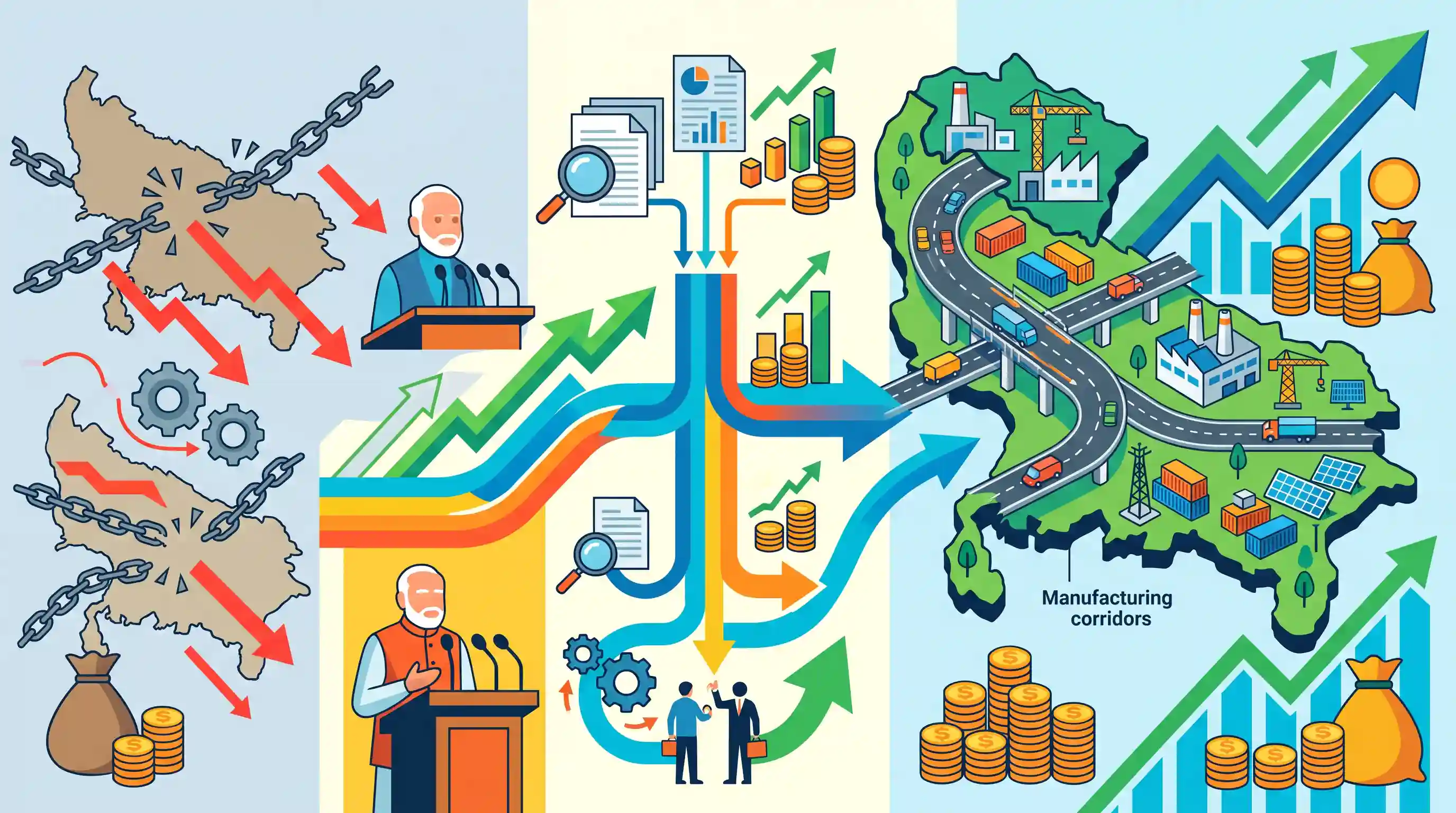
Uttar Pradesh annual budget records threefold expansion since 2017
Source:republicworld ↗
Why It Matters
Understanding Uttar Pradesh's fiscal transformation, budget growth trajectory (from Rs 3 lakh crore in 2017 to Rs 9 lakh crore in 2026), and capital expenditure focus on expressways is highly relevant for UPPSC Prelims questions addressing state-level budget statistics, economic development, and major infrastructure initiatives.
Summary
Speaking at the 'UP Summit 2026 – Unchaiyon Par Uttar Pradesh' in Lucknow, Chief Minister Yogi Adityanath highlighted the massive economic turnaround of Uttar Pradesh since 2017. The state’s annual budget expanded three-fold, growing from Rs 3 lakh crore to Rs 9 lakh crore in 2026. This fiscal growth, driven by rigorous tax compliance and revenue stream mobilization, has successfully funded mega-infrastructure projects, including expressways and industrial corridors, marking a paradigm shift from a debt-ridden 'BIMARU' state to a robust economic performer.
Key Points
- Uttar Pradesh's annual budget has witnessed a three-fold expansion, increasing from Rs 3 lakh crore in 2017 to Rs 9 lakh crore in 2026.
- In 2017, the state faced extreme fiscal distress with an empty treasury, low creditworthiness, and a lack of responsiveness from financial institutions.
- Reforms such as cracking down on tax evasion, streamlining revenue collection, and enhancing ease of doing business have significantly expanded the state's revenue base.
- The increased budgetary resources are funding massive regional infrastructure projects, including expressways (like Ganga and Purvanchal expressways), industrial corridors, and public welfare schemes without relying on high-interest emergency overdrafts.
- The governance model has transitioned Uttar Pradesh's image from a 'BIMARU' state to 'Utsav Pradesh' (State of Celebrations) through improved law and order and rapid economic growth.
Important Terms
BIMARU States

An acronym referring to the historically economically backward states of Bihar, Madhya Pradesh, Rajasthan, and Uttar Pradesh, coined by demographer Ashish Bose in 1985 to highlight India's developmental and demographic challenges.
UPSC context
GS Paper I & II: Social Issues and Governance. Tests awareness of regional developmental disparities and demography.
One District One Product (ODOP) Scheme
An initiative designed to promote balanced regional economic growth by identifying, branding, and marketing unique local handicrafts, agricultural produce, or traditional items from each district across India.
UPSC context
GS Paper II & III: Government Policies and Economy. Tests knowledge of MSME empowerment, rural entrepreneurship, and export promotion.
Gross State Domestic Product (GSDP)
The total monetary value of all finished goods and services produced within a state's geographic boundaries during a given fiscal year, representing the state-level equivalent of national GDP.
UPSC context
GS Paper III: Indian Economy. Tests understanding of state economic measurement and indicators of regional growth.
UP Summit 2026 – Unchaiyon Par Uttar Pradesh
A developmental summit organized in 2026 in Lucknow to discuss and highlight Uttar Pradesh’s fiscal expansion, infrastructure growth, and transition from a lagging state to an economic leader.
UPSC context
GS Paper II & III: State Governance and Economic Growth. Tests knowledge of investment mobilization and regional development paradigms.
Prelims Trap
UP is India's second-largest economy by GSDP, and its Purvanchal Expressway directly connects Lucknow to Basti and Varanasi.
UP is India's third-largest GSDP economy (behind Maharashtra and Tamil Nadu). The Purvanchal Expressway connects Lucknow to Ghazipur, bypassing both Basti and Varanasi.
Static Concepts Connected
Origin and significance of the demographic term 'BIMARU'
- Originator and intent: Coined by demographer Ashish Bose in the mid-1980s to identify states dragging down national demographic and family planning targets.
- State composition: Represents Bihar, Madhya Pradesh, Rajasthan, and Uttar Pradesh based on combined lagging social indicators.
- Modern critique: Criticized today for ignoring rapid GSDP growth, structural reforms, and deep sub-regional development disparities within these large states.
Capital Expenditure (Capex) versus Revenue Expenditure in State Budgets
- Capex utility: Spending on asset creation (like expressways and industrial parks) that generates long-term economic returns and multiplies future revenue.
- Revenue expenditure: Consumptive spending on salaries, subsidies, and interest payments that keeps the administration running but does not create physical assets.
- Fiscal constraints: States must balance Capex targets against borrowing ceilings imposed by Article 293(3) and successive Finance Commissions.
Cross-Topic Patterns
Infrastructure corridors & demographic shifts
How mega-expressways like the Ganga and Purvanchal corridors act as decentralized growth poles, reducing rural-urban migration patterns.
Fiscal federalism & resource mobilization
Analyzing state-level tax-to-GSDP ratios and how enhanced domestic mobilization reduces vertical fiscal imbalance and dependence on Finance Commission devolutions.

State-level Capex multipliers, GSDP dynamics, and corridor-based industrialization patterns will likely feature as a comparative GS-3 theme.
Linked PYQs · 3
Linked PYQs · 3
- 2022UPPSC_PRELIMSGS1
With reference to Budget of Uttar Pradesh for the Financial Year 2020 - 21, which of the following statement(s) is/are true ? 1. The size of the budget was Rs. 5,12,860.72 crores. 2. Certain new schemes were also included in this budget amounting to Rs. 10,967.87 crores. Select the correct answer from the code given below.
- 2024UPPSC_PRELIMSGS1
Match List-I with List-II and select the correct answer from the codes given below. List-I (State): (A) Maharashtra (B) Uttar Pradesh (C) Tamil Nadu (D) Karnataka List-II (Rank according to expenditure on infrastructure 2019 - 23): 1. First 2. Second 3. Third 4. Fourth
- 2023UPPSC_PRELIMSGS1
Which of the following Scheme/Programme is not the Central Government Programme and it is Uttar Pradesh Government's Programme?
