Sustainable Tiger Tourism Practices Highlighted in Bandhavgarh
Source:The Hindu ↗
Why It Matters
Bandhavgarh is one of Madhya Pradesh's most famous tiger reserves. Understanding tiger tourism, forest ecosystems, and wildlife management is directly relevant to MPPSC Prelims questions concerning MP geography and environmental conservation.
Summary
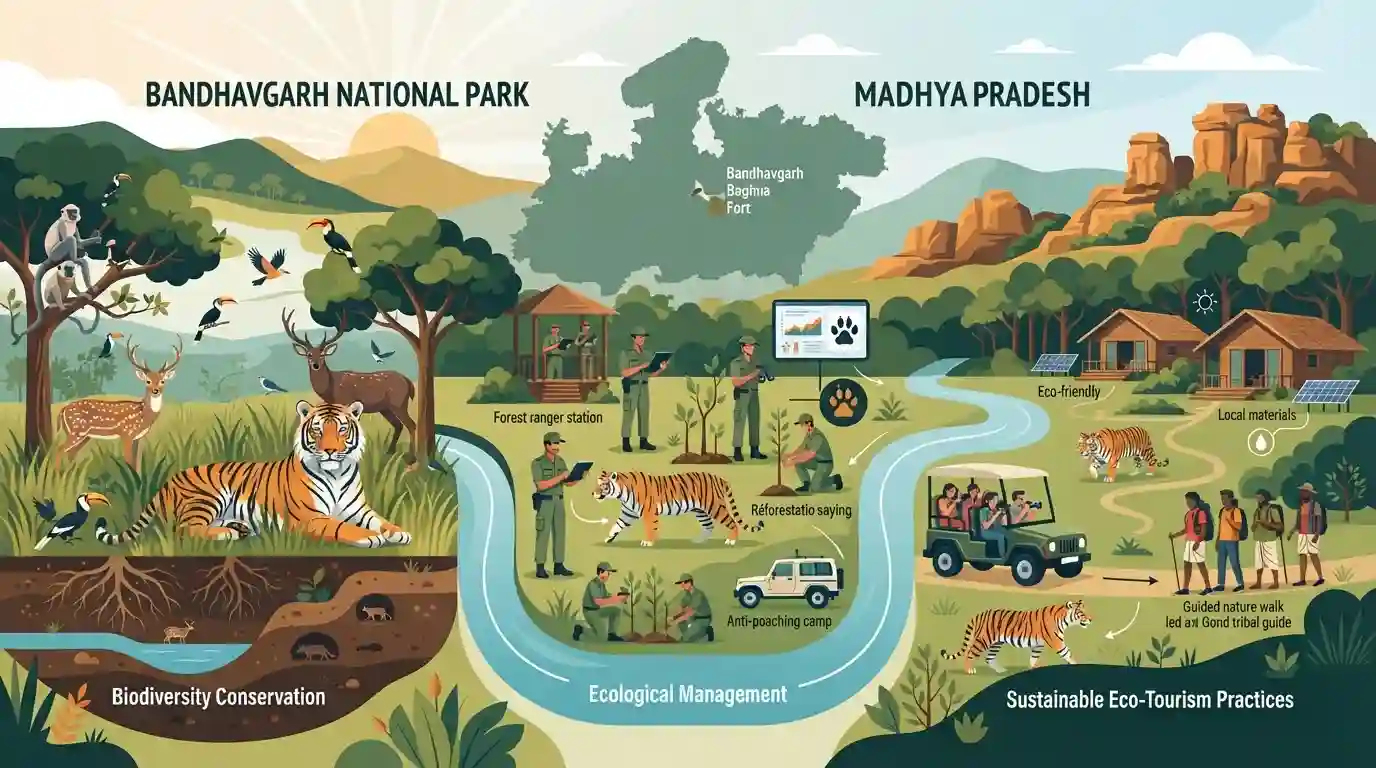
An in-depth look at Bandhavgarh National Park's evolving tiger tourism landscape, focusing on biodiversity conservation, ecological management, and sustainable eco-tourism practices in Madhya Pradesh.
Key Points
- Bandhavgarh National Park in Madhya Pradesh is witnessing a significant evolution in tiger tourism, balancing wildlife conservation and visitor management.
- The article explores the intricacies of forest management, local communities, and ecological sustainability in one of India's premier tiger reserves.
- Tiger tourism dynamics require careful regulatory frameworks to protect biodiversity while ensuring sustainable eco-tourism livelihoods.
Important Terms
Bandhavgarh National Park

A prominent tiger reserve located in Madhya Pradesh's Umaria district, known for its high tiger density, rich biodiversity, and historical significance including the ancient Bandhavgarh Fort.
UPSC context
Important for MPPSC Prelims (Geography of MP, National Parks) and Mains (Environment and Wildlife Conservation).
Project Tiger
A Government of India flagship conservation program launched on April 1, 1973, to protect endangered Royal Bengal Tigers and their natural habitats.
UPSC context
Important for MPPSC Prelims (Tiger Reserves in MP) and Mains Paper III (Biodiversity and Environmental Protection).
Prelims Trap
Bandhavgarh National Park is exclusively located within the Umaria district of Madhya Pradesh.
Aspirants often assume Bandhavgarh is solely in Umaria district, missing that its extended areas and buffer zones touch Katni and Shahdol districts.
Static Concepts Connected
What are the core and buffer zones of Tiger Reserves in Madhya Pradesh under Project Tiger?
- Core Zone: Core Zone is strictly kept for inviolate wildlife conservation with zero human interference and commercial tourism allowed only in regulated parts.
- Buffer Zone: Buffer Zone acts as a shock absorber around the core, permitting controlled sustainable resource use and eco-tourism livelihoods for local communities.
- Project Tiger: Project Tiger was launched in 1973 by the Government of India to ensure a viable population of the Bengal tiger.
Cross-Topic Patterns
Tiger Tourism vs. Eco-Sensitive Zone Governance
Balancing heavy tourist footfall with fragile tiger habitats in MP parks mirrors the wider policy tension between industrial land use and eco-sensitive zones in Western Ghats and central Indian forests.
Community Livelihoods and Buffer Zone Management
Integrating local communities in buffer zones for sustainable livelihoods directly links forest conservation strategies with the Ministry of Environment's rural welfare and Van Dhan schemes.

Bandhavgarh's core zones (Tala, Magadhi, Khitauli) and buffer zones will feature in a matching or map-based MPPSC geography question.
Linked PYQs · 3
Linked PYQs · 3
- 2023MPPSC_PRELIMSGS1
Which type of forests are not found in Madhya Pradesh ?
- 2016MPPSC_PRELIMSGS1
'Dhupgarh' the highest peak of Madhya Pradesh, is located in
- 2018MPPSC_PRELIMSGS1
Dhoogparh, the highest peak of Madhya Pradesh, is located at
