Youth Innovation and Traditional Methods Vital for Climate Action
Source:The Hindu ↗
Why It Matters
The article provides a multi-stakeholder framework (Youth, Industry, Academia, Traditional Knowledge) for sustainable development. Concrete case studies, such as the Arvari river revival by Rajendra Singh, offer excellent empirical fodder for Mains answers in GS1 (Water Resources) and GS3 (Environment/Conservation).
Summary
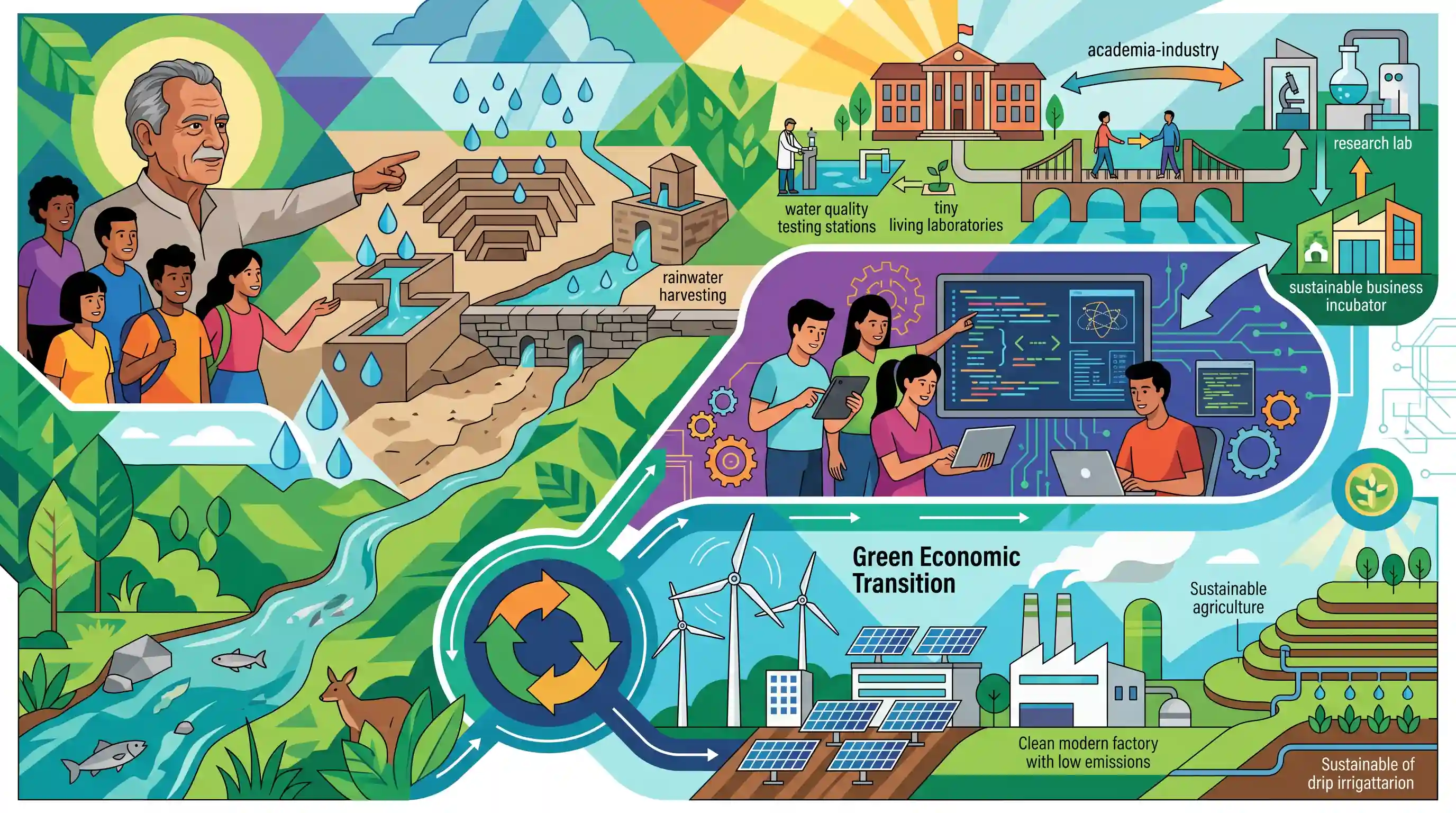
A recent 'youth sustainability' conference in Jaipur underscored the pivotal role of young people in combating climate change through innovation, digital fluency, and the integration of indigenous knowledge. Rajendra Singh, the 'Waterman of India', highlighted the effectiveness of traditional water harvesting systems by citing the successful revival of the Arvari river in Alwar. Speakers also emphasized the critical need for a green economic transition encompassing circular economy practices, renewable energy, and sustainable agriculture. Furthermore, stronger academia-industry synergy was advocated to transform educational institutions into "living laboratories" for localized environmental action.
Key Points
- Youth Empowerment: The digital fluency and creativity of young people are essential drivers for the transition towards a green and environmentally sustainable economy.
- Traditional Conservation Methods: Integrating indigenous knowledge with modern innovation can successfully tackle ecological crises, as demonstrated by the revival of the Arvari river in Alwar.
- Green Economic Transition: Industries are encouraged to adopt eco-friendly innovations, including renewable energy, sustainable agriculture, and circular economy practices.
- Academia-Industry Collaboration: Educational institutions should act as "living laboratories" by synergizing with industries for curriculum co-creation and localized climate action.
Important Terms
Tarun Bharat Sangh (TBS)

A Rajasthan-based NGO led by Rajendra Singh that rejuvenates rivers and aquifers using traditional water-harvesting structures like 'johads' through community participation.
UPSC context
GS Paper III (Environment/Water): Tests knowledge of community-led conservation and traditional ecological knowledge in climate adaptation.
Haridev Joshi University of Journalism (HJU)
A Jaipur-based state university specialized in media education, focusing on development communication, ethical journalism, and the role of media in climate action.
UPSC context
GS Paper II (Education): Highlights the role of specialized academic institutions in fostering 'climate literacy' and social advocacy.
Rajasthan Chamber of Commerce and Industry (RCCI)
The apex industry body in Rajasthan that facilitates policy dialogue and supports MSMEs in adopting sustainable business practices and green energy transitions.
UPSC context
GS Paper III (Economy): Relevant for industry-academia synergy and the private sector's role in sustainable economic growth.
Lok Samvad Sansthan (LSS)
A Jaipur-based NGO focused on development communication and advocacy, collaborating with international agencies to mobilize youth for social and environmental sustainability.
UPSC context
GS Paper II (NGOs): Illustrates how civil society organizations bridge the gap between policy objectives and grassroots youth engagement.
Sustainability Karma
A digital media platform and podcast series (broadcast on All India Radio) that discusses ESG, SDGs, and climate innovation with global thought leaders.
UPSC context
GS Paper III (Environment): Shows the role of digital FLUENCY and specialized media in promoting 'Mission LiFE' and environmental awareness.
Prelims Trap
The 'Arvari Pani Sansad' is a statutory water governance body established under the Water Act.
It is an informal, community-led decentralized water parliament formed by local villagers in Rajasthan. It has no statutory or legal backing from the state or Parliament.
Static Concepts Connected
What are key examples of traditional water harvesting systems in India?
- Johads: Small, earthen check dams built to capture and conserve rainwater, significantly improving groundwater recharge. Highly successful in arid regions like Rajasthan.
- Zabo system: An indigenous, integrated system in Nagaland combining forestry, agriculture, and animal husbandry with downhill water harvesting.
- Eris (Tanks): Ancient networks of cascading irrigation tanks in Tamil Nadu designed by communities to control floods, prevent soil erosion, and store runoff.
What are the three foundational principles of a Circular Economy?
- Design out waste: Preventing waste and pollution from being created in the first place by fundamentally rethinking product design and manufacturing processes.
- Keep in use: Extending the lifespan of products and materials through robust repair, reuse, remanufacturing, and recycling loops.
- Regenerate natural systems: Enhancing and revitalizing natural ecosystems rather than merely extracting from them, including transitioning to renewable energy inputs.
Cross-Topic Patterns
Decentralized resource governance + FRA 2006
The community-led success of the informal Arvari Pani Sansad parallels the decentralized governance ethos seen in the Forest Rights Act (FRA 2006) through Community Forest Resource (CFR) rights.
Indigenous Knowledge + UNFCCC platforms
Linking traditional practices like 'Johads' with modern climate adaptation echoes the objectives of the UNFCCC's Local Communities and Indigenous Peoples Platform (LCIPP), a frequent UPSC focus.

Expect a match-the-following Prelims question pairing traditional water harvesting structures (Johads, Zabo, Eris) with their respective states.
Linked PYQs · 4
Linked PYQs · 4
- 2018MainsGS1
The ideal solution of depleting ground water resources in India is water harvesting system." How can it be made effective in urban areas?
- 2023MainsGS1
Why is the world today confronted with a crisis of availability of and access to freshwater resources?
- 2022MainsGS3
Do you think India will meet 50 percent of its energy needs from renewable energy by 2030 ? Justify your answer. How will the shift of subsidies from fossil fuels to renewables help achieve the above objective ? Explain.
- 2019MainsGS3
Define the concept of carrying capacity of an ecosystem as relevant to an environment. Explain how understanding this concept is vital while planning for sustainable development of a region.
