Deep Tech Innovations for Strategic Sectors
Source:The Hindu ↗
Why It Matters
Provides concrete, contemporary examples of how deep tech startups are solving structural Indian issues (e.g., agricultural credit verification via satellites, thermal management in EV charging, defense indigenization). These examples are highly useful for GS-3 answers related to science and technology applications, agricultural e-technology, and infrastructure development.
Summary
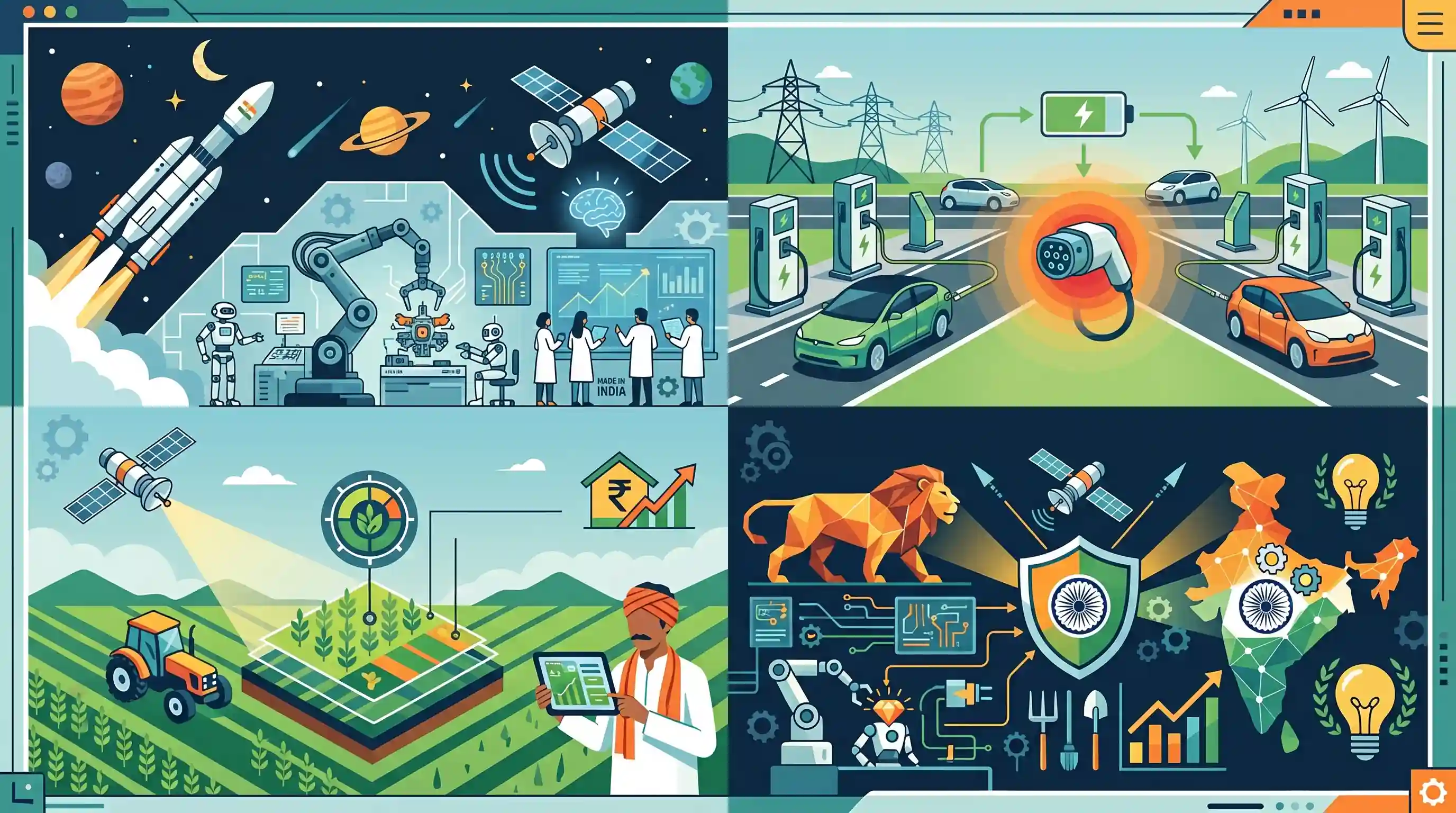
The Deep Tech Summit 2026 highlighted India's growing ecosystem of deep tech startups developing indigenous solutions for critical sectors. Key innovations showcased included satellite-based remote sensing tools to verify agricultural credit (addressing risks in the ₹25 lakh crore crop credit sector), advanced materials and robotics to reduce defense imports, and highly efficient electric vehicle (EV) charging connectors that minimize thermal buildup. The summit demonstrated how home-grown technological interventions in space, agriculture, and mobility can drive self-reliance and solve complex structural challenges in the Indian economy.
Key Points
- The Deep Tech Summit 2026 served as a platform for emerging startups to showcase innovations across agriculture, defense, electric mobility, and robotics.
- Valyria Visions presented 'Phenolens', a satellite intelligence platform that verifies land boundaries and crop existence to secure India's ₹25 lakh crore crop credit system against defaults and fraud.
- Propel Tech Innovations focused on indigenous advancements in material science, aerospace, and robotics to help reduce India's dependence on foreign defense technology imports.
- Tamirabot showcased next-generation EV charging connectors utilizing patented technology to reduce thermal rate buildup, thereby increasing fast-charging efficiency by 7.8%.
- Student innovators from SRMIST showcased deep tech capabilities in space exploration by presenting Mars rover prototypes built for international competitions.
Important Terms
Valyria Visions Private Limited

An agri-fintech startup using its 'Phenolens' platform for satellite-based remote sensing. It provides banks with data-driven crop verification and risk scoring, digitizing the monitoring of India’s ₹25 lakh crore agricultural credit sector.
UPSC context
GS Paper III: E-technology in aid of farmers; tests knowledge of digital interventions to solve structural challenges in agricultural financing.
Propel Tech Innovations
An indigenous deep tech startup specializing in defense indigenization. It leverages material science, aerospace engineering, and robotics to manufacture high-precision components locally, aiming to reduce India's strategic reliance on foreign defense imports.
UPSC context
GS Paper III: Indigenization of technology; critical for discussing 'Atmanirbhar Bharat' and strategic autonomy in the domestic defense manufacturing ecosystem.
Tamirabot
A homegrown manufacturer of next-generation electric vehicle (EV) charging connectors. Its patented thermal distribution technology minimizes heat buildup during fast charging, improving energy efficiency by 7.8% and significantly extending the lifespan of connectors.
UPSC context
GS Paper III: Infrastructure and Energy; relevant for India’s green energy transition and solving technical bottlenecks in electric vehicle adoption.
SRMIST (Team Rudra)
A student robotics team from SRM Institute of Science and Technology that develops Mars rover prototypes. Their work demonstrates indigenous capabilities in autonomous navigation and scientific instrumentation for planetary exploration.
UPSC context
GS Paper III: Awareness in the fields of Space and Robotics; highlights the role of academic R&D in fostering frontier technology talent.
Prelims Trap
"Deep tech ventures are defined strictly as startups utilizing artificial intelligence and machine learning software."
Deep tech involves fundamental scientific/engineering breakthroughs (like advanced materials, quantum, or robotics) with high IP creation and long gestation, not just AI software.
Static Concepts Connected
How is Satellite Remote Sensing applied in Indian agriculture?
- Acreage & Production: Estimating crop area and yield before harvest under the FASAL project.
- Credit & Insurance: Verifying land boundaries and crop health to settle PMFBY claims and prevent Kisan Credit Card (KCC) loan frauds.
- Drought Assessment: Monitoring drought conditions and soil moisture at the national level via NADAMS.
What are the defining traits of a Deep Tech startup?
- Scientific R&D: Built on fundamental scientific discoveries or engineering innovations rather than mere business model disruptions (e.g., e-commerce).
- Long Gestation: Requires significant time and intensive capital for lab-to-market commercialization due to high technical uncertainty.
- IP Creation: Focuses heavily on generating and protecting novel intellectual property (IP) and patents.
Cross-Topic Patterns
Space tech for rural NPA management
Applying satellite intelligence for crop credit verification links space technology directly with RBI's Priority Sector Lending targets and rural NPA reduction.
EV charging efficiency & critical minerals
Innovations reducing thermal buildup in EV connectors lower energy loss, indirectly maximizing battery life and addressing India's critical mineral (Lithium/Cobalt) import vulnerabilities.

Expect a multi-statement Prelims question comparing 'Deep Tech' traits (IP-driven, high gestation) with standard IT/software startups.
Linked PYQs · 3
Linked PYQs · 3
- 2023MainsGS3
How does e-Technology help farmers in production and marketing of agricultural produce? Explain it.
- 2023MainsGS3
The adoption of electric vehicles is rapidly growing worldwide. How do electric vehicles contribute to reducing carbon emissions and what are the key benefits they offer compared to traditional combustion engine vehicles?
- 2021MainsGS3
What are the present challenges before crop diversification? How do emerging technologies provide an opportunity for crop diversification?
