Deep Tech Innovation Ecosystem and Techno Nationalism Challenges
Source:The Hindu ↗
Why It Matters
The article connects cutting-edge technology policies (techno-nationalism) with domestic economic reform and urban governance. It provides a comprehensive framework for GS-3 answers on deep tech, demonstrating that technological advancement is inseparable from ease of doing business and urban quality of life.
Summary
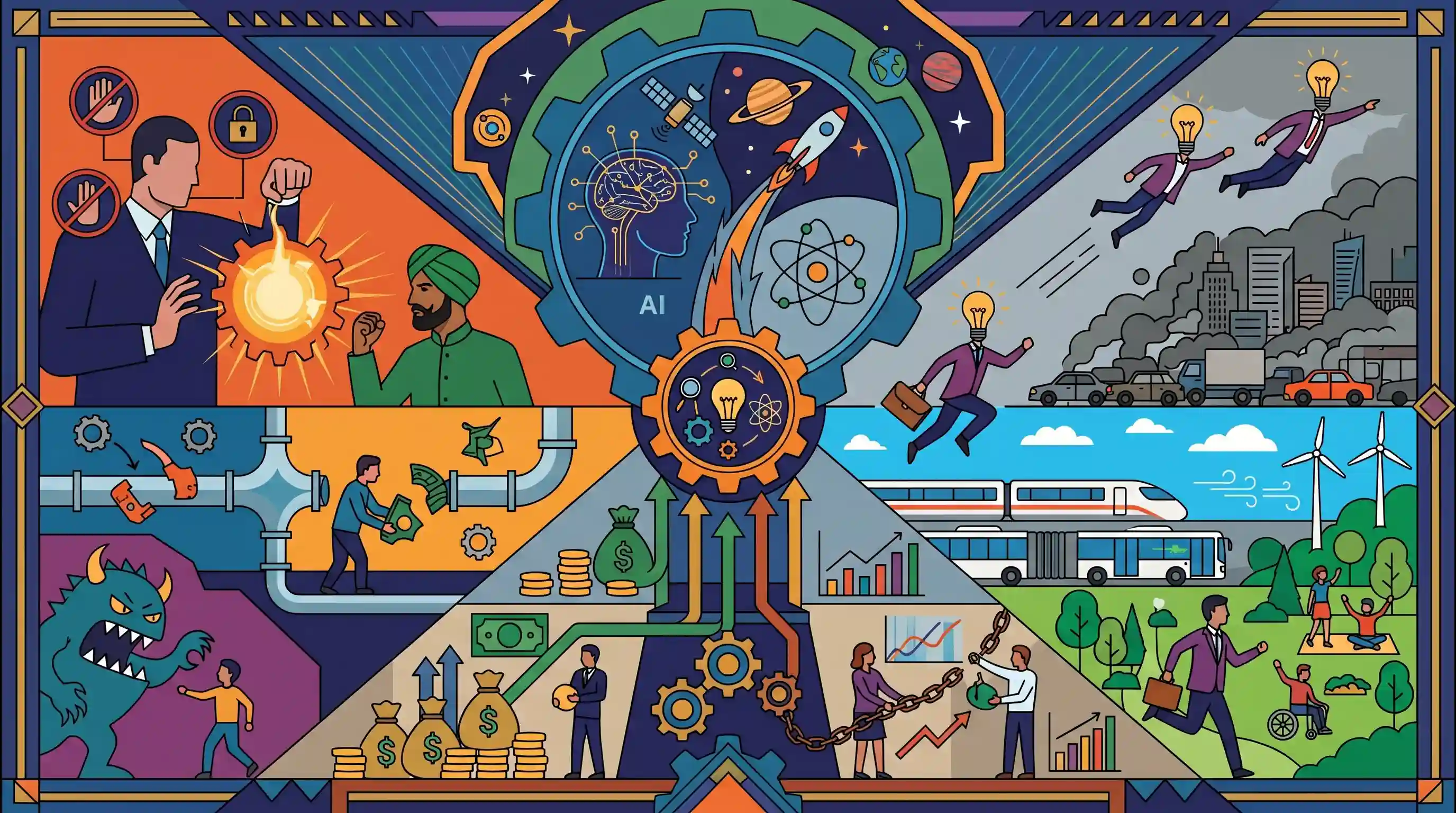
The editorial emphasizes the critical need for India to cultivate a robust and self-sustaining innovation ecosystem, particularly in deep tech sectors like AI, space, and defense, amidst rising global techno-nationalism. Highlighting instances such as Anthropic limiting its latest AI access to Americans, the article argues that India must 'innovate or be eaten.' While diplomatic efforts like 'Bharat Innovates 2026' in France showcase India's startup potential, domestic structural reforms are imperative. The piece outlines that attracting and retaining venture capital requires stable tax policies and the elimination of bureaucratic rent-seeking. Furthermore, reversing the brain drain requires elevating urban living standards by investing heavily in public goods—such as clean air, efficient public transport, and green spaces—to retain top-tier talent.
Key Points
- Techno-nationalism is rising, as seen with Anthropic restricting its newest AI model exclusively to US citizens, underscoring the urgency for India to build indigenous tech capabilities.
- India's potential as a global startup hub was highlighted at the 'Bharat Innovates 2026' event in France, indicating opportunities for tech diplomacy and collaboration with 'middle powers'.
- To nurture deep tech innovations in fields like AI, space, and defense, India must become a highly attractive destination for both capital and talent.
- Capital retention requires addressing unpredictable tax policies, minimizing bureaucratic friction, and curbing rent-seeking behaviors that drive investors away.
- Talent retention and reversing the brain drain depend fundamentally on urban quality of life, necessitating investments in public goods such as clean air, green spaces, and reliable public transport.
Important Terms
Techno-nationalism

The strategic linking of a nation's technological capabilities to its national security, identity, and sovereignty, often involving state-led restrictions on foreign technology or promotion of domestic self-sufficiency.
UPSC context
GS-2 (International Relations) and GS-3 (Science & Technology); tests understanding of geoeconomics and technology as an instrument of statecraft.
Deep Tech
Startups or ventures founded on significant scientific discoveries or tangible engineering breakthroughs (e.g., AI, quantum computing, space tech), typically characterized by high R&D costs and long gestation periods.
UPSC context
GS-3 (Economy/S&T); relates to indigenization of technology and the National Deep Tech Startup Policy.
Bharat Innovates 2026
A major India-France technology summit held in Nice (June 2026) to showcase over 120 Indian deep-tech startups and foster innovation-led partnerships with global investors and research institutions.
UPSC context
GS-2 (Bilateral Relations); specifically India-France relations and the 'Year of Innovation' initiatives.
Anthropic
A prominent US-based AI safety and research company (maker of Claude); its 2026 compliance with US export controls that restricted foreign access to frontier models highlighted global technology dependency risks.
UPSC context
GS-3 (Science & Technology); case study for AI ethics, export controls, and the need for 'Sovereign AI' in India.
Rent-seeking
The practice of obtaining economic gain by manipulating the political or legal environment—such as through lobbying, subsidies, or bureaucratic hurdles—without creating any new wealth or increasing productivity.
UPSC context
GS-3 (Indian Economy); tests knowledge of structural barriers to growth, Ease of Doing Business, and administrative reforms.
Public Goods
Commodities or services (e.g., clean air, public transport, lighthouses) that are non-excludable and non-rivalrous, typically provided by the state to improve societal welfare and urban living standards.
UPSC context
GS-1 (Urbanization) and GS-3 (Infrastructure/Economy); concerns the state's role in providing quality of life to retain human capital.
Prelims Trap
Techno-nationalism is primarily enforced through traditional trade tariffs and import quotas on electronic goods.
Modern techno-nationalism relies heavily on export controls for critical tech, data localization laws, and restricting access to advanced AI/software based on citizenship, not just physical goods.
Static Concepts Connected
What are 'Deep Tech' startups and how do they differ from traditional IT startups?
- High R&D Focus: Based on tangible engineering innovation, fundamental scientific advances, or complex IP, rather than simple business model innovation.
- Long Gestation: Requires significantly longer timeframes to develop market-ready products compared to typical consumer apps or SaaS companies.
- Patient Capital Needs: Demands substantial, patient venture capital due to high technological risk (e.g., space tech, quantum computing, AI hardware).
What are the structural push factors driving high-net-worth and intellectual capital out of India?
- Tax Unpredictability: Unpredictable tax demands (like the historical Angel Tax) and sudden shifts in regulatory policies deter long-term investors.
- Bureaucratic Friction: Compliance burdens and rent-seeking behaviors increase the operational cost for emerging tech startups.
- Quality of Life: Poor urban livability, pollution, and lack of premium public goods drive founders to 'flip' their headquarters abroad.
Cross-Topic Patterns
Urban Infrastructure as an R&D Catalyst
GS1 Urbanization connects directly to GS3 S&T. Retaining high-value STEM talent relies as much on civic public goods—like clean air and mass transit—as on corporate salaries and R&D funding.
Tech Diplomacy and Middle Powers
Collaborating with middle powers like France on startup initiatives helps India hedge against US-China tech bipolarity, secure patient capital, and assert strategic autonomy in deep tech.

Expect a GS3 Mains question linking India's urban infrastructure deficits (pollution, transit) directly to the 'brain drain' of STEM talent.
Linked PYQs · 5
Linked PYQs · 5
- 2023MainsGS3
Introduce the concept of Artificial Intelligence (AI). How does Al help clinical diagnosis? Do you perceive any threat to privacy of the individual in the use of Al in healthcare?
- 2015MainsGS3
What are the areas of prohibitive labour that can be sustainably managed by robots ? Discuss the initiatives that can propel research in premier research institutes for substantive and gainful innovation.
- 2015MainsGS2
The quality of higher education in India requires major improvements to make it internationally competitive. Do you think that the entry of foreign educational institutions would help improve the quality of higher and technical education in the country? Discuss.
- 2016MainsGS1
With a brief background of quality of urban life in India, introduce the objectives and strategy of the 'Smart City Programme'.
- 2019MainsGS1
How is efficient and affordable urban mass transport key to the rapid economic development of India?
