Constitutional Mandates and Lok Sabha Deputy Speaker
Source:The Hindu ↗
Why It Matters
The issue of the Deputy Speaker's election is crucial for UPSC aspirants as it touches upon Constitutional mandates (Article 93) versus political reality. It raises questions about the enforceability of constitutional phrases like 'as soon as may be', the importance of unwritten parliamentary conventions (giving the post to the Opposition), and the overall democratic functioning and balance of power within the legislature.
Summary
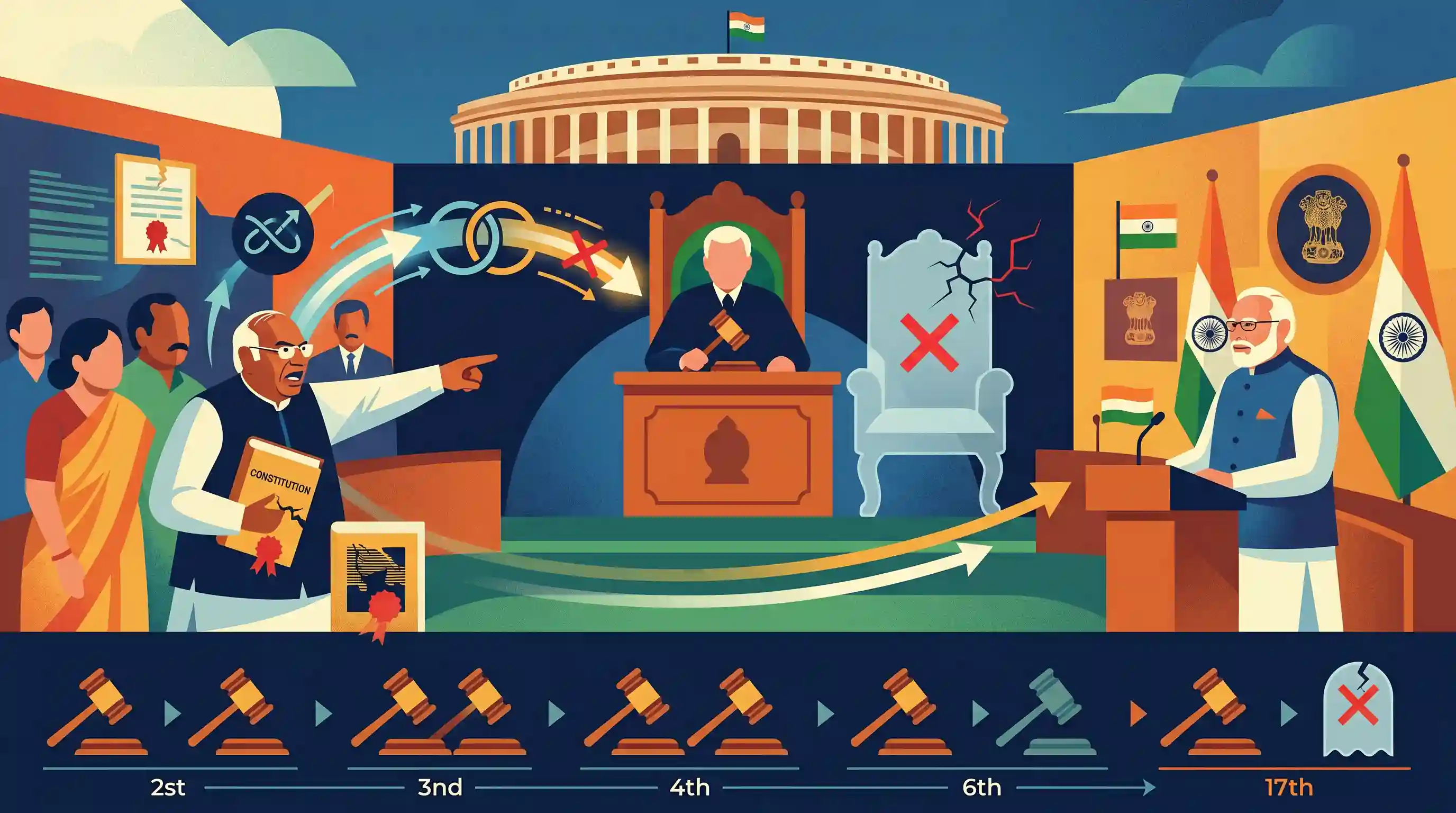
Congress President Mallikarjun Kharge has officially urged Prime Minister Narendra Modi to initiate the process of electing the Deputy Speaker of the Lok Sabha. Citing Article 93 of the Constitution, Kharge argued that keeping the second-highest presiding officer's post vacant is a constitutional violation. He also highlighted the parliamentary convention of allocating the Deputy Speaker position to the principal Opposition party. The demand comes in the wake of the 17th Lok Sabha concluding its full term without electing a Deputy Speaker, an unprecedented occurrence in Indian parliamentary history.
Key Points
- Congress President Mallikarjun Kharge wrote to PM Modi urging the initiation of the Deputy Speaker's election in the Lok Sabha.
- Article 93 of the Constitution mandates the election of both a Speaker and a Deputy Speaker 'as soon as may be', making prolonged vacancy a constitutional violation.
- A strong parliamentary convention dictates that the Deputy Speaker post is given to the principal Opposition party, a practice followed since the 11th Lok Sabha (1996).
- The 17th Lok Sabha operated without a Deputy Speaker for its entire term, an unprecedented gap that the Opposition seeks to prevent in the 18th Lok Sabha.
- While Congress has not officially finalized a name, MP Kodikunnil Suresh is considered a front-runner for the position.
Important Terms
Article 93 of the Constitution of India

Constitutional provision mandating the Lok Sabha to choose two members as Speaker and Deputy Speaker "as soon as may be" after the House is constituted or a vacancy occurs.
UPSC context
GS Paper II: Indian Polity (Parliament). Tests understanding of mandatory constitutional duties vs. discretionary executive delays in presiding officer appointments.
Deputy Speaker of the Lok Sabha
The second-highest presiding officer of the Lok Sabha, holding an independent constitutional post. They assume the Speaker's powers when the office is vacant or during the Speaker's absence.
UPSC context
GS Paper II: Parliament and State Legislatures. Focuses on the role, powers, and significance of the office in maintaining legislative continuity.
Parliamentary Convention (Deputy Speaker)
An unwritten but established parliamentary practice since the 11th Lok Sabha where the Speaker is chosen from the ruling party and the Deputy Speaker from the principal Opposition.
UPSC context
GS Paper II: Indian Constitution—Historical Underpinnings and Evolution. Examines how informal norms supplement formal constitutional provisions to ensure democratic balance.
Rule 8 of Lok Sabha Rules
The formal requirement that the date for electing a Deputy Speaker is fixed by the Speaker of the Lok Sabha, moved via a motion.
UPSC context
GS Paper II: Parliament. Tests procedural knowledge of how constitutional mandates (Article 93) are operationalized through House rules.
Principal Opposition Party
The largest party in the Lok Sabha not in the government. By convention, this party is typically offered the post of Deputy Speaker to ensure power-sharing.
UPSC context
GS Paper II: Parliament. Relates to the role of the Opposition in a parliamentary democracy and the institutionalization of their influence.
Prelims Trap
The President fixes the election date for the Deputy Speaker, who must constitutionally belong to the principal Opposition party.
Two errors: The Speaker (not President) fixes the Deputy Speaker's election date. Second, allocating the post to the Opposition is a parliamentary convention, not a constitutional mandate.
Static Concepts Connected
What are the unique powers and constitutional position of the Deputy Speaker?
- Independent authority: The Deputy Speaker is not subordinate to the Speaker. They are directly responsible to the House and have the exact same powers when presiding.
- Committee privilege: If the Deputy Speaker is appointed as a member of any parliamentary committee, they automatically become its chairman by default.
- Election date: Under the Rules of Procedure, the date of election of the Deputy Speaker is fixed by the Speaker, whereas the President fixes the Speaker's election date.
Cross-Topic Patterns
Conventions vs. Constitutional Provisions
UPSC frequently tests the blurred lines between unwritten parliamentary conventions (Deputy Speaker given to Opposition) and explicit constitutional mandates (Article 93 directing election "as soon as may be").
LoP vs. Deputy Speaker status
Comparing the statutory recognition of the Leader of Opposition (LoP Act, 1977) against the constitutional origin (Article 93) but convention-driven political appointment of the Deputy Speaker.

Expect a 2026 prelims question mixing Article 93, the Speaker's role in fixing the election date, and the 'Opposition' convention.
Linked PYQs · 5
Linked PYQs · 5
- 2022PrelimsGS1
With reference to Deputy Speaker of Lok Sabha, consider the following statements: 1. As per the Rules of Procedure and Conduct of Business in Lok Sabha, the election of Deputy Speaker shall be held on such date as the Speaker may fix. 2. There is a mandatory provision that the election of a candidate as Deputy Speaker of Lok Sabha shall be from either the principal opposition party or the ruling party. 3. The Deputy Speaker has the same power as of the Speaker when presiding over the sitting of the House and no appeal lies against his rulings. 4. The well established parliamentary practice regarding the appointment of Deputy Speaker is that the motion is moved by the Speaker and duly seconded by the Prime Minister. Which of the statements given above are correct?
- 2017PrelimsGS1
Consider the following statements: 1. In the election for Lok Sabha or State Assembly, the winning candidate must get at least 50 percent of the votes polled, to be declared elected. 2. According to the provisions laid down in the Constitution of India, in Lok Sabha, the Speaker's post goes to the majority. party and the Deputy Speaker's to the Opposition. Which of the statements given above is/are correct?
- 2024PrelimsGS1
With reference to the Speaker of the Lok Sabha, consider the following statements : While any resolution for the removal of the Speaker of the Lok Sabha is under consideration 1. He/She shall not preside. 2. He/She shall not have the right to speak. 3. He/She shall not be entitled to vote on the resolution in the first instance. Which of the statements given above is/are correct?
- 2023MainsGS2
Discuss the role of Presiding Officers of state legislatures in maintaining order and impartiality in conducting legislative work and in facilitating best democratic practices.
- 2020MainsGS2
Once a Speaker, Always a Speaker' ! Do you think this practice should be adopted to impart objectivity to the office of the Speaker of Lok Sabha ? What could be its implications for the robust functioning of parliamentary business in India?
