MoSPI Infrastructure Project Cost Overrun and Execution Bottlenecks
Source:The Hindu ↗
हे का महत्त्वाचे आहे
Infrastructure development is crucial for rapid and inclusive economic growth, but persistent cost and time overruns limit fiscal space and reduce the viability of PPP models. MoSPI's data is vital evidence for GS-3 answers discussing infrastructure bottlenecks, governance efficiency, and project execution strategies.
सारांश
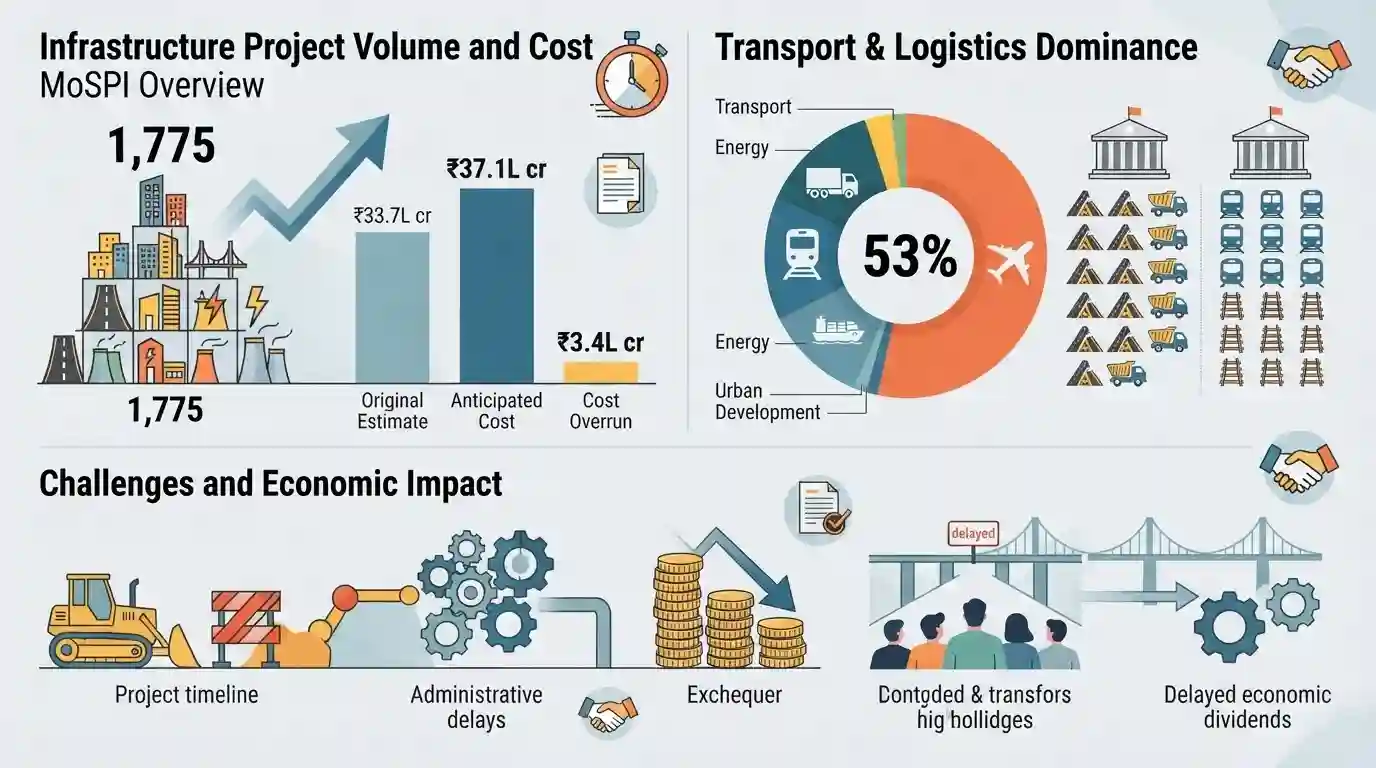
The Ministry of Statistics and Programme Implementation (MoSPI) has highlighted a massive cost overrun of ₹3.4 lakh crore across 1,775 ongoing infrastructure projects. The total anticipated cost of these projects has jumped from ₹33.7 lakh crore to ₹37.1 lakh crore. The Transport and Logistics sector dominates these infrastructure efforts, accounting for 53% of the total cost share, with the Ministry of Road Transport and Highways and the Ministry of Railways leading in the number of projects. This data underscores persistent bottlenecks and inefficiencies in project execution, which pose a heavy burden on the exchequer and delay expected economic dividends.
मुख्य मुद्दे
- MoSPI reports a cost overrun of ₹3.4 lakh crore across 1,775 ongoing central infrastructure projects.
- The original estimated cost of ₹33.7 lakh crore has escalated to an anticipated cost of ₹37.1 lakh crore.
- Actual expenditure incurred so far is ₹19.26 lakh crore, or 51.91% of the revised cost.
- The Transport & Logistics sector accounts for 53% of the total project costs, followed by Energy at 29%.
- The Ministry of Road Transport and Highways has the highest number of projects (993), followed by Railways (190) and Coal (121).
महत्त्वाच्या संज्ञा
Ministry of Statistics and Programme Implementation (MoSPI)

The nodal central ministry that monitors central-sector infrastructure projects costing over ₹150 crore. Utilizing the PAIMANA digital portal, it tracks physical and financial progress, helping identify time and cost overruns across various government bodies.
UPSC context
GS Paper 2 & 3 (Governance & Infrastructure). Vital for questions on infrastructure bottlenecks, project monitoring, and fiscal governance.
Ministry of Road Transport and Highways
The central government body responsible for India's national highways. It currently executes the vast majority of central infrastructure projects, playing a central role in expanding transport logistics but also facing significant project cost overruns.
UPSC context
GS Paper 3 (Infrastructure - Roads). Important for topics on PM Gati Shakti, asset monetization, and logistics cost reduction.
Ministry of Railways
The Union ministry managing the national railway network. It is responsible for the second-largest share of monitored infrastructure projects, managing significant capital expenditure but frequently encountering implementation delays that inflate national project budgets.
UPSC context
GS Paper 3 (Infrastructure - Railways). Tests knowledge on dedicated freight corridors, the National Rail Plan, and infrastructure financing.
Ministry of Coal
The central authority overseeing coal reserves, exploration, and production. It handles numerous large-scale infrastructure projects that are closely monitored for delays, as their timely completion is fundamental to securing India's domestic energy supply.
UPSC context
GS Paper 1 & 3 (Resources & Energy). Essential for topics spanning India's energy security, power sector stability, and the transition toward renewables.
पूर्वपरीक्षा सापळा
MoSPI tracks and monitors all public-private partnership (PPP) and state-level infrastructure projects costing ₹100 crore or more.
IPMD/MoSPI's mandate is restricted to central sector projects costing ₹150 crore or more, not state-level or general private projects.
संबंधित स्थिर संकल्पना
What are India's institutional mechanisms for monitoring large-scale infrastructure projects?
- PMG (DPIIT): Resolves regulatory bottlenecks for public, private, and PPP projects worth ₹500 crore and above.
- PRAGATI Platform: Interactive, three-tier platform (PMO, Union Secretaries, State Chief Secretaries) for fast-tracking delayed vital projects.
- MoSPI IPMD: Legally mandated under Allocation of Business Rules to monitor central projects costing ₹150 crore or more.
What are the classification categories of monitored central infrastructure projects?
- Mega Projects: Central sector infrastructure projects with an estimated or sanctioned cost of ₹1,000 crore and above.
- Major Projects: Central sector projects with costs ranging between ₹150 crore and less than ₹1,000 crore.
आंतर-विषय नमुने
Project delays and fiscal deficit strain
Capital cost overruns force extra government borrowing, directly altering fiscal deficit targets and crowding out social sector revenue expenditures.
Clearances and environmental federalism
Delays in forestry clearances highlight administrative friction between central infrastructure targets and state-level environmental compliance under the Forest Conservation Act.

Analytical questions may link MoSPI's overrun data to the effectiveness of PAIMANA, PM GatiShakti, and CAPEX efficiency in GS3.
संबंधित PYQ · 3
संबंधित PYQ · 3
- 2021MainsGS3
“Investment in infrastructure is essential for more rapid and inclusive economic growth.” Discuss in the light of India's experience.
- 2022MainsGS3
Why is Public Private Partnership (PPP) required in infrastructural projects ? Examine the role of PPP model in the redevelopment of Railway Stations in India.
- 2014MainsGS3
Explain how Private Public Partnership arrangements, in long gestation infrastructure projects, can transfer unsustainable liabilities to the future. What arrangements need to be put in place to ensure that successive generations' capacities are not compromised?
