West Bengal Uses Infrastructure Boost to Curb School Enrolment Dip
Source:millenniumpost ↗
Why It Matters
Important for understanding state-level administrative measures and social sector interventions in West Bengal's educational framework.
Summary
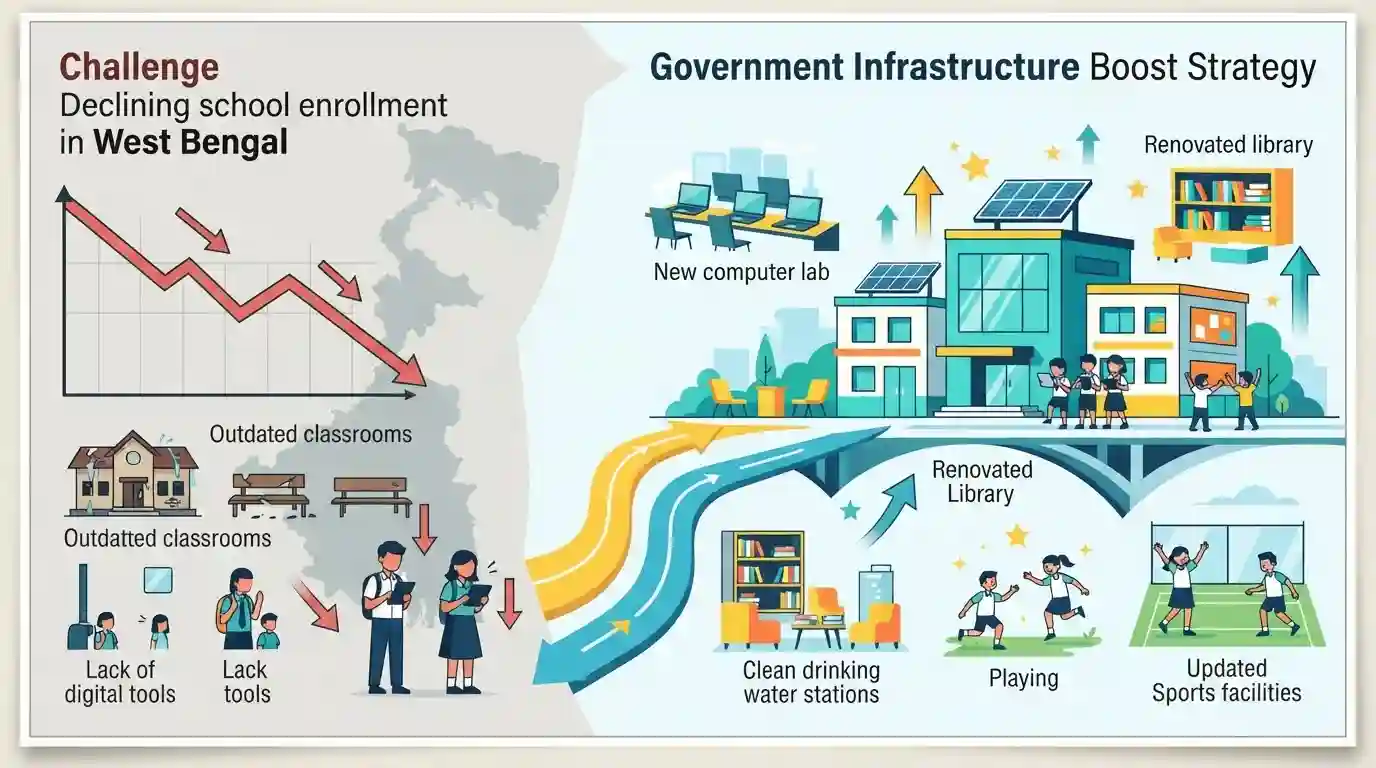
The West Bengal government has devised an infrastructure boost strategy to curb the dip in school enrolment across state-run and state-aided schools, aiming to enhance educational retention and public school appeal.
Key Points
- The West Bengal government is focusing on infrastructure enhancement in state-run and state-aided schools to tackle the declining trend in school enrolment.
- Measures include upgrading classroom facilities, improving digital and basic sanitation amenities, and strengthening welfare schemes to retain students.
- Addressing enrolment dips is critical for sustaining literacy rates and improving educational outcomes across rural and urban West Bengal.
Important Terms
West Bengal Government

The elected executive authority and administrative machinery of the State of West Bengal, responsible for formulating and implementing regional policies across sectors like education, healthcare, and infrastructure.
UPSC context
WBCS Paper IV (Public Administration and West Bengal Governance): Evaluates state-level policy implementation, administrative interventions, and welfare schemes.
Prelims Trap
state-run and state-aided schools enrolment strategies are exclusively funded and centrally monitored via Samagra Shiksha Abhiyan.
Aspirants often assume enrolment revival policies are entirely centrally funded, missing that state-run rationalization drives and district-level inventorying are driven by state-level executive mandates.
Static Concepts Connected
What are the key institutional mechanisms under the Right to Education (RTE) Act, 2009 for school management and teacher deployment?
- SMC Mandate: School Management Committee (SMC): Mandated for every school to monitor working, prepare school development plans, and utilize grants.
- Statutory PTR: Pupil-Teacher Ratio (PTR): Specifies statutory limits for teachers per students in primary (30:1) and upper-primary (35:1) classes.
- Non-Teaching Duties: Prohibition of Deployment: Bans deployment of teachers for non-educational purposes other than decennial census, disaster relief, and election duties.
Cross-Topic Patterns
Enrolment Dips and PRI Asset Monitoring
School enrolment declines intersect with fiscal decentralization debates, as Panchayati Raj Institutions (PRIs) play a crucial role in grassroots asset monitoring and midday meal supervision under district planning committees.
Teacher Rationalization and RTE Norms
Addressing teacher rationalization alongside infrastructure revival directly links to the implementation of the Right to Education (RTE) Act norms across remote West Bengal districts.

Expect statement-based questions combining UDISE+ indicators, district magistrate committee roles, and RTE student-teacher ratio norms.
Linked PYQs · 3
Linked PYQs · 3
- 2019WBCS_PRELIMSGS1
Literacy rate of West Bengal is
- 2021WBCS_PRELIMSGS1
How many new Government Medical Colleges have become functional in West Bengal during the last ten years?
- 2020WBCS_PRELIMSGS1
Literacy rate in West Bengal census 2011 —
