Inflation Dynamics and Monetary Policy Interest Rate Adjustments
Source:Indian Express ↗
Why It Matters
Directly relates to the syllabus topic of mobilization of resources, growth, development, and the role of monetary policy and central banking in controlling inflation.
Summary
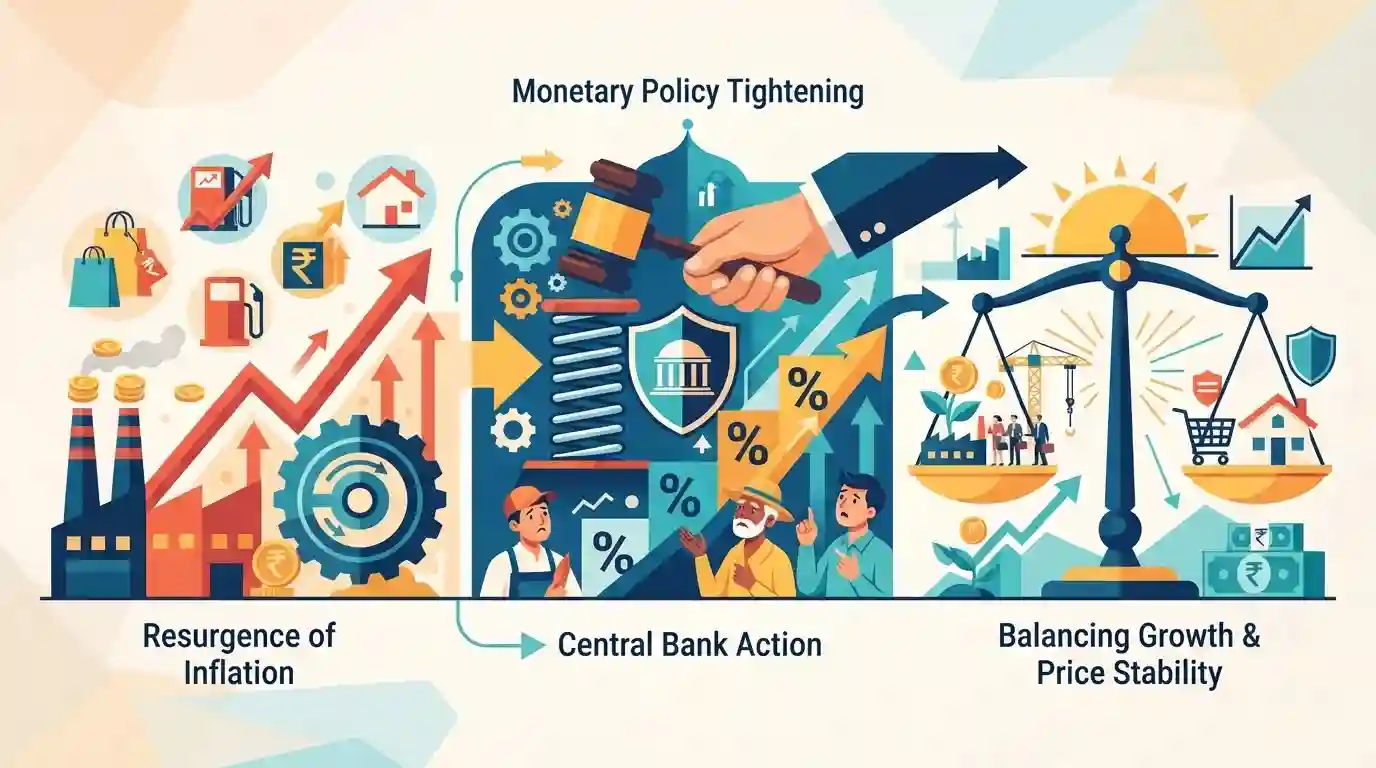
The article discusses the resurgence of inflation and its implications for monetary policy tightening and interest rate hikes by central banks like the RBI, balancing economic growth with price stability.
Key Points
- Headline inflation is showing signs of settling in, driven by persistent pressures that complicate monetary policy choices.
- Interest rate hikes or prolonged pauses are being debated as central banks navigate balancing growth and price stability.
- Food and core inflation dynamics dictate the policy trajectory of the Reserve Bank of India (RBI).
Important Terms
Reserve Bank of India

India's central banking institution that controls monetary policy, issues currency, regulates the banking system, and acts as a banker to the government.
UPSC context
UPSC Prelims/Mains (GS Paper III): Essential for questions on Indian economy, central banking, and monetary policy management.
Monetary Policy Committee
A statutory six-member committee headed by the RBI Governor, responsible for fixing the benchmark interest rate to achieve the inflation target while supporting growth.
UPSC context
UPSC Prelims/Mains (GS Paper III): Frequently tested in questions regarding inflation targeting and institutional mechanisms of monetary management in India.
Prelims Trap
Core inflation includes food and fuel components while headline inflation measures only manufactured goods.
Aspirants often assume core inflation includes food and fuel, whereas core inflation specifically strips out volatile items like food and energy to measure demand-pull pressures.
Static Concepts Connected
What are the institutional mandates and components of India's Flexible Inflation Targeting framework?
- Legislative Basis: Statutory backing under the RBI Act, 1934, mandating price stability as the primary objective while keeping growth in mind.
- Target Band: Targeted consumer price inflation (CPI-Combined) at 4% with a tolerance band of +/- 2% (upper limit 6%, lower limit 2%).
- MPC Structure: Monetary Policy Committee (MPC) sets the repo rate by majority vote, consisting of six members with a casting vote for the RBI Governor.
Cross-Topic Patterns
Monetary Policy versus Fiscal Deficit Targets
Central bank rate tightening cycles directly impact government borrowing costs, debt servicing, and fiscal deficit targets set under the FRBM Act.
Food Inflation and Macroeconomic Stability Linkage
Food price shocks driving headline inflation complicate RBI's task, linking agricultural supply chain bottlenecks directly to macroeconomic stability.

RBI's flexible inflation targeting framework + tolerance band (+/- 2%) is a prime candidate for a conceptual statement-based question.
Linked PYQs · 2
Linked PYQs · 2
- 2024MainsGS3
What are the causes of persistent high food inflation in India? Comment on the effectiveness of the monetary policy of the RBI to control this type of inflation.
- 2019MainsGS3
Do you agree with the view that steady GDP growth and low inflation have left the Indian economy in good shape? Give reasons in support of your arguments.
