Domestic animal disease threats to wildlife in Nilgiris
Source:The Hindu ↗
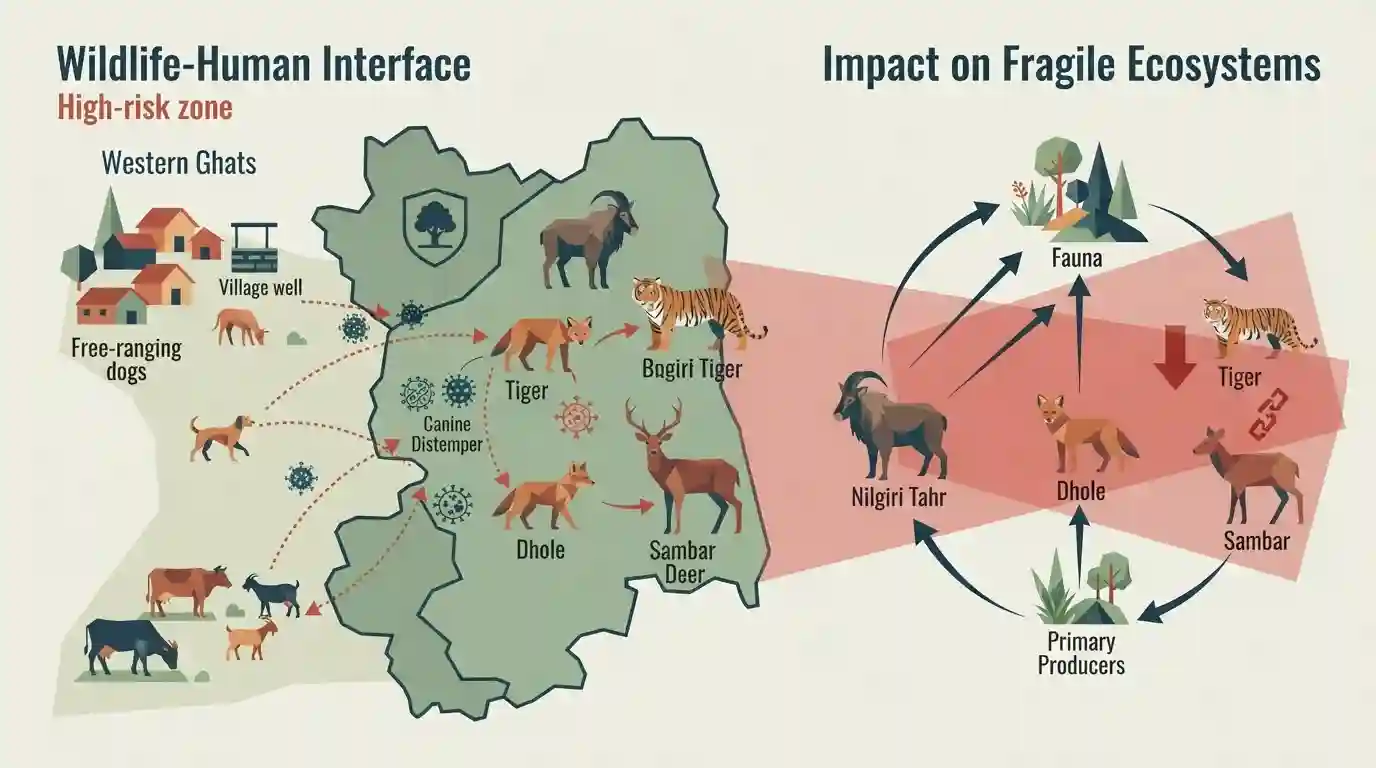
Why It Matters
This issue highlights the critical ecological challenge of pathogen transmission from domestic animals to endangered wildlife at forest fringes, an important topic for biodiversity conservation and wildlife management under GS Paper III.
Summary
Free-ranging domestic animals like dogs and livestock in the Nilgiris region present a major threat to indigenous wildlife by transmitting infectious diseases such as canine distemper and rabies. The wildlife-human interface serves as a high-risk zone for pathogen spillover, endangering fragile ecosystems and species in the Western Ghats.
Key Points
- Free-ranging domestic animals such as dogs and cattle in the Nilgiris pose a severe disease transmission risk to wild fauna.
- Diseases like canine distemper and rabies from domestic dogs threaten endangered wildlife species like wild dogs (dholes), leopards, and large herbivores.
- Interface zones between human habitations and protected forests act as transmission hotspots for zoonotic and infectious spillover.
- Conservation challenges require strict livestock vaccination, pet management, and monitoring of animal health around protected areas.
Important Terms
Wildlife Protection Act

India's apex legislation for protecting wild animals, birds, and plants, providing legal frameworks for national parks, sanctuaries, and regulating wildlife trade and habitat destruction.
UPSC context
UPSC Prelims/Mains (GS Paper III): Environment & Biodiversity conservation, legal frameworks, and protected areas.
Tamil Nadu Forest Department
The state government agency tasked with the management of reserved forests, protected areas, wildlife conservation, and biodiversity preservation across Tamil Nadu.
UPSC context
UPSC Mains (GS Paper III): Conservation, forest management, and institutional roles in state-level wildlife administration.
Nilgiris Wildlife and Environment Association
A historic regional conservation body in the Nilgiri Hills dedicated to safeguarding local flora, fauna, and fragile mountain ecosystems.
UPSC context
UPSC Prelims/Mains (GS Paper III): Grassroots conservation efforts, civil society bodies, and Western Ghats biodiversity preservation.
Prelims Trap
Endemic wild carnivores act as the primary natural reservoir for maintaining canine distemper virus within protected forest cores without domestic animal interface.
Canine distemper is a viral disease affecting wild carnivores like dholes and leopards, but it is primarily maintained and transmitted by domestic dogs, not endemic wild carnivores acting as the primary reservoir.
Static Concepts Connected
What are the key legal and institutional frameworks for wildlife conservation and disease management in India?
- Wildlife Act: Statutory backing: The Wild Life (Protection) Act, 1972 provides the apex legal framework for protecting endangered species and managing sanctuaries and national parks.
- Disease Surveillance: Pathogen monitoring: Project Tiger and state forest departments increasingly incorporate veterinary care and disease surveillance units to prevent zoonotic spillover from domestic livestock.
- One Health Approach: One Health framework: Integrates human, animal, and environmental health approaches to combat zoonotic threats at forest-human interfaces across ecologically sensitive areas.
Cross-Topic Patterns
Wildlife Conservation + Livestock Health Policies
Zoonotic disease management requires synchronising the Wildlife Protection Act with livestock health policies under the Ministry of Fisheries, Animal Husbandry and Dairying.
Western Ghats Ecology + UNESCO Sites
Pathogen spillover at forest fringes tests the management efficacy of UNESCO World Heritage natural sites like the Western Ghats.

Pathogen spillover between domestic animals and wild fauna in protected interface zones will likely feature as a statement-based MCQs.
Linked PYQs · 3
Linked PYQs · 3
- 2023PrelimsGS1
Consider the following fauna: 1. Lion-tailed Macaque 2. Malabar Civet 3. Sambar Deer How many of the above are generally nocturnal or most active after sunset?
- 2022PrelimsGS1
With reference to Indian laws about wildlife protection, consider the following statements : 1. Wild animals are the sole property of the government. 2. When a wild animal is declared protected, such animal is entitled for equal protection whether it is found in protected areas or outside. 3. Apprehension of a protected wild animal becoming a danger to human life is sufficient ground for its capture or killing. Which of the statements given above is/are correct?
- 2024PrelimsGS1
Consider the following statements: 1. Lions do not have a particular breeding season. 2. Unlike most other big cats, cheetahs do not roar. 3. Unlike male lions, male leopards do not proclaim their territory by scent marking. Which of the statements given above are correct?
