WEF Survey Highlights Economic Inequality as Global Youth Concern
Source:The Hindu ↗
Why It Matters
The WEF survey provides critical global data on youth perspectives regarding economic disparity, AI-induced job disruptions, and climate change. These findings serve as excellent fodder for Mains answers in GS2 and GS3 (especially concerning inclusive growth, human resource development, and the demographic dividend), and WEF report publications are frequently asked in Prelims.
Summary
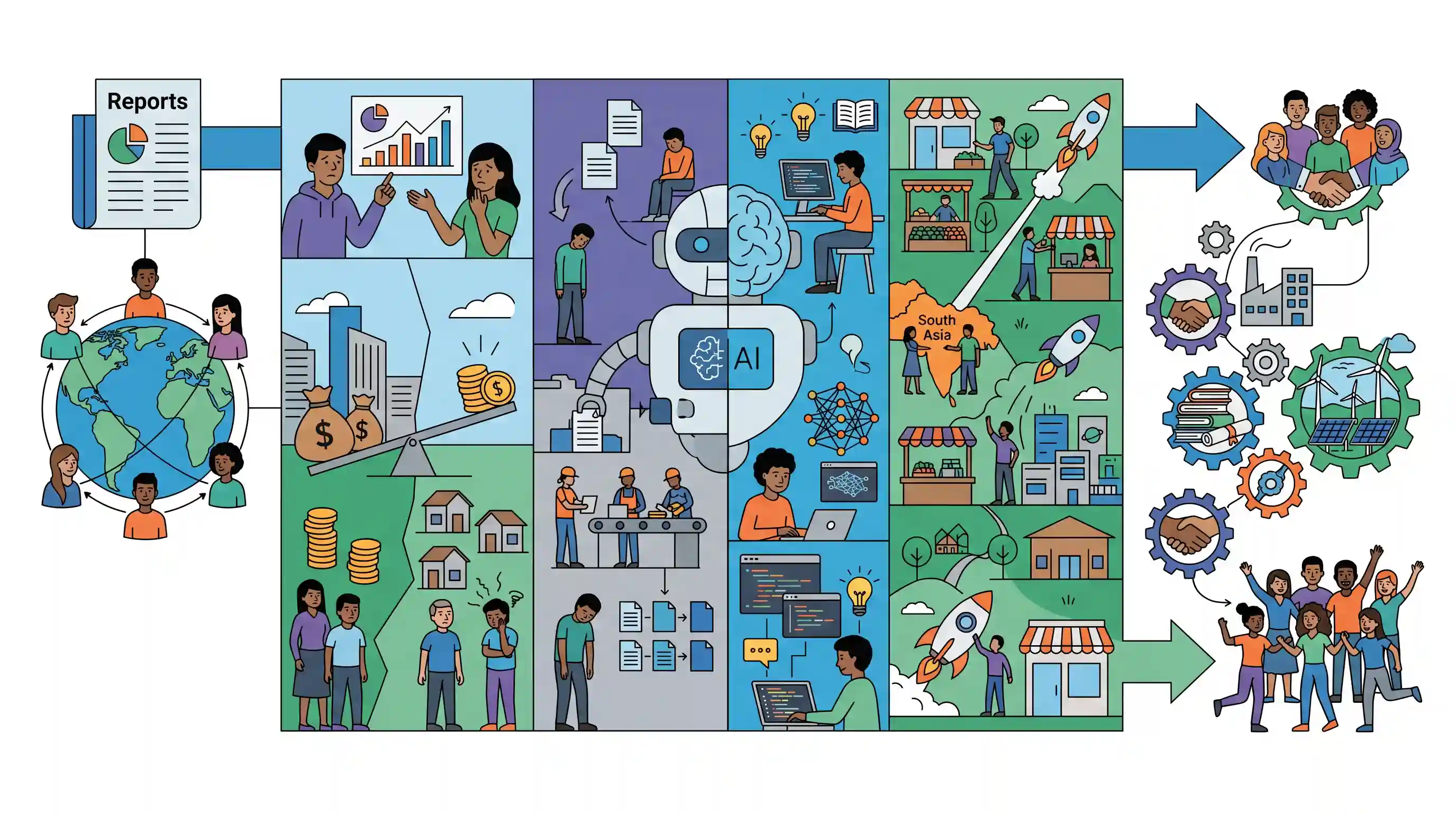
The World Economic Forum's "Youth Pulse" survey highlights that economic inequality and financial anxiety are the top economic concerns for youth globally. The report reveals a nuanced view on technology: while there are widespread fears about Artificial Intelligence replacing entry-level jobs, a majority of youth actively utilize AI tools for upskilling. Furthermore, entrepreneurship is highly regarded as a key economic force, especially in South Asia and Sub-Saharan Africa. These findings underscore the pressing need for policy interventions focused on inclusive growth, job creation, affordable education, and climate action to effectively harness the global demographic dividend.
Key Points
- The WEF's 'Youth Pulse' survey reveals that economic inequality (48.2%) and financial instability (over 57%) are the primary economic concerns for global youth.
- Entrepreneurship is increasingly viewed as a vital economic driver, particularly in developing regions like South Asia and Sub-Saharan Africa.
- Youth identify job creation, affordable quality education, affordable housing, and financial independence as the most crucial measures for empowerment.
- While two-thirds of respondents fear Artificial Intelligence will eliminate entry-level jobs, nearly 60% are proactively using AI to enhance their skills.
- Climate change continues to be recognized as the defining global macro-concern (56%) among the younger generation.
Important Terms
World Economic Forum (WEF)

A Geneva-based international organization for public-private cooperation founded in 1971. It hosts the annual Davos summit to shape global economic, social, and environmental agendas through its "stakeholder capitalism" framework.
UPSC context
GS Paper II (International Institutions) and GS III (Economy). Tests understanding of global governance and influential economic reports.
Youth Pulse Report
A flagship WEF survey capturing perspectives from young people globally. It identifies key trends like rising economic inequality, financial anxiety, and the dual role of AI as both a job threat and upskilling tool.
UPSC context
GS Paper I (Social Issues) and GS III (Employment). Relevant for analyzing global youth trends and technological adaptation.
Inclusive Growth
Economic growth that is broad-based across sectors and distributed fairly across society. It emphasizes creating productive employment, reducing poverty, and ensuring equitable access to essential services like health and education.
UPSC context
GS Paper III (Indian Economy). A core syllabus topic testing strategies for equitable development and poverty reduction.
Demographic Dividend
The economic growth potential resulting from a shift in a population's age structure, specifically when the working-age population (15-64) is larger than the dependent population (children and elderly).
UPSC context
GS Paper I (Population) and GS III (Economy). Tests analysis of India’s youthful demographic as a growth driver.
Artificial Intelligence (AI) in Employment
The integration of machine learning and automation into the labor market. It risks displacing routine entry-level roles while simultaneously creating high-skilled opportunities, necessitating national-level reskilling and policy interventions.
UPSC context
GS Paper III (S&T and Economy). Tests understanding of technological disruption and its impact on the labor market.
Stakeholder Capitalism
A model where companies prioritize the interests of all stakeholders—including employees, customers, and society—rather than focusing solely on shareholder profits. This is a central philosophy promoted by the WEF.
UPSC context
GS Paper III (Economy/Ethics). Relevant for discussions on corporate governance and sustainable, ethical economic models.
Prelims Trap
"The 'Youth Pulse' report highlighting global youth employment concerns is published by the International Labour Organization (ILO)."
Aspirants naturally associate employment, youth, and labor-related indices with the ILO or World Bank. The 'Youth Pulse' survey is specifically published by the World Economic Forum (WEF).
Static Concepts Connected
What differentiates a 'Demographic Dividend' from a 'Demographic Disaster'?
- Demographic Dividend: Occurs when the working-age population outnumbers dependents, creating a window for rapid economic growth and high savings rates.
- Demographic Disaster: Manifests when the economy fails to generate sufficient jobs for the expanding workforce, leading to structural unemployment and severe social unrest.
- Policy Prerequisites: Reaping the dividend mandates immediate investments in human capital (health, quality education) and labor-intensive economic sectors.
Besides the 'Youth Pulse', what major global indices and reports are published by the WEF?
- Global Competitiveness Report: Assesses the microeconomic and macroeconomic foundations of national competitiveness across different countries.
- Global Gender Gap: Benchmarks national gender gaps on economic participation, education, health, and political empowerment criteria.
- Global Risks Report: Published annually ahead of the Davos meeting, it analyzes severe global risks including climate, cyber, and economic threats.
Cross-Topic Patterns
AI job fears + Platform Economy vulnerabilities
As AI threatens formal entry-level roles, youth are increasingly pushed towards gig work, linking tech-induced automation fears with the urgent need for social security codes for platform workers.
Climate anxiety + Green transition job creation
Youth identifying climate as the top macro-concern connects environmental degradation directly to economic instability, mapping closely to the push for 'green transition' jobs and sustainable entrepreneurship.

Mains GS-3 2026 will likely blend AI-induced entry-level job loss with India's demographic dividend and the rise of youth entrepreneurship.
Linked PYQs · 5
Linked PYQs · 5
- 2020MainsGS3
Explain intra-generational and inter-generational issues of equity from the perspective of inclusive growth and sustainable development.
- 2022MainsGS3
Is inclusive growth possible under market economy ? State the significance of financial inclusion in achieving economic growth in India.
- 2019MainsGS3
It is argued that the strategy of inclusive growth is intended to meet the objectives of inclusiveness and sustainability together. Comment on this statement.
- 2023MainsGS3
Most of the unemployment in India is structural in nature. Examine the methodology adopted to compute unemployment in the country and suggest improvements.
- 2023MainsGS2
Skill development programmes have succeeded in increasing human resources supply to various sectors. In the context of the statement analyse the linkages between education, skill and employment.
