Agrochemical sector raises concerns over draft pesticides bill
Source:The Hindu ↗
Why It Matters
The draft Pesticides Management Bill aims to replace the outdated Insecticides Act of 1968. It represents a critical juncture for agricultural policy, balancing the need for modernization and foreign export compliance with environmental safety and affordable input access for farmers. The debate over the Protection of Regulatory Data (PRD) highlights the persistent tension between enforcing Intellectual Property Rights to spur innovation and preventing agricultural monopolies. Furthermore, managing pesticide residue is vital for overcoming non-tariff barriers (phytosanitary measures) hindering Indian agricultural exports.
Summary
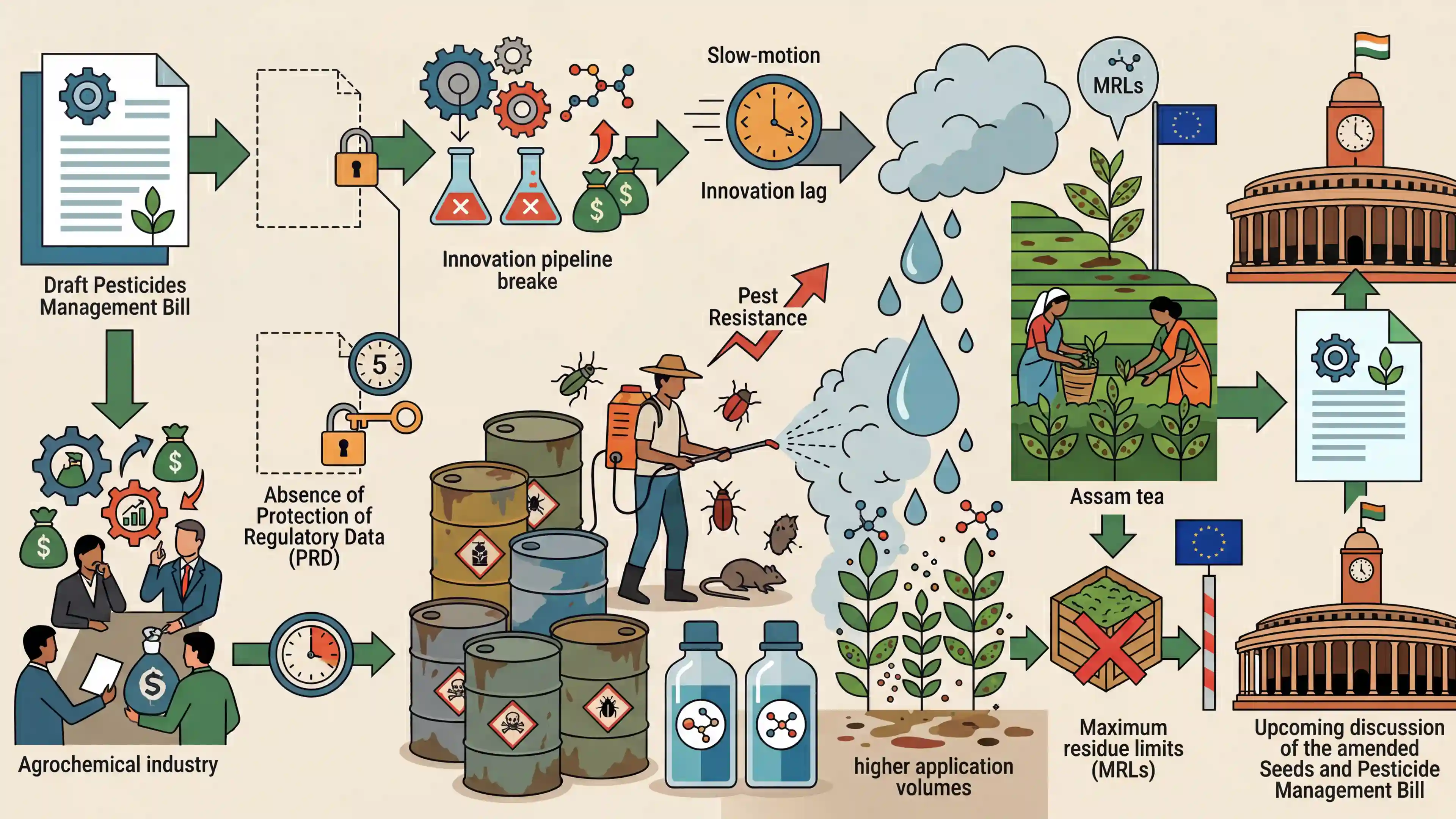
The agrochemical industry, represented by CropLife India, has expressed concerns over the draft Pesticides Management Bill, specifically highlighting the absence of a Protection of Regulatory Data (PRD) framework. Introducing new, safer, and more targeted crop protection molecules requires massive investments in regulatory data for safety and efficacy. Without a 5-year data exclusivity period (PRD), innovators face a disincentive, leading to an 'innovation lag'. This lag forces farmers to rely on older chemistries, which causes faster pest resistance, higher application volumes, and elevated chemical residues. Consequently, Indian agricultural exports, such as Assam tea, frequently struggle to meet the stringent maximum residue limits (MRLs) set by markets like the European Union. The government is expected to table the amended Seeds and Pesticide Management Bill in the upcoming parliamentary session.
Key Points
- The agrochemical industry body, CropLife India, has urged the government to incorporate a Protection of Regulatory Data (PRD) framework in the upcoming draft Pesticides Management Bill.
- A 5-year time-bound PRD framework is proposed to protect the heavy investments required to generate safety, efficacy, and environmental data for new molecules.
- Without data exclusivity, there is an 'innovation lag' in India, leaving farmers dependent on older, off-patent chemistries.
- Prolonged use of older pesticides accelerates pest resistance, requires higher spray intensity, and leads to residue accumulation.
- High pesticide residue makes it difficult for Indian agricultural exports, such as Assam tea, to comply with strict phytosanitary measures in foreign markets like the European Union.
- The Union Agriculture Minister has confirmed plans to introduce an amended Seeds and Pesticide Management Bill in the upcoming Parliament session.
Important Terms
Draft Pesticides Management Bill

A proposed legislation to replace the 1968 Insecticides Act, aiming to centralize pesticide regulation, enhance safety standards, and minimize health and environmental risks throughout the product lifecycle.
UPSC context
GS Paper 2 (Statutory/Regulatory Bodies) and GS Paper 3 (Agriculture/Environment). Tests knowledge of governance reforms and technology in farming.
Protection of Regulatory Data (PRD) framework
A legal provision protecting proprietary safety and efficacy data of a new molecule for a fixed period (e.g., 5 years), preventing generic competitors from using it for registration.
UPSC context
GS Paper 3 (Intellectual Property Rights and Economy). Relevant for discussions on innovation incentives vs. affordable generic access.
Maximum Residue Limits (MRLs)
The highest level of pesticide residue legally tolerated in food or agricultural products to ensure safety, often used as a non-tariff barrier in international trade.
UPSC context
GS Paper 3 (Indian Economy/Exports). Key concept for Sanitary and Phytosanitary (SPS) measures and global trade disputes.
Insecticides Act, 1968
The primary legislation currently governing the import, manufacture, and sale of insecticides in India; the new Bill seeks to repeal and modernize this half-century-old framework.
UPSC context
GS Paper 2/3. Essential background for understanding the evolution of agricultural regulation and the shift toward holistic pesticide management.
CropLife India
A leading industry association representing 17 R&D-driven crop protection companies, advocating for scientific-based regulations and the inclusion of data protection in Indian law.
UPSC context
GS Paper 3 (Agriculture/Industry). Represents the role of pressure groups and industry stakeholders in the policy-making process.
Seeds and Pesticide Management Bill
The latest nomenclature for the amended legislative package combining seed and pesticide reforms, expected to be tabled in Parliament to overhaul agricultural input regulations.
UPSC context
GS Paper 2 (Governance/Legislation). Tracks current parliamentary business and legislative attempts to improve the Ease of Doing Business in agriculture.
Prelims Trap
WTO-TRIPS explicitly mandates a strict 5-year data exclusivity period for agrochemical and pharmaceutical formulations.
TRIPS mandates protection of undisclosed test data against "unfair commercial use", but does NOT explicitly mandate a fixed period of data exclusivity (a TRIPS-Plus demand).
Static Concepts Connected
What is the difference between Data Protection and Data Exclusivity under TRIPS?
- Data Protection: Requires protecting undisclosed test data from "unfair commercial use," but regulators can still technically rely on it to approve generics.
- Data Exclusivity: A TRIPS-Plus framework that explicitly prevents regulators from using an innovator's clinical/safety data to approve generic versions for a set period.
- India's Stance: India historically resists strict data exclusivity to safeguard its massive generic pharmaceutical and agrochemical industries, adhering strictly to the baseline TRIPS mandate.
How do Maximum Residue Limits (MRLs) interact with WTO trade rules?
- SPS Agreement: Allows WTO member nations to set their own food safety and plant health standards, such as pesticide residue limits.
- Scientific Justification: Standards must be based on science (often Codex Alimentarius) and cannot be applied arbitrarily to act as disguised trade barriers.
- Export Rejections: Differences between domestic Indian MRLs and stricter limits in markets like the EU frequently lead to legitimate export rejections for products like tea and rice.
Cross-Topic Patterns
Agri-IPR mirroring Pharma generic battles
The demand for TRIPS-Plus data exclusivity for new pesticide molecules perfectly mirrors India's historical resistance to similar data exclusivity in pharmaceuticals to protect generic drug manufacturers.
MRLs acting as Non-Tariff Barriers
Older chemistries leading to higher residues directly impacts India's agricultural exports, as developed markets increasingly use Sanitary and Phytosanitary (SPS) measures under WTO to reject shipments like Assam tea.
Overhauling 1960s Green Revolution Laws
Replacing the Insecticides Act (1968) parallels the ongoing push to modernize the Seeds Act (1966), reflecting a broader mandate to centralize and digitize agricultural input regulation.

Expect a 2026 prelims question linking the new Pesticides Management Bill with WTO-TRIPS 'data exclusivity' vs 'data protection' clauses.
Linked PYQs · 3
Linked PYQs · 3
- 2024MainsGS3
What is the present world scenario of intellectual property rights with respect to life materials? Although, India is second in the world to file patents, still only a few have been commercialized. Explain the reasons behind this less commercialization.
- 2025MainsGS3
Elaborate the scope and significance of supply chain management of agricultural commodities in India.
- 2022MainsGS3
What are the main bottlenecks in upstream and downstream process of marketing of agricultural products in India?
