Andhra Pradesh Industrial Subsidies to Boost Manufacturing Sector
Source:Indian Express ↗
Why It Matters
Important for APPSC Group 1 aspirants to understand state-level industrial policies, investment promotion strategies, and economic development frameworks of Andhra Pradesh.
Summary
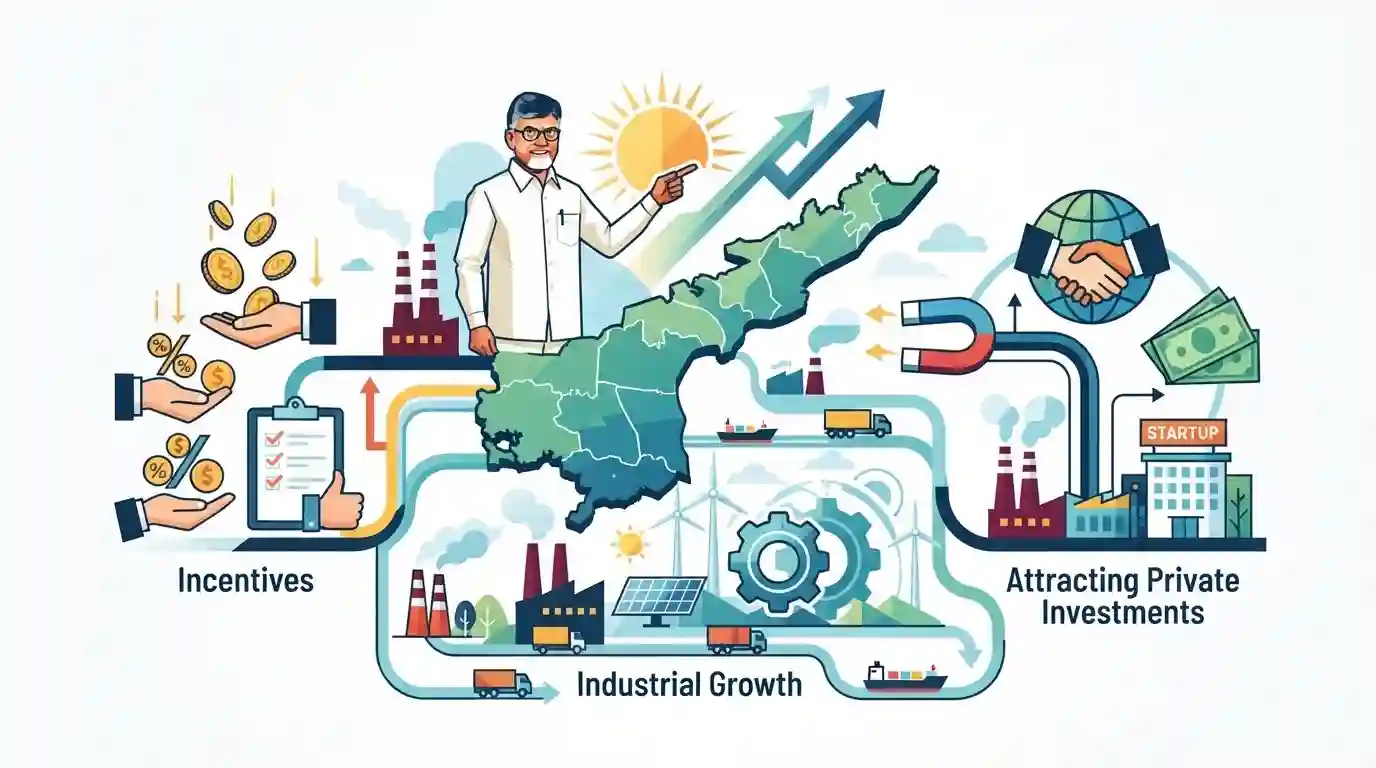
Andhra Pradesh Chief Minister N. Chandrababu Naidu announced substantial subsidies and incentives aimed at driving industrial growth, attracting private investments, and improving the manufacturing landscape within the state.
Key Points
- Chief Minister N. Chandrababu Naidu announced that Andhra Pradesh is rolling out massive subsidies and incentives to attract major industries and boost manufacturing.
- The state aims to position itself as a top investment destination by providing competitive financial packages and fast-track single-window clearances.
- Focus is directed towards employment generation, ease of doing business, and infrastructure development through bodies like APIIC.
Important Terms
Andhra Pradesh Industrial Policy

A comprehensive framework introduced by the Andhra Pradesh government offering capital investment subsidies, tax reimbursements, and incentives to drive manufacturing growth, create jobs, and attract domestic and foreign investments.
UPSC context
Important for APPSC Group 1 & 2 (Economy of Andhra Pradesh & Industrial Development). Tests understanding of state industrial growth strategies and subsidies.
APIIC
The premier nodal state-owned agency of Andhra Pradesh responsible for planning, acquiring land, and developing physical infrastructure, industrial parks, SEZs, and sector-specific clusters across the state.
UPSC context
Crucial for APPSC exams (Andhra Pradesh Geography & Economy). Tests knowledge of institutional frameworks driving infrastructure and industrial investments.
Static Concepts Connected
What are the core developmental functions and objectives of the Andhra Pradesh Industrial Infrastructure Corporation (APIIC)?
- Land & Parks: Promotes industrial infrastructure by acquiring land and developing industrial parks, SEZs, and growth centers across the state.
- Facilitation: Acts as a nodal agency for government land allotment and facilitates single-window clearances for incoming investors.
- Joint Ventures: Joint ventures with private players to build specialized sector-specific clusters like pharma, apparel, and electronics.
Cross-Topic Patterns
Subsidies vs Fiscal Deficit in State Budgets
AP's industrial subsidies directly intersect with the Fiscal Responsibility and Budget Management (FRBM) limits and capital expenditure quality examined in APPSC Group 1 mains.
Industrial Land Banks & AP Land Laws
APIIC's land provisioning role links industrial growth with land acquisition laws, environmental clearances, and social impact assessments.

APIIC's role in land allocation and single-window clearance mechanisms will likely feature in APPSC Group 2 polity/economy MCQs.
Linked PYQs · 2
Linked PYQs · 2
- 2024APPSC_PRELIMSGS1
Which of the following statement/statements is/are incorrect regarding the Andhra Pradesh Industrial Policy 2023 - 27? I. To achieve a minimum contribution of 25% by industry in the State GDP II. To provide end-to-end facilitation in 2 weeks III. To envisage ten (10) priorities of accomplishment IV. To focus on becoming a 'Plug and Play State' for investments V. Ensuring land allotment by APIIC within a period of 2 weeks upon receipt of application Select the answer using the codes given below :
- 2024APPSC_PRELIMSGS1
Which of the following statements are valid in connection with Andhra Pradesh Green Hydrogen and Green Ammonia Policy (2023)? I. The objective is to target Green Energy production up to the capacity of 1 MPTA (Million Tonnes Per Annum) or Green Ammonia production up to the capacity of 2-0 MTPA in the next five years. II. New and Renewable Energy Development Corporation of A.P. Ltd (NREDCAP) shall act as a Nodal Agency under this policy. III. All the Ports in the State have infrastructure for storing liquid nitrogen which can then be utilized for storing Green Hydrogen for exporting to other countries. IV. The Policy prohibits the production of Green Hydrogen/Green Ammonia by using Renewable Energy and/or Biomass from 'Third-Party/Power exchange'. Select the correct answer using the codes given below :
