Industrial Relations Code Needs Reforms for Job Security in AI Era
Source:The Hindu ↗
Why It Matters
The intersection of labour laws (specifically the recently passed Labour Codes) and emerging technologies (AI/automation) is highly relevant for GS Paper 3. It highlights the socio-economic implications of the Fourth Industrial Revolution on India's demographic dividend and structural unemployment, bridging the gap between economic reforms and technological advancement.
Summary
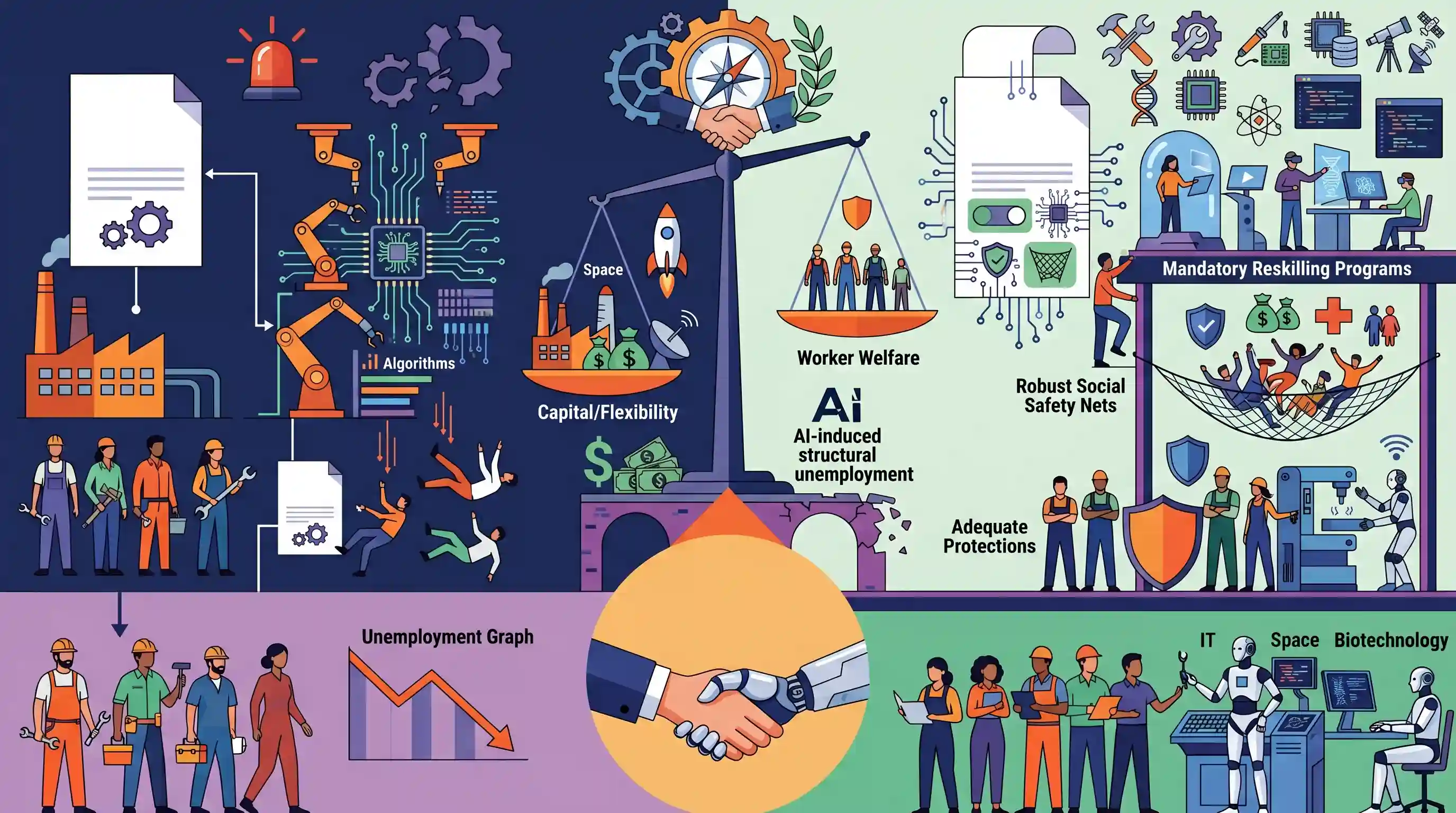
The article discusses the necessity of harmonising the provisions of the Industrial Relations Code with the emerging realities of the Artificial Intelligence (AI) era. While the new labour codes were designed to enhance industrial flexibility and the ease of doing business, the rapid advancement of AI and automation poses severe threats to job security and could lead to structural unemployment. The piece argues that labour market reforms must balance the interests of capital with the welfare of workers by incorporating robust social safety nets, mandatory reskilling programs, and adequate protections against AI-induced retrenchment, ensuring that technological progress does not come at the expense of livelihoods.
Key Points
- The Industrial Relations Code, 2020 aims to provide flexibility to employers, such as increasing the threshold for retrenchment without government permission, but faces new challenges in the AI era.
- Artificial Intelligence and automation threaten widespread structural unemployment, impacting both blue-collar and white-collar jobs.
- There is a critical need to balance 'ease of doing business' with robust job security and social safety nets for workers displaced by technological disruption.
- Labor laws must evolve to include provisions for mandatory reskilling, upskilling, and transition support for workers affected by AI-driven automation.
Important Terms
Industrial Relations Code, 2020

A 2020 law consolidating three acts to simplify trade union recognition, employment conditions, and dispute resolution, while raising the layoff threshold to 300 workers for greater industrial flexibility.
UPSC context
GS Paper II/III: Governance and Economy; tests understanding of labor market flexibility versus worker rights and industrial peace.
Code on Social Security, 2020
A framework unifying nine laws to extend social protection (pensions, insurance) to all workers, including previously excluded categories like gig, platform, and unorganized sector workers.
UPSC context
GS Paper II/III: Social Justice and Economy; critical for discussing inclusive growth and safety nets in the digital economy.
Worker Re-Skilling Fund
A statutory fund under the IR Code, 2020, where employers contribute 15 days' wages for every retrenched worker to facilitate their training and re-employment in new industries.
UPSC context
GS Paper III: Economy/Employment; explores state-led mechanisms to mitigate technological unemployment and structural shifts in the workforce.
Retrenchment
The termination of a worker's service by an employer for any reason other than disciplinary action, often occurring due to surplus labor or technological automation.
UPSC context
GS Paper III: Indian Economy; relates to job security issues and the 'hire and fire' debate in industrial policy.
Gig Workers
Workers outside traditional employer-employee relationships who perform activities like app-based delivery or freelance tasks, legally recognized for the first time under the 2020 Social Security Code.
UPSC context
GS Paper III: Economy/Employment; vital for analyzing the changing nature of work and social security gaps in the AI era.
Fixed-Term Employment (FTE)
A provision in the IR Code allowing companies to hire workers for a specific duration via written contracts, offering permanent-like benefits without the long-term liability of regular employment.
UPSC context
GS Paper III: Economy; focuses on labor market formalization and the trend toward 'contractualization' of the workforce.
Labour Codes
The consolidation of 29 central labor laws into four codes (Wages, Industrial Relations, Social Security, OSH) to enhance ease of doing business and ensure universal worker welfare.
UPSC context
GS Paper II/III: Governance and Economy; tests the impact of structural reforms on industrial growth and labor rights.
Prelims Trap
"The 'Re-skilling Fund' under the IR Code is financed by a dedicated Union Budget allocation."
The Re-skilling Fund is not a government-funded scheme; it is financed directly by the employer, who must contribute 15 days of wages for every retrenched worker.
Static Concepts Connected
What differentiates structural unemployment from cyclical and frictional unemployment?
- Structural Unemployment: Caused by a fundamental mismatch between workers' skills and market needs, often driven by technological changes like AI and automation.
- Cyclical Unemployment: Caused by overall economic downturns and deficiency in aggregate demand during the recessionary phase of a business cycle.
- Frictional Unemployment: Temporary unemployment that occurs when workers are in the transition phase of moving from one job to another.
What are the core components of India's new Labour Codes?
- Code on Wages: Regulates minimum wages and bonus payments across all employments.
- Industrial Relations Code: Amalgamates laws on trade unions, conditions of employment, and dispute investigation (raised retrenchment threshold to 300).
- Social Security Code: Extends social safety nets, notably recognizing 'gig' and 'platform' workers for the first time.
- OSH Code: Consolidates regulations regarding workplace safety, health standards, and working conditions.
Cross-Topic Patterns
AI Automation and the Gig Economy
As AI displaces routine jobs, the workforce shifts toward platform work, inextricably linking the IR Code's retrenchment provisions with the Social Security Code's gig worker protections.
DPSP vs. Industrial Flexibility
Increasing retrenchment thresholds reflects post-1991 industrial flexibility, but triggers Article 41 (Right to work) and Article 43 (living wage) debates regarding the state's welfare obligations.

Expect a 2026 multi-statement Prelims question mixing the IR Code's 300-worker retrenchment threshold with the employer Re-skilling Fund.
Linked PYQs · 3
Linked PYQs · 3
- 2024MainsGS3
Discuss the merits and demerits of the four 'Labour Codes' in the context of labour market reforms in India. What has been the progress so far in this regard?
- 2022MainsGS3
Economic growth in the recent past has been led by increase in labour productivity." Explain this statement. Suggest the growth pattern that will lead to creation of more jobs without compromising labour productivity.
- 2023MainsGS3
Most of the unemployment in India is structural in nature. Examine the methodology adopted to compute unemployment in the country and suggest improvements.
