Indus Waters Treaty Faces Geopolitical Stress and Modification Demands
Source:Indian Express ↗
Why It Matters
The Indus Waters Treaty is a vital test case for transboundary water governance and India-Pakistan bilateral diplomacy. Understanding its mechanics, dispute resolution frameworks, and recent modifications debate is essential for GS2 International Relations.
Summary
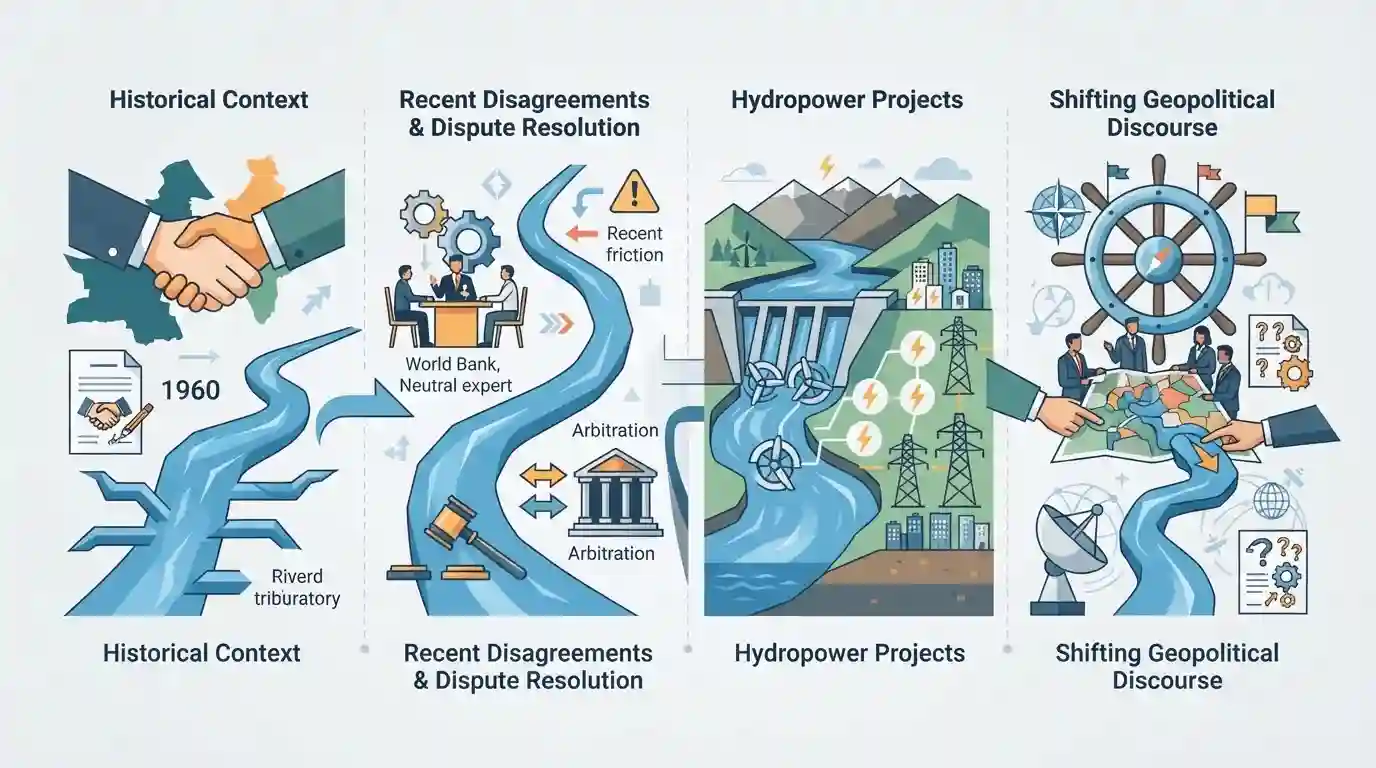
An analytical overview of the Indus Waters Treaty (IWT) between India and Pakistan, covering historical context, recent disagreements over dispute-resolution mechanisms, hydropower projects, and the shifting geopolitical and strategic discourse on modifying or reviewing the treaty.
Key Points
- India and Pakistan share the Indus Waters Treaty (IWT) brokered by the World Bank in 1960, governing the distribution of waters from the Indus river system.
- Recent geopolitical tensions, strategic disputes over hydropower projects (like Kishenganga and Ratle), and disagreements over the dispute-resolution mechanism (Neutral Expert vs. Court of Arbitration) have strained the treaty.
- India has pushed for modifications/re-negotiations of the treaty citing changed circumstances, population growth, climate change, and cross-border terrorism, while Pakistan emphasizes strict compliance.
- The treaty's robustness as a rare surviving bilateral pact amidst hostilities faces unprecedented stress.
Important Terms
Indus Waters Treaty 1960

A 1960 water-distribution treaty between India and Pakistan, brokered by the World Bank, which divides the Indus basin's six rivers into eastern rivers for India and western rivers for Pakistan.
UPSC context
Crucial for UPSC GS Paper II (International Relations / Bilateral Agreements) and water diplomacy frameworks between India and Pakistan.
Permanent Court of Arbitration
An intergovernmental arbitration tribunal based in The Hague that handles international legal disputes, recently involved in conflicting jurisdiction rulings over Indus Waters Treaty projects.
UPSC context
Important for UPSC GS Paper II under international judicial bodies, treaty obligations, and global dispute resolution mechanisms.
World Bank
The international financial institution that acted as a mediator and signatory guarantor for the 1960 Indus Waters Treaty to facilitate transboundary water sharing.
UPSC context
Relevant for UPSC GS Paper II (Global financial institutions and their role in multilateral mediation and transboundary resource management).
Indus Commissioners
Bilateral commissioners appointed by India and Pakistan under the Indus Waters Treaty to regularly meet, exchange data, inspect works, and address initial questions.
UPSC context
Tested in UPSC perspective for bilateral channels of communication and operationalizing transboundary water treaties at the technical level.
Prelims Trap
India can unilaterally suspend or terminate the Indus Waters Treaty due to cross-border terrorism or changed geopolitical circumstances.
Aspirants often assume India has absolute sovereignty over Western rivers or that unilateral suspension of the IWT is legally permitted under international law without treaty provisions.
Static Concepts Connected
What are the key institutional mechanisms and water allocation principles under the Indus Waters Treaty 1960?
- Eastern Rivers: Eastern Rivers (Ravi, Beas, Sutlej) allocated to India for unrestricted use, with certain transition period provisions.
- Western Rivers: Western Rivers (Indus, Jhelum, Chenab) allocated largely to Pakistan, permitting non-consumptive uses like power generation for India under strict design criteria.
- Bilateral Commission: Permanent Indus Commission serves as a regular channel for cooperation and information exchange between Commissioners of both nations.
- Dispute Resolution: Multi-tiered dispute resolution involves technical differences handled by a Neutral Expert and legal disputes by the Court of Arbitration.
Cross-Topic Patterns
Water Diplomacy + Bilateral Foreign Policy
Transboundary water management issues intersect with India's neighbourhood first policy and strategic assertions over western river basins.
International Arbitration + Treaty Law
Treaty renegotiation demands parallel debates on sovereign rights over natural resources versus international arbitration norms.

IWT dispute mechanisms (Neutral Expert vs. Court of Arbitration) and Article XII modification provisions are high-yield for prelims.
Linked PYQs · 2
Linked PYQs · 2
- 2012MainsGS2
The situation today is far different to that prevalent fifty years back when the Indus Water Treaty was signed." Highlight the complexity of the current challenges on both sides of the border in this regard. Do you think that a review of the Treaty is in India's best interests?
- 2026PrelimsGS1
Identify the river of the Indian sub-continent on the basis of the following information : 1. It has an antecedent drainage system. 2. It flows through three countries. 3. It originates in the Tibetan Plateau and is an important river for irrigation. 4. It does not form distributaries. Select the answer from the following :
