India rejects Court of Arbitration authority under Indus treaty
Source:Indian Express ↗
Why It Matters
The Indus Waters Treaty is a historic water-sharing pact that has survived multiple wars. India's recent actions—boycotting the Court of Arbitration, demanding a treaty review, and linking treaty abeyance to cross-border terrorism—mark a major shift in its diplomatic and security strategy. It holds high relevance for UPSC GS2 (India and its neighborhood relations; Bilateral agreements) and GS1 (Water resources/Geography).
Summary
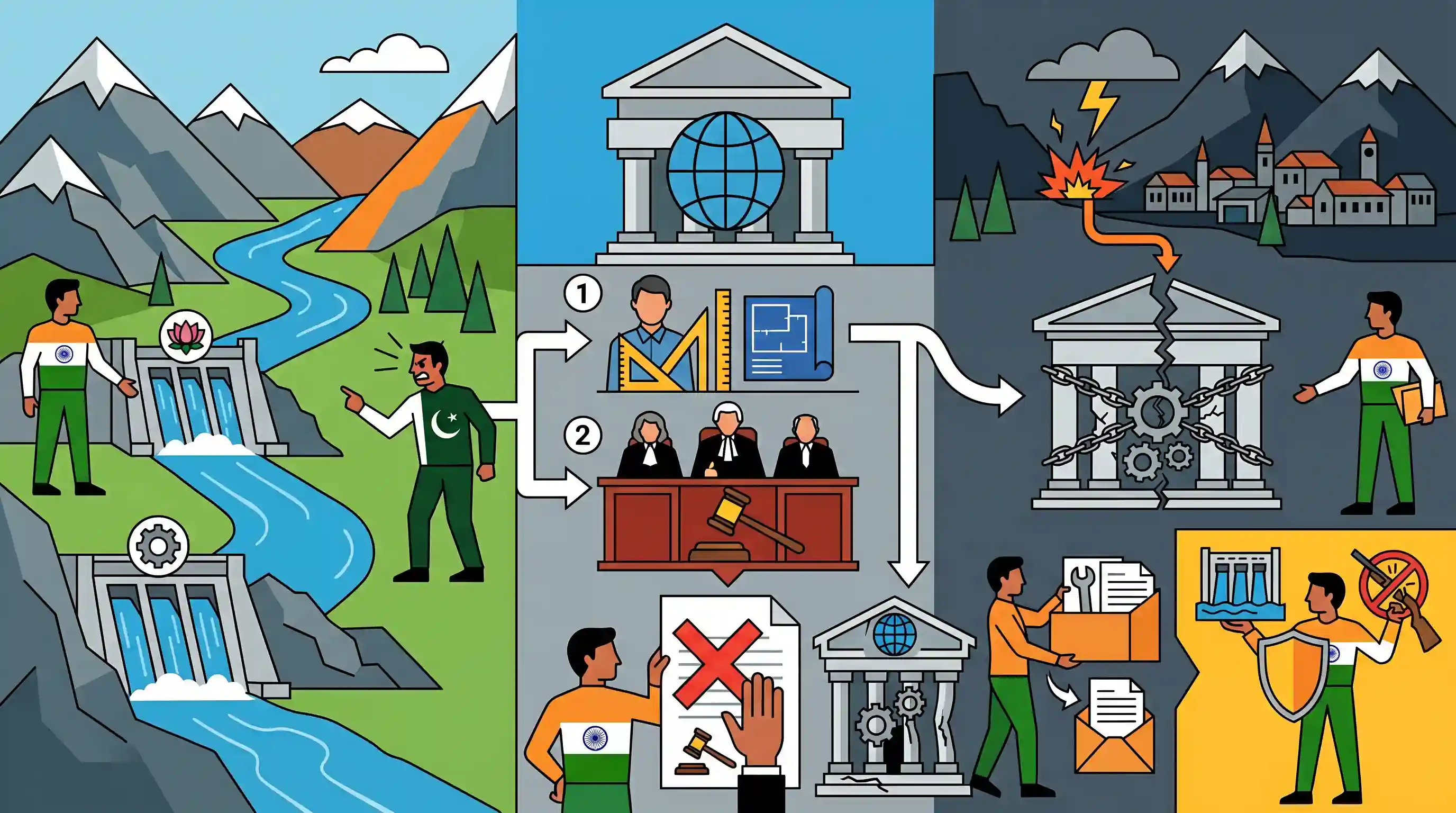
India has firmly rejected a "supplemental award" issued by the Court of Arbitration at The Hague concerning the Kishenganga and Ratle hydroelectric projects, declaring the body "illegal." The core of the dispute stems from Pakistan approaching the World Bank for two concurrent dispute settlement mechanisms—a Neutral Expert and a Court of Arbitration—under the 1960 Indus Waters Treaty (IWT). India, maintaining that parallel proceedings are legally impermissible, participates only in the Neutral Expert track. Following a recent terror attack in Pahalgam, India placed the IWT in "abeyance" and has issued multiple notices (in 2023 and 2024) to review and modify the treaty. The standoff underscores the geopolitical fragility of transboundary water agreements and signals a shift in India's strategic posture regarding water sharing and cross-border terrorism.
Key Points
- India has rejected the authority of the 'illegal' Court of Arbitration constituted under the Indus Waters Treaty, calling the proceedings a 'charade' initiated by Pakistan.
- The dispute revolves around India's run-of-the-river hydroelectric projects in Jammu & Kashmir: the Kishenganga project on a Jhelum tributary and the Ratle project on the Chenab river.
- The conflict escalated when Pakistan simultaneously requested a Neutral Expert and a Court of Arbitration, leading the World Bank to appoint both mechanisms in October 2022, which India argues violates the treaty.
- India suspended the Indus Waters Treaty following the Pahalgam terror attack in April and has issued formal notices to Pakistan in January 2023 and September 2024 seeking to modify the treaty.
- Under the 1960 treaty, the Eastern Rivers (Sutlej, Beas, Ravi) are allocated for India's unrestricted use, while Pakistan receives the Western Rivers (Indus, Jhelum, Chenab), with India permitted limited non-consumptive usage.
Important Terms
Indus Waters Treaty (IWT)

A 1960 water-sharing agreement between India and Pakistan, brokered by the World Bank. It allocates the Eastern rivers (Ravi, Beas, Sutlej) to India and Western rivers (Indus, Jhelum, Chenab) to Pakistan.
UPSC context
GS-II (International Relations); essential for understanding transboundary water diplomacy and the 'neighborhood first' policy.
Court of Arbitration (CoA)
The third and highest tier of dispute resolution under the IWT for 'disputes' over treaty interpretation. India currently deems the Hague-based body 'illegal' due to parallel proceedings.
UPSC context
GS-II (International Law); tests knowledge of tiered international dispute settlement mechanisms.
Neutral Expert
A technical expert appointed by the World Bank (Level 2 mechanism) to resolve 'differences' of a technical nature. India favors this track for the Kishenganga and Ratle projects.
UPSC context
GS-II (International Relations); focuses on technical vs. legal dispute resolution in bilateral treaties.
Permanent Court of Arbitration (PCA)
An intergovernmental organization in The Hague that provides administrative support for international arbitrations, including the current IWT Court of Arbitration rejected by India.
UPSC context
GS-II (Important International institutions); frequently asked in Prelims regarding jurisdiction and headquarters.
Article XII (IWT)
The clause in the Indus Waters Treaty that allows for the treaty to be modified or reviewed from time to time by a duly ratified bilateral agreement.
UPSC context
GS-II (Bilateral Agreements); relevant to India's recent strategic shift in seeking to renegotiate the 1960 pact.
World Bank
A global financial institution acting as a signatory and guarantor of the IWT. It appoints both Neutral Experts and the Chair of the Court of Arbitration.
UPSC context
GS-II (International Institutions); evaluates the role of third-party mediators in bilateral conflicts.
Prelims Trap
"The World Bank acts as a guarantor and final arbitrator in Indus Waters Treaty disputes."
The World Bank is a signatory solely for specific procedural roles (e.g., appointing a Neutral Expert). It is neither a guarantor, arbitrator, nor adjudicator under the treaty.
Static Concepts Connected
What is the 3-tier dispute resolution mechanism under the IWT?
- Tier 1 (Questions): "Questions" over water sharing are first addressed bilaterally by the Permanent Indus Commission (PIC).
- Tier 2 (Differences): "Differences" of a technical nature are referred to a Neutral Expert appointed by the World Bank.
- Tier 3 (Disputes): "Disputes" involving legal complexities or unresolved differences are escalated to a 7-member Court of Arbitration.
What are India's rights over the Western Rivers under the IWT?
- Non-consumptive mandate: India is granted unrestricted use of Eastern Rivers but can only use Western Rivers (Indus, Jhelum, Chenab) for limited non-consumptive purposes.
- Run-of-the-river hydro: India is permitted to construct run-of-the-river (RoR) hydroelectric projects, provided they do not involve significant water storage.
- Domestic and agriculture: Specific, restricted quotas of Western river water are permitted for domestic use and local agriculture in Jammu & Kashmir.
Cross-Topic Patterns
Water diplomacy and state-sponsored terrorism
India placing the IWT in 'abeyance' links bilateral water sharing directly to state-sponsored terrorism, mirroring its broader diplomatic strategy of isolating Pakistan in regional forums like SAARC.
Himalayan RoR hydro projects constraints
Kishenganga and Ratle are Run-of-the-River (RoR) dams. UPSC often links the ecological viability of Himalayan RoR hydro projects with the geopolitical constraints of transboundary water treaties.

Expect a 2026 Prelims question testing the 3-tier IWT dispute sequence and mapping of Kishenganga/Ratle projects to their parent rivers.
Linked PYQs · 3
Linked PYQs · 3
- 2021PrelimsGS1
With reference to the Indus river system, of the following four rivers, three of them pour into one of them which joins the Indus direct. Among the following, which one is such river that joins the Indus direct?
- 2009PrelimsGS1
The Dul Hasti Power Station is based on which one of the following rivers?
- 2012MainsGS2
The situation today is far different to that prevalent fifty years back when the Indus Water Treaty was signed." Highlight the complexity of the current challenges on both sides of the border in this regard. Do you think that a review of the Treaty is in India's best interests?
