Indus Waters Treaty Implications Amid Cross Border Terrorism
Source:Indian Express ↗
Why It Matters
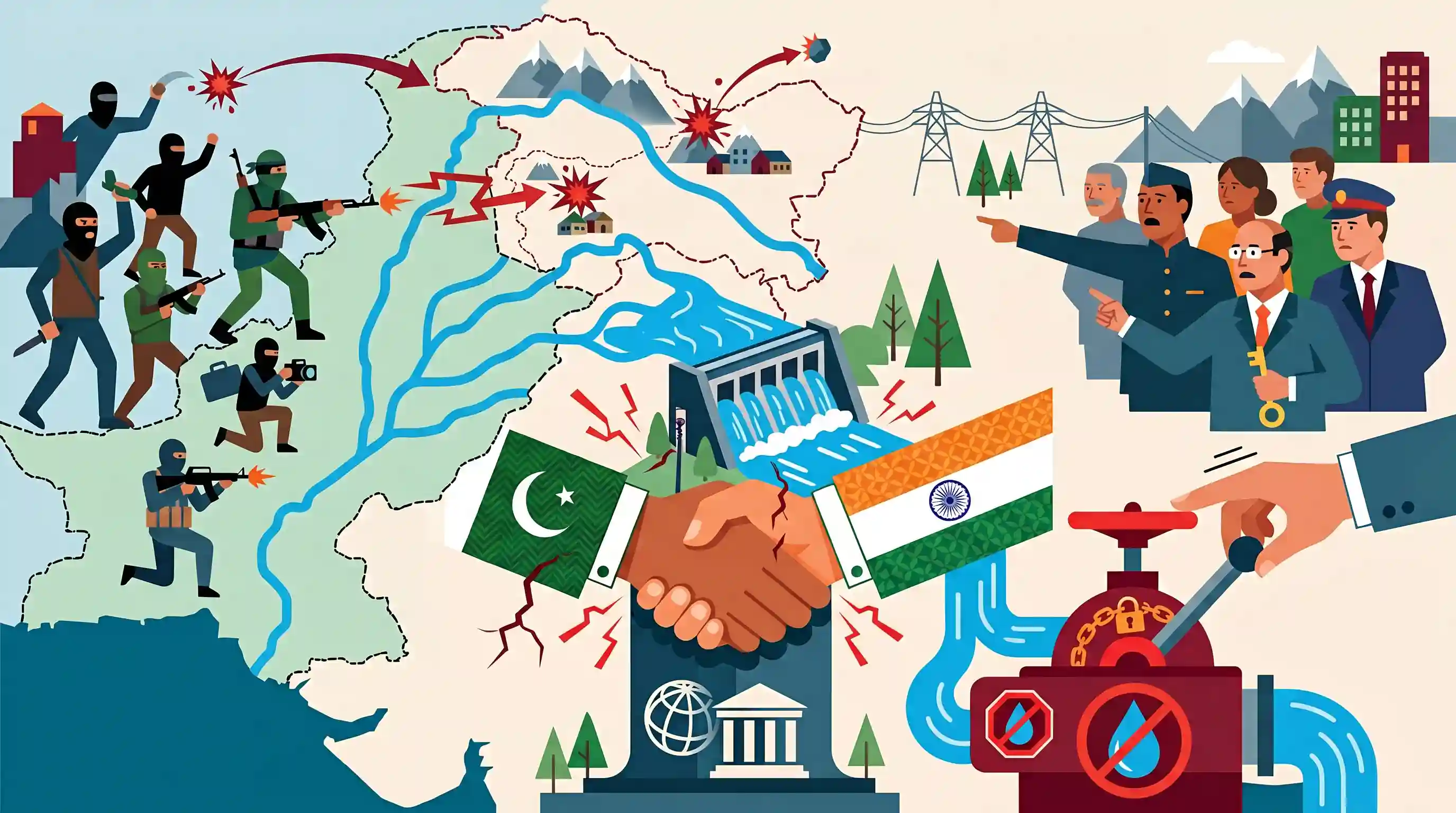
The Indus Waters Treaty is frequently cited as a resilient mechanism for water sharing; however, linking it to state-sponsored terrorism reflects a major shift in India's neighborhood policy. It highlights the intersection of hydrology, international law, and national security.
Summary
The article discusses the Indus Waters Treaty (IWT) within the context of recent terror attacks in Pahalgam, Jammu and Kashmir. Brokered by the World Bank in 1960, the IWT dictates the sharing of the Indus river system between India and Pakistan. However, persistent cross-border terrorism from Pakistan has reignited debates in India about reviewing or weaponizing the treaty. The discourse emphasizes that continuous terror attacks compromise the mutual trust required to sustain such bilateral agreements, putting pressure on India to potentially restrict the flow of water to its neighbor as a strategic countermeasure.
Key Points
- The Indus Waters Treaty (IWT) of 1960 governs water sharing between India and Pakistan, dividing the six rivers of the Indus basin.
- Recent terror attacks in Pahalgam, Jammu & Kashmir, have exacerbated bilateral tensions, shifting focus onto the strategic dimensions of the IWT.
- Following the doctrine that 'blood and water cannot flow together', there are growing demands in India to utilize its upper-riparian advantage to exert pressure on Pakistan.
- Modifying or abrogating the treaty presents complex challenges under international law and could attract global scrutiny, but it underscores the failure to deter cross-border terrorism.
Important Terms
Indus Waters Treaty (IWT)

A 1960 water-sharing agreement between India and Pakistan, brokered by the World Bank. It allocates the Eastern rivers (Ravi, Beas, Sutlej) to India and Western rivers (Indus, Jhelum, Chenab) to Pakistan.
UPSC context
GS Paper 2 (International Relations); critical for understanding India-Pakistan hydro-politics and bilateral security dynamics.
World Bank
A global financial institution that acted as the mediator and a signatory for the 1960 Indus Waters Treaty, facilitating its dispute resolution mechanisms.
UPSC context
GS Paper 2 (International Institutions); specifically the role of multilateral bodies in regional peace-building.
The Resistance Front (TRF)
A militant organization active in Jammu and Kashmir, considered a proxy/offshoot of Lashkar-e-Taiba (LeT), which claimed responsibility for the 2025 Pahalgam attack.
UPSC context
GS Paper 3 (Internal Security); relevant for studying proxy warfare and cross-border terrorism in J&K.
Permanent Indus Commission (PIC)
A bilateral body established under the IWT to implement the treaty and resolve issues through annual meetings and information exchange between Indian and Pakistani commissioners.
UPSC context
GS Paper 2 (India and its Neighborhood); tests knowledge of institutional mechanisms for bilateral resource management.
Upper Riparian State
A state located upstream on a river system, giving it natural control over water flow before it reaches downstream (lower riparian) neighbors.
UPSC context
GS Paper 1 (Geography) and GS Paper 2 (Strategic Interests); essential for understanding hydrological leverage in geopolitics.
Prelims Trap
India is completely barred from building any hydroelectric projects on the Western rivers (Indus, Jhelum, Chenab).
False. India is expressly permitted to construct non-consumptive, run-of-the-river hydroelectric projects on the Western rivers (e.g., Kishanganga and Ratle).
Static Concepts Connected
What is the 3-tier dispute resolution mechanism under the Indus Waters Treaty?
- Permanent Indus Commission: Handles initial 'questions' and routine issues through bilateral negotiations between appointed commissioners from India and Pakistan.
- Neutral Expert: Appointed by the World Bank to investigate and resolve technical 'differences' regarding dam and project designs.
- Court of Arbitration: Adjudicates major legal 'disputes' that cannot be resolved at the technical or bilateral commission levels.
Under what grounds can treaties be legally suspended under the Vienna Convention (VCLT)?
- Material Breach: Article 60 allows suspension if one party violates an essential provision, though legally linking terrorism as a breach of a water treaty is highly complex.
- Rebus sic stantibus: Article 62 allows termination due to a fundamental, unforeseeable change of circumstances radically altering the remaining obligations of the parties.
Cross-Topic Patterns
Water as a strategic deterrent
Linking upper-riparian geographical advantage with internal security strategies to counter state-sponsored terrorism reflects India's shift toward utilizing hard-power leverage over pure diplomacy.
Run-of-the-river hydro conflicts
Technical disputes over run-of-the-river dams (like Kishanganga) mirror India's internal federal water disputes, legally testing the definitions of "consumptive use" and "storage" in water sharing.

Expect a Prelims statement mixing IWT's 3-tier dispute mechanism with India's specific run-of-the-river rights on Western rivers.
Linked PYQs · 3
Linked PYQs · 3
- 2015MainsGS2
Terrorist activities and mutual distrust have clouded India-Pakistan relations. To what extent the use of soft power like sports and cultural exchanges could help generate goodwill between the two countries? Discuss with suitable examples.
- 2024MainsGS3
India has a long and troubled border with China and Pakistan fraught with contentious issues. Examine the conflicting issues and security challenges along the border. Also give out the development being undertaken in these areas under the Border Area Development Programme (BADP) and Border Infrastructure and Management (BIM) Scheme.
- 2021PrelimsGS1
With reference to the Indus river system, of the following four rivers, three of them pour into one of them which joins the Indus direct. Among the following, which one is such river that joins the Indus direct?
