Indus Waters Treaty Abeyance and Chenab Hydropower Projects
Source:Indian Express ↗
কেন এটি গুরুত্বপূর্ণ
This article highlights a major paradigm shift in India's water diplomacy and bilateral posture toward Pakistan. By linking the historic, six-decade-old Indus Waters Treaty directly to Pakistan's actions on cross-border terrorism, India is redefining the limits of its strategic patience while simultaneously asserting its rights to develop transboundary river infrastructure for clean energy.
সারসংক্ষেপ
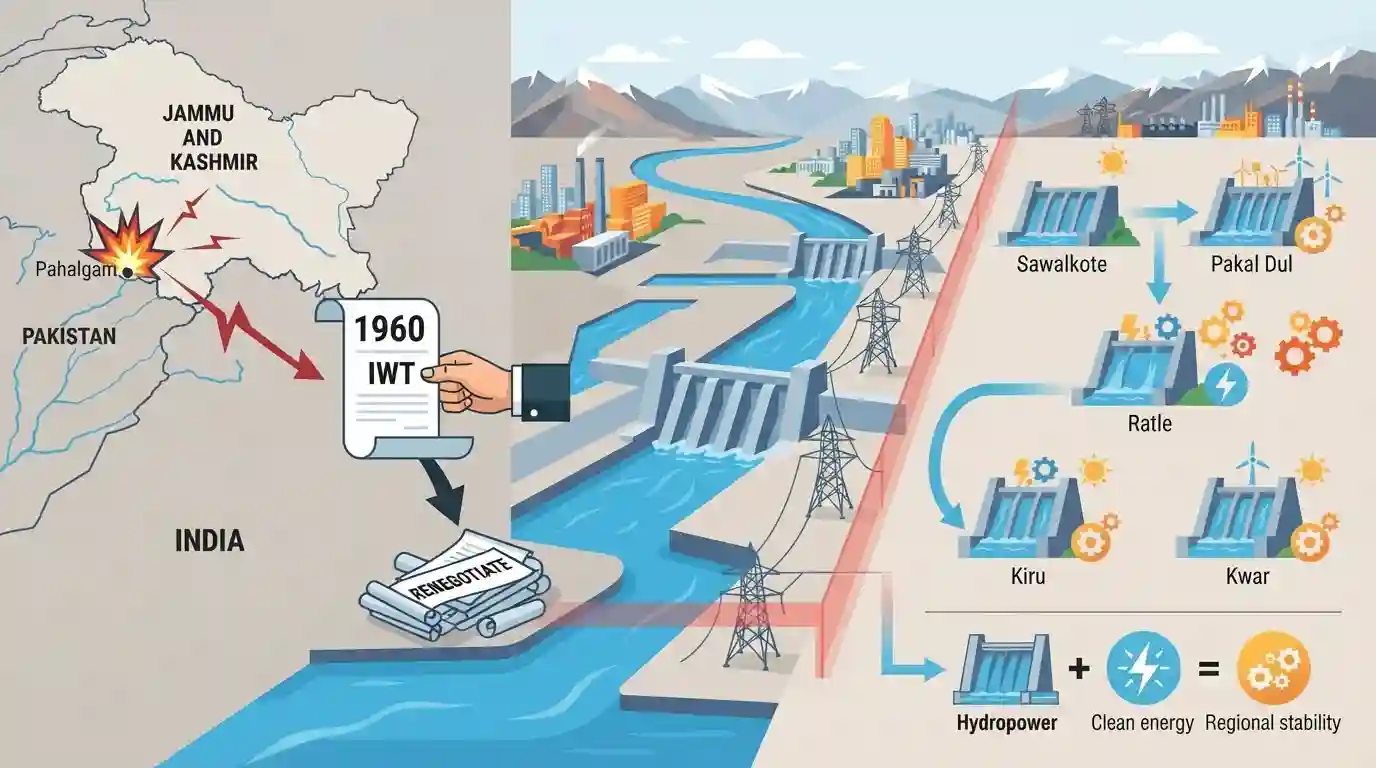
Following a terror attack in Pahalgam, the Indian government has placed the 1960 Indus Waters Treaty (IWT) in abeyance, asserting that the pact has outlived its utility and must be renegotiated. Making any future cooperation contingent on Pakistan permanently halting cross-border terrorism, India is pivoting to rapidly develop over 5,000 MW of run-of-the-river hydropower capacity on the Chenab River. This includes key projects like Sawalkote, Pakal Dul, Ratle, Kiru, and Kwar, which are vital for India's clean energy transition, regional growth, and the full utilization of its treaty-permissible water rights.
মূল বিষয়
- India has put the 60-year-old Indus Waters Treaty (IWT) in 'abeyance' following a terror attack in Pahalgam, stating that the treaty has outlived its utility in its current form.
- The Indian government is pushing for a renegotiation of the IWT to make it more balanced, asserting that any future reactivation of the water-sharing provisions is strictly contingent on Pakistan permanently halting cross-border terrorism.
- India's immediate priority is the speedy completion of five major run-of-the-river hydropower projects on the Chenab River, with a combined capacity of over 5,000 MW.
- The five projects are: Sawalkote (1,856 MW), Pakal Dul (1,000 MW), Ratle (850 MW), Kiru (624 MW), and Kwar (540 MW). Kiru and Pakal Dul are slated for completion by the end of 2026.
- These projects are essential for India's clean energy transition, grid stability, regional development, and for enabling the full utilization of India's legitimate rights within the Indus basin.
- The Indian government maintains that cooperative implementation of the treaty requires mutual trust and reciprocity, which have been destroyed by Pakistan's persistent acts of hostility.
প্রিলিমস ফাঁদ
India, as a signatory state to the Vienna Convention on the Law of Treaties (VCLT), formally invoked its provisions...
India is not a party to the Vienna Convention on the Law of Treaties (VCLT). However, it relies on VCLT Article 60 as it reflects customary international law. UPSC often falsely frames India as a VCLT signatory.
সংযুক্ত স্থির ধারণা
What is the river allocation and permissible usage under the 1960 Indus Waters Treaty?
- Eastern Rivers: Sutlej, Beas, and Ravi are allocated to India for unrestricted use, accounting for roughly 20% of the basin's total water.
- Western Rivers: Indus, Jhelum, and Chenab are allocated to Pakistan, but India has limited, non-consumptive usage rights.
- Permitted Uses: India is permitted to generate electricity using run-of-the-river plants, domestic use, and restricted agricultural use without storing water.
How does the three-tiered dispute resolution mechanism of the IWT operate?
- Permanent Indus Commission: Bilaterally handles technical queries and "questions" raised by either country.
- Neutral Expert: Appointed by the World Bank to resolve technical "differences" that the Commission cannot resolve.
- Court of Arbitration: Adjudicates formal "disputes" regarding treaty interpretation or systemic breaches. Parallel proceedings at multiple tiers are a source of current friction.
আন্তঃবিষয় প্যাটার্ন
Customary international law vs security pacts
Links transboundary water treaties with the Vienna Convention (VCLT) to counter state-sponsored terrorism, demonstrating how national security priorities redefine long-standing resource-sharing pacts.
Hydropower geopolitics and climate targets
Leveraging strategic run-of-the-river J&K hydro projects (Chenab basin) to meet domestic Net-Zero targets while asserting legitimate upstream rights under geopolitical stress.

Map-based questions linking Chenab tributaries (Marusudar) to run-of-the-river projects and VCLT's customary status likely in 2026.
সংযুক্ত PYQ · 2
সংযুক্ত PYQ · 2
- 2012MainsGS2
The situation today is far different to that prevalent fifty years back when the Indus Water Treaty was signed." Highlight the complexity of the current challenges on both sides of the border in this regard. Do you think that a review of the Treaty is in India's best interests?
- 2026PrelimsGS1
Which of the following pairs of ancient and modern names of rivers is/are correctly matched ? 1. Vitasta : Chenab 2. Asikni : Jhelum 3. Parushni : Ravi 4. Yavyavati : Beas Select the answer using the code given below :
