Transboundary River Treaties and Upper Riparian Water Rights
Source:Indian Express ↗
Why It Matters
The Indus Water Treaty is a cornerstone of India-Pakistan bilateral relations and a frequent subject in UPSC examinations. Understanding the geopolitical implications of the treaty, India's rights as an upper riparian state, and the debate over abrogating the treaty to leverage water strategically against terrorism is critical for GS Paper 2 (International Relations) and GS Paper 1 (Geography/Water Resources).
Summary
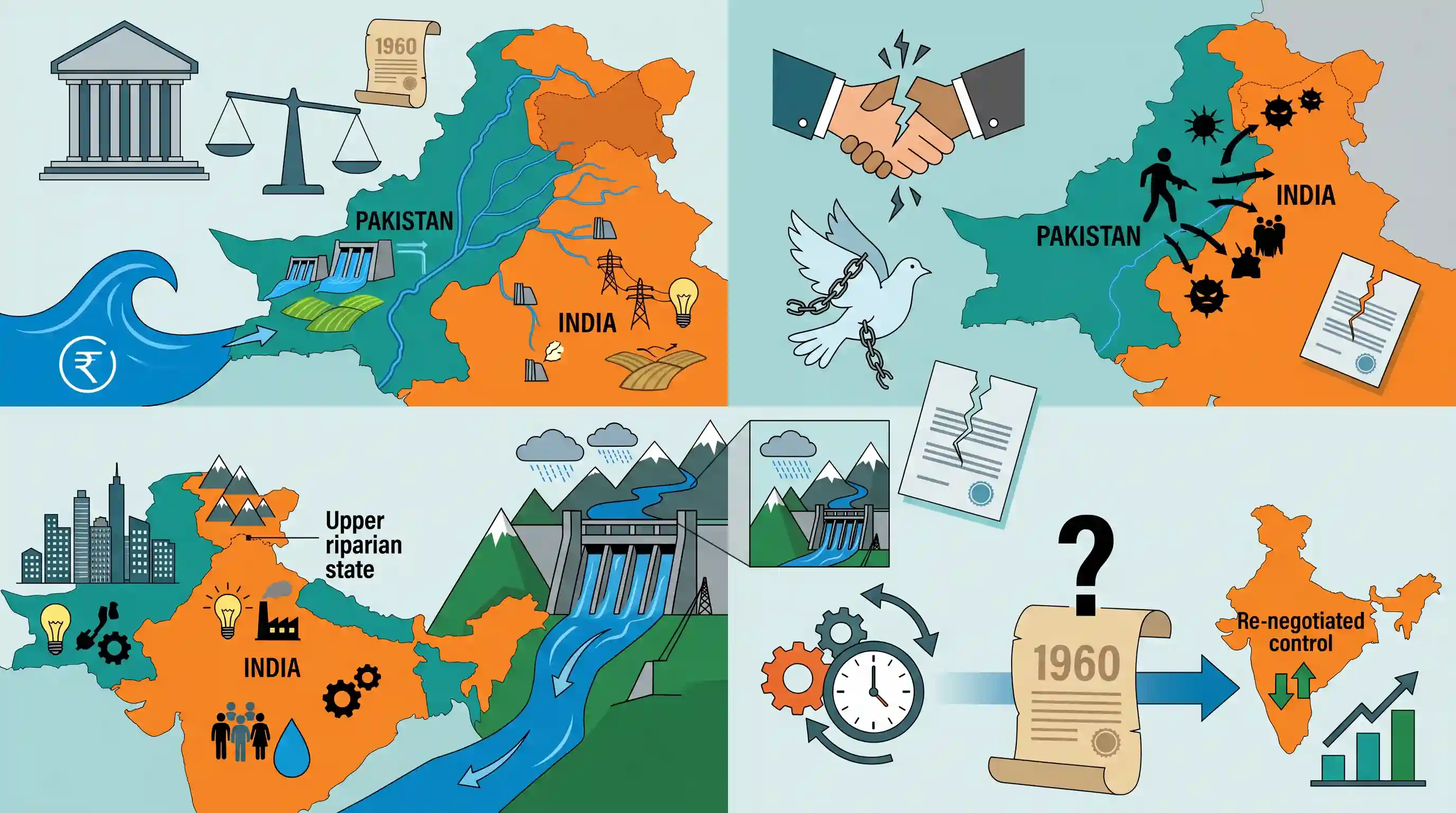
The article argues that the 1960 Indus Water Treaty (IWT) is heavily skewed against Indian interests and suggests that New Delhi should consider abrogating it. Under the World Bank-brokered agreement, India relinquished the bulk of the water from the western rivers (Indus, Jhelum, Chenab) to Pakistan, which severely hampers India's ability to develop hydroelectric power and irrigation infrastructure, particularly affecting Jammu and Kashmir. The author contends that the treaty has failed to buy peace or goodwill from Pakistan. Given Pakistan's sustained use of cross-border terrorism and India's growing domestic water and energy requirements, calls are intensifying for India to shed its defensive posture, use its upper riparian geographic advantage as strategic leverage, and decisively rethink the Cold War-era water-sharing arrangement.
Key Points
- The 1960 Indus Water Treaty (IWT) allocates the eastern rivers (Ravi, Beas, Sutlej) to India and the western rivers (Indus, Jhelum, Chenab) largely to Pakistan.
- Critics argue the treaty is fundamentally unequal, granting Pakistan approximately 80% of the Indus basin's waters despite India being the upper riparian state.
- The treaty imposes strict restrictions on India's ability to build storage and run-of-the-river hydroelectric projects on the western rivers, severely constraining the economic and energy development of Jammu & Kashmir.
- Given Pakistan's continued state sponsorship of cross-border terrorism, commentators argue India should utilize its upper riparian status as strategic leverage by abrogating or renegotiating the IWT.
Important Terms
Indus Water Treaty (IWT)

A 1960 water-distribution agreement between India and Pakistan, brokered by the World Bank, partitioning the Indus river system's waters between the two nations.
UPSC context
GS-II (International Relations); tests knowledge of transboundary water diplomacy, neighborhood policy, and historical bilateral agreements.
Western Rivers
The Indus, Jhelum, and Chenab rivers. Under the IWT, their waters are primarily allocated to Pakistan, with India restricted to specific non-consumptive uses like run-of-the-river power.
UPSC context
GS-I (Geography/Drainage Systems); essential for understanding the specific resource division that forms the core of Indo-Pak water disputes.
Permanent Indus Commission (PIC)
A bilateral body of officials from India and Pakistan mandated to manage treaty implementation and resolve technical disputes through regular annual meetings.
UPSC context
GS-II (Bilateral Institutions); tests understanding of the official institutional mechanisms used to sustain communication despite regional tensions.
Upper Riparian State
A state situated upstream on a river system. India's position provides geographic leverage and control over water flow entering downstream Pakistan (the lower riparian).
UPSC context
GS-II (International Relations); critical for discussing water security, strategic leverage, and obligations under customary international law.
World Bank
The international financial institution that brokered the 1960 IWT and serves as a signatory and mediator in its multi-tier dispute resolution mechanism.
UPSC context
GS-II (International Organizations); highlights the role of international third-party mediation in resolving complex regional conflicts.
Abrogation
The formal repeal or unilateral termination of an agreement. Currently discussed as a strategic option for India to withdraw from the 1960 water-sharing framework.
UPSC context
GS-II (International Law/Diplomacy); involves examining legal repercussions, treaty obligations, and the "Blood and Water" strategic doctrine.
Prelims Trap
"Under the Indus Water Treaty, India is entirely barred from utilizing the Western rivers for hydroelectric power generation."
India is permitted non-consumptive uses, including run-of-the-river (RoR) hydroelectric projects on the Western rivers, provided they adhere to specific design criteria without building large storage.
Static Concepts Connected
What is the three-tier dispute resolution mechanism under the Indus Water Treaty?
- Permanent Indus Commission: The first step for resolving bilateral "questions" regarding treaty implementation between India and Pakistan.
- Neutral Expert: Appointed by the World Bank to resolve technical "differences" (e.g., specific dam design parameters).
- Court of Arbitration: Established to adjudicate complex legal "disputes" regarding treaty interpretation if unresolved by the Neutral Expert.
What distinguishes a Run-of-the-River (RoR) hydroelectric project permitted on Western rivers?
- No Large Reservoirs: Relies on the natural flow and elevation drop of a river rather than creating large water storage reservoirs.
- Non-Consumptive Use: Water is temporarily diverted to spin turbines and returned to the river basin without reducing downstream volume.
Cross-Topic Patterns
Upper Riparian Leverage vs Strategic Vulnerability
India’s threat to use upper riparian leverage against Pakistan mirrors its own fears regarding China’s dam-building on the Brahmaputra, linking IR strategy directly with physical geography.
Vienna Convention and Treaty Abrogation
Calls to abrogate the IWT invoke the Vienna Convention’s doctrine of rebus sic stantibus (fundamental change of circumstances) due to state-sponsored terrorism, linking bilateral hydrology to international law.

Expect a 2026 prelims question pairing RoR dams (Kishanganga, Ratle) with Western rivers, alongside the IWT 3-tier dispute mechanism.
Linked PYQs · 3
Linked PYQs · 3
- 2012MainsGS2
The situation today is far different to that prevalent fifty years back when the Indus Water Treaty was signed." Highlight the complexity of the current challenges on both sides of the border in this regard. Do you think that a review of the Treaty is in India's best interests?
- 2021PrelimsGS1
With reference to the Indus river system, of the following four rivers, three of them pour into one of them which joins the Indus direct. Among the following, which one is such river that joins the Indus direct?
- 2009PrelimsGS1
The Dul Hasti Power Station is based on which one of the following rivers?
