PNG Supply Capped for Delhi Hospitals Amid Resource Shortages
Source:Indian Express ↗
Why It Matters
The capping of PNG supplies to critical institutions like hospitals exposes India's vulnerability to natural gas supply chain disruptions. It underscores the critical need for robust energy contingency planning and resilience in public healthcare infrastructure, directly relevant to UPSC topics on energy security, infrastructure, and governance.
Summary
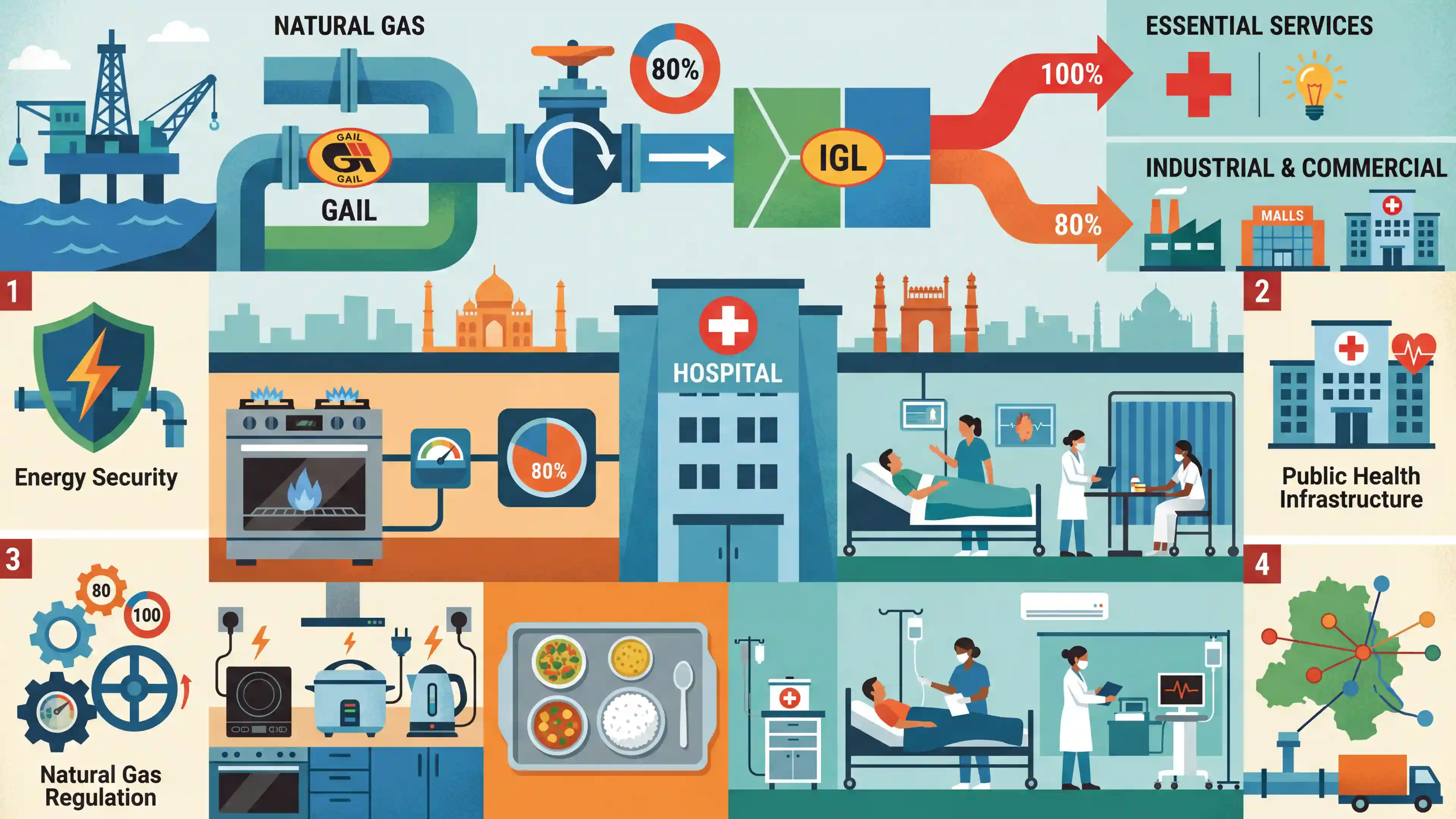
Indraprastha Gas Limited (IGL) has restricted Piped Natural Gas (PNG) supply to 80% of average daily consumption for industrial and commercial users, notably impacting hospitals in Delhi. This directive, stemming from GAIL Gas Limited, has forced critical healthcare facilities to adopt alternative cooking methods, such as utilizing electrical appliances and revising patient menus to conserve fuel. While IGL asserts that the supply is stable and that essential services are prioritized, the development highlights vulnerabilities in urban energy supply chains and tests the resilience of public healthcare infrastructure during resource constraints.
Key Points
- Indraprastha Gas Limited (IGL) has capped the Piped Natural Gas (PNG) supply for commercial and industrial consumers, including hospitals in Delhi, at 80% of their average daily consumption.
- The rationing follows a directive from upstream supplier GAIL Gas Limited amidst broader natural gas supply chain constraints.
- In response to the supply cuts, major Delhi hospitals are implementing contingency measures such as shifting to electrical cooking appliances, altering dietary menus, and reducing in-house preparations that require high fuel consumption.
- Despite the cuts, IGL maintains that overall supply remains stable and assures that essential services are being prioritized to prevent disruptions in critical care.
Important Terms
Indraprastha Gas Limited (IGL)

A joint venture between GAIL, BPCL, and the Delhi Government, IGL is the primary supplier of Compressed Natural Gas (CNG) and Piped Natural Gas (PNG) in the National Capital Region.
UPSC context
GS-III: Infrastructure and Energy Security; tests knowledge of urban fuel distribution and public-private partnerships.
GAIL Gas Limited
A wholly-owned subsidiary of Maharatna PSU GAIL (India) Limited, it manages City Gas Distribution (CGD) projects and supplies gas to distributors like IGL across various Indian states.
UPSC context
GS-III: Energy Sector; highlights the role of central PSUs in national gas grid management.
GB Pant Hospital
A premier Delhi Government-run super-specialty tertiary hospital specializing in advanced cardiac, neurological, and gastrointestinal care, established in 1964 and affiliated with Maulana Azad Medical College.
UPSC context
GS-II: Social Justice (Health); critical for understanding tertiary healthcare infrastructure and specialized medical access.
GTB Hospital
A major tertiary care teaching hospital in East Delhi affiliated with the University College of Medical Sciences (UCMS), serving as a vital healthcare hub for the Trans-Yamuna population.
UPSC context
GS-II: Governance (Public Health); tests awareness of regional public health infrastructure and medical education.
Sir Ganga Ram Hospital
A renowned private-charitable trust hospital in Delhi known for high-end clinical services and as a leading center for Diplomate in National Board (DNB) medical training.
UPSC context
GS-II: Public Health; exemplifies the role of the private-charitable sector in India's dual healthcare system.
Delhi State Cancer Institute
An autonomous super-specialty oncology center established by the Delhi Government to provide comprehensive and subsidized cancer treatment, including radiotherapy and chemotherapy, to the public.
UPSC context
GS-II: Health Infrastructure; highlights specialized public health initiatives and the management of non-communicable diseases.
Prelims Trap
The PNGRB regulates the upstream exploration and production of natural gas in India.
PNGRB regulates downstream activities (refining, transport, City Gas Distribution) and pricing. Upstream exploration and production of crude oil and natural gas fall under the Directorate General of Hydrocarbons (DGH).
Static Concepts Connected
What are the primary regulatory functions of the PNGRB?
- Downstream Regulation: Regulates refining, processing, storage, transportation, distribution, and marketing of natural gas and petroleum products.
- CGD Authorization: Authorizes entities to establish and operate City Gas Distribution (CGD) networks for PNG and CNG supply.
- No Upstream Powers: It does not possess the mandate to regulate upstream exploration and production of oil and gas.
What are India's targets for transitioning to a Gas-Based Economy?
- Energy Mix Target: Aim to increase the share of natural gas in India's primary energy mix from the current ~6% to 15% by 2030.
- CGD Expansion: Expansion of City Gas Distribution (CGD) networks for supplying PNG to domestic/industrial users and CNG for transport.
- National Gas Grid: Developing a pan-India pipeline network (One Nation, One Gas Grid) to ensure equitable supply across all regions.
Cross-Topic Patterns
Energy Security meets Healthcare Resilience
PNG rationing forcing hospitals to alter operations links urban energy vulnerability directly to the National Disaster Management Guidelines for Hospital Safety.
Import Dependency vs. Gas-Based Economy
Achieving the 15% natural gas target by 2030 requires balancing geopolitical supply chain risks and import dependencies with expanding City Gas Distribution networks.

Expect a prelims statement interlinking PNGRB's downstream regulatory limits with India's 15% natural gas target for 2030.
Linked PYQs · 5
Linked PYQs · 5
- 2019PrelimsGS1
Consider the following statements : 1. Petroleum and Natural Gas Regulatory Board (PNGRB) is the first regulatory body set up by the Government of India. 2. One of the tasks of PNGRB is to ensure competitive markets for gas. 3. Appeals against the decisions of PNGRB go before the Appellate Tribunals for Electricity. Which of the statements given above are correct?
- 2025PrelimsGS1
Consider the following activities : I. Production of crude oil II. Refining, storage and distribution of petroleum III. Marketing and sale of petroleum products IV. Production of natural gas How many of the above activities are regulated by the Petroleum and Natural Gas Regulatory Board in our country?
- 2018MainsGS3
“Access to affordable, reliable, sustainable and modern energy is the sine qua non to achieve Sustainable Development Goals (SDGs).” Comment on the progress made in India in this regard.
- 2021MainsGS2
“Besides being a moral imperative of a Welfare State, primary health structure is a necessary precondition for sustainable development.” Analyze.
- 2024MainsGS2
In a crucial domain like the public healthcare system the Indian State should play a vital role to contain the adverse impact of marketisation of the system. Suggest some measures through which the State can enhance the reach of public healthcare at the grassroots level.
