Indore water tragedy inquiry panel blames six officials
Source:free-press-journal ↗
Why It Matters
The tragedy highlights the gaps in urban public service delivery, administrative accountability in municipal corporations, and the role of the judiciary in upholding citizens' right to clean drinking water under Article 21 and public health under Article 47.
Summary
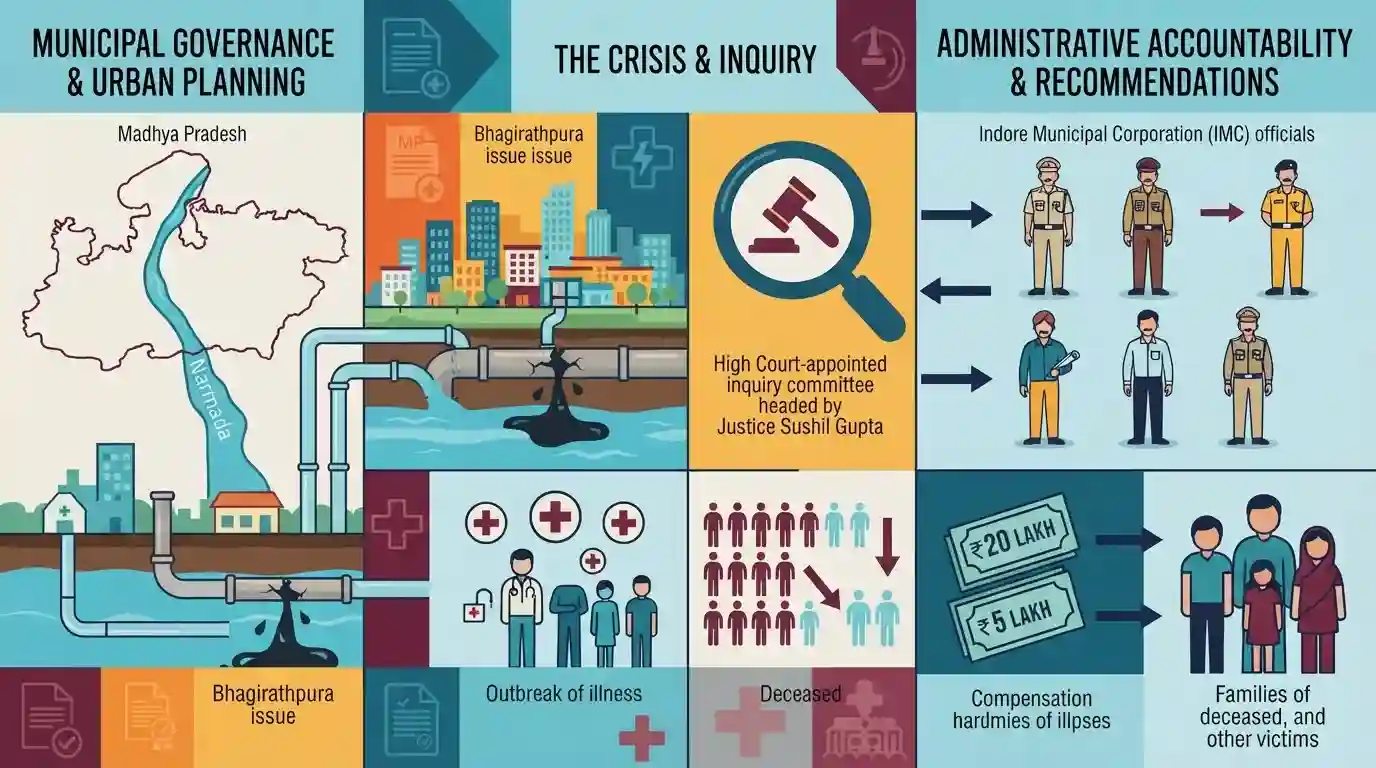
A High Court-appointed inquiry committee headed by Justice Sushil Gupta has held six Indore Municipal Corporation (IMC) officials responsible for administrative lapses and delay in replacing an old Narmada water pipeline, which led to contaminated water supply and caused 24 deaths in Indore's Bhagirathpura. While clearing elected political representatives and the Mayor-in-Council, the report recommended compensation of Rs 20 lakh for the deceased's families and Rs 5 lakh for other victims. The case highlights crucial issues of administrative accountability, municipal governance under the MP Municipal Corporation Act 1956, and public health delivery.
Key Points
- The Justice Sushil Gupta Committee, appointed by the Madhya Pradesh High Court, submitted its report on the Bhagirathpura (Indore) water contamination tragedy.
- The 150-page inquiry report linked 24 of 36 recorded deaths directly to contaminated water supplied from an aging and leaking Narmada pipeline.
- The committee held six civic officials responsible for administrative lapses and delays in replacing the dilapidated Narmada water pipeline, including Narmada Project Executive Engineer Sanjeev Shrivastava and former municipal commissioner Ashish Singh.
- Elected representatives, the Mayor-in-Council (MiC), and former municipal commissioners Shivam Verma, Pratibha Pal, and Dilip Yadav were given a clean chit by the panel.
- The panel recommended a compensation of Rs 20 lakh for the families of those who died and Rs 5 lakh for the affected victims.
- An application has been filed by petitioner Pramod Dwivedi seeking the public disclosure of the committee's report and the live-streaming of High Court proceedings.
Important Terms
Madhya Pradesh Municipal Corporation Act, 1956

State legislation that structures and governs municipal corporations in larger urban areas of Madhya Pradesh, detailing administrative powers, election procedures, and municipal duties.
UPSC context
MPPSC GS Paper II (Part A: Governance); tests municipal laws, local self-government, and bureaucratic accountability.
74th Constitutional Amendment Act, 1992
A landmark amendment adding Part IXA and the Twelfth Schedule, granting constitutional status to urban local bodies, mandating five-year tenures, and devolving 18 functional matters.
UPSC context
MPPSC GS Paper II (Polity & Constitution); tests urban governance, decentralization, and the devolution of municipal powers.
Constitution of India (Article 47)
A Directive Principle of State Policy (DPSP) instructing the State to prioritize public health, nutrition, and standard of living as its primary duties.
UPSC context
MPPSC GS Paper II (DPSPs); tests state welfare obligations, public health policy, and the right to basic amenities.
Indore Municipal Corporation (IMC)
The urban local self-government body responsible for civic infrastructure, sanitation, and water supply in Indore, established under state municipal legislation.
UPSC context
MPPSC GS Paper II (MP Local Governance); tests the implementation of municipal laws and civic issues in MP.
Madhya Pradesh High Court
The apex judicial body in Madhya Pradesh, headquartered in Jabalpur with benches in Indore and Gwalior, responsible for upholding constitutional and legal rights.
UPSC context
MPPSC GS Paper II (State Judiciary); tests the roles, power, and jurisdiction of state-level judicial institutions.
Prelims Trap
Executive power of the Indore Municipal Corporation is vested in the Mayor-in-Council under the MP Municipal Corporation Act, 1956.
Under Section 69(3) of the Act, entire executive power is vested in the appointed Municipal Commissioner, not the elected Mayor or Mayor-in-Council.
Static Concepts Connected
What are the key structural features of the Mayor-in-Council (MIC) under the MP Municipal Corporation Act 1956?
- Composition: Consists of the Mayor and 5 to 10 members nominated by the Mayor from elected Councillors under Section 37.
- Executive Authority: Vests the entire executive power in the Municipal Commissioner, establishing a strong-commissioner model.
- Recall Provisions: Allows recall of the Mayor/President via secret ballot if supported by >50% voters, initiated by >= 3/4th of councillors.
Why is the Indore Narmada River Water Supply Project geographically unique?
- Elevation Lift: The source water from Narmada River must be lifted up a height of 534 meters onto the Malwa Plateau.
- Multi-stage Pumping: Purified water is pumped over a horizontal distance of 70 km in five distinct stages, making it highly energy-intensive.
Cross-Topic Patterns
Article 21 and Municipal Negligence
High Court-mandated compensation for water contamination establishes that clean drinking water is a fundamental right under Article 21, creating strict civil liability for urban local bodies.
Narmada hydrology and Malwa's urban growth
Indore's costly reliance on high-lift Narmada pumping highlights the geographical mismatch between MP's water-rich river basins and its fast-growing, water-stressed plateau cities.

MP Municipal Act's executive division (Commissioner vs Mayor) and the mechanics of Mayor recall will likely feature in Polity MCQs.
Linked PYQs · 2
Linked PYQs · 2
- 2010MPPSC_PRELIMSGS1
Total length of Narmada river in Madhya Pradesh is:
- 2022MPPSC_PRELIMSGS1
When did the Madhya Pradesh State Election Commission come into existence?
