Macroeconomic Trade Pacts and Domestic Agricultural Protection
Source:The Hindu ↗
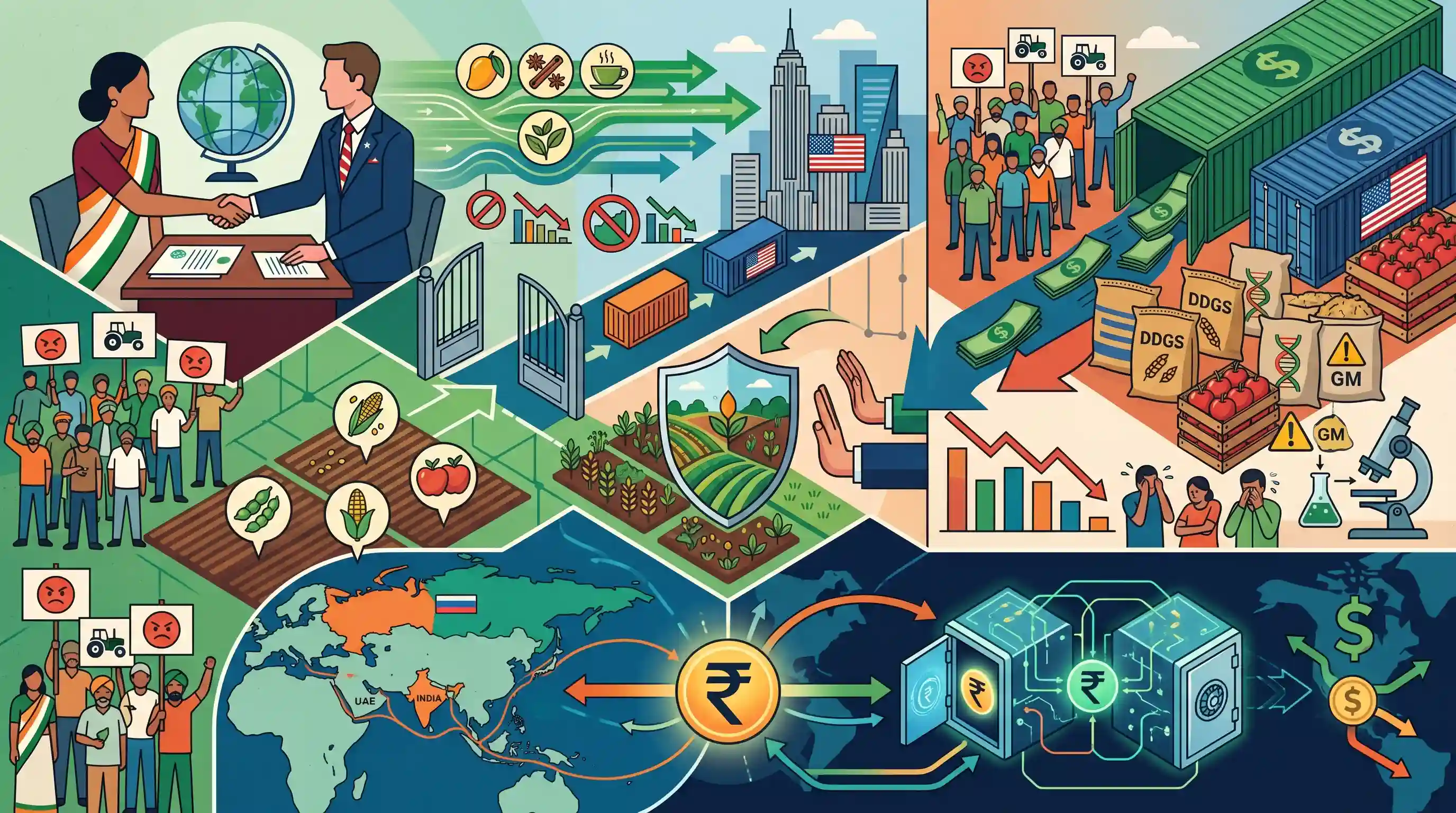
Why It Matters
This article illustrates the classic tension between macro-level trade integration and domestic agricultural protectionism. It is highly relevant for UPSC as it connects foreign trade policy, agricultural tariffs (like MIP), GM crop regulations, and strategic macroeconomic shifts (like Rupee internationalization) with grassroots rural impacts.
Summary
The 2026 Indo-US Interim Trade Agreement promises to boost bilateral commerce by cutting tariffs and opening US markets to Indian horticultural exports. However, it faces intense backlash from Indian rural communities—specifically soybean, maize, and apple farmers—who fear that cheap, subsidized American imports (such as DDGS animal feed and apples) will crash domestic prices and threaten livelihoods. The deal also raises environmental and regulatory concerns over importing GM-derived feed. To balance these risks and protect food security, sensitive agricultural staples are excluded, while India continues to diversify its global trade via Special Rupee Vostro Accounts (SRVAs) to bypass dollar dependency.
Key Points
- The 2026 Indo-US Interim Trade Agreement offers a 0-18% tariff window, dropping punitive 50% duties, which greatly benefits Indian horticultural exports like spices, tea, coffee, and mangoes.
- The agreement permits limited US imports of red sorghum and DDGS (animal feed), aimed at stabilizing domestic milk and meat prices.
- Soybean and maize farmers in Maharashtra and Madhya Pradesh protest the deal, fearing cheap, subsidized American animal feed will crash domestic prices.
- Apple growers in J&K and Himachal Pradesh are concerned over a 25% duty and a Minimum Import Price (MIP) of ₹80/kg for US apples, threatening marginal farmers.
- Importing GM-derived feed such as DDGS raises regulatory and environmental concerns regarding India's non-GM food integrity.
- To counter volatility, India continues export diversification toward the EU, UK, and Baltics, while utilizing Special Rupee Vostro Accounts (SRVAs) for rupee-denominated trade with Russia.
Important Terms
Indo-US Interim Trade Agreement

A 2026 framework to lower tariffs, where the US reduced reciprocal rates to 18% while India opened markets for specific agricultural and industrial goods.
UPSC context
GS II: International Relations/Bilateral Agreements; GS III: Economy; tests understanding of trade diplomacy and economic integration.
Special Rupee Vostro Accounts (SRVA)
A rupee-denominated bank account held by a foreign bank with an Indian bank to settle international trade in INR, bypassing major reserve currencies.
UPSC context
GS III: Economy/External Sector; tests knowledge of rupee internationalization and financial mechanisms to mitigate currency volatility.
Minimum Import Price (MIP)
A government-prescribed floor value for imports; goods priced below this threshold are either prohibited or taxed based on the floor price to protect domestic producers.
UPSC context
GS III: Agriculture/Economy; tests awareness of trade-protection tools and their impact on farmer livelihoods and domestic price stability.
Distillers Dried Grains with Solubles (DDGS)
A protein-rich byproduct of ethanol production used as animal feed; US imports are controversial in India due to potential genetically modified (GM) corn origins.
UPSC context
GS III: Agriculture/Science & Technology; tests knowledge of livestock feed security and regulatory concerns over GM imports.
Bilateral Trade Agreement (BTA)
The comprehensive long-term trade framework currently being negotiated between India and the US, aiming for deeper market access beyond the 2026 interim deal.
UPSC context
GS II: International Relations; GS III: Economy; tests ability to analyze multi-sectoral trade negotiations and strategic partnerships.
Genetically Modified (GM) Crops
Plants whose DNA is altered through genetic engineering; their import as feed or oil is a major regulatory and environmental debate in Indian trade.
UPSC context
GS III: Science & Technology/Environment/Agriculture; tests understanding of biosafety, non-tariff barriers, and food security.
Prelims Trap
Minimum Import Price (MIP) on agricultural imports is fixed by the CACP.
MIP is a trade barrier enforced by the Directorate General of Foreign Trade (DGFT) under the Commerce Ministry, whereas CACP recommends domestic Minimum Support Prices (MSP).
Static Concepts Connected
What is a Special Rupee Vostro Account (SRVA)?
- Definition: An account maintained by a domestic Indian bank on behalf of a foreign bank, denominated in Indian Rupees (INR).
- Core Purpose: Enables cross-border trade settlement directly in INR, bypassing US Dollar dependency and lowering exchange rate risks.
- Regulatory Approval: Banks require prior approval from the Reserve Bank of India (RBI) under the Foreign Exchange Management Act (FEMA).
How is the import of GM-derived agricultural products regulated?
- Apex Authority: The Genetic Engineering Appraisal Committee (GEAC) under MoEFCC must approve the import of GM-derived animal feed like DDGS.
- FSSAI vs GEAC: While GEAC handles environmental and feed approvals, the Food Safety and Standards Authority of India (FSSAI) regulates GM food meant for direct human consumption.
Cross-Topic Patterns
WTO farm subsidies & domestic protections
The clash between subsidized US agriculture (Amber Box) and Indian farmer protests directly mirrors India's long-standing WTO negotiations regarding the peace clause and public stockholding.
GM approvals acting as non-tariff barriers
India often uses environmental regulations (like GEAC clearance for GM-maize DDGS) alongside trade tools (MIP) to shield domestic agricultural markets from cheap foreign dumping.

Expect a multi-statement question linking WTO agricultural subsidies, DGFT's MIP mechanisms, and GEAC's role in approving GM-derived feed.
Linked PYQs · 5
Linked PYQs · 5
- 2021MainsGS3
Discuss how emerging technologies and globalisation contribute to money laundering. Elaborate measures to tackle the problem of money laundering both at national and international levels.
- 2023MainsGS3
What are the direct and indirect subsidies provided to farm sector in India? Discuss the issues raised by the World Trade Organization (WTO) in relation to agricultural subsidies.
- 2023MainsGS2
Indian diaspora has scaled new heights in the West. Describe its economic and political benefits for India.
- 2022MainsGS2
How will I2U2 (India, Israel, UAE and USA) grouping transform India's position in global politics?
- 2020PrelimsGS1
In India, which of the following can be considered as public investment in agriculture? 1. Fixing Minimum Support Price for agricultural produce of all crops 2. Computerization of Primary Agricultural Credit Societies 3. Social Capital development 4. Free electricity supply to farmers 5. Waiver of agricultural loans by the banking system 6. Setting up of cold storage facilities by the governments Select the correct answer using the code given below:
