US Command Restructuring Sparks Debate on Regional Strategy
Source:Indian Express ↗
Why It Matters
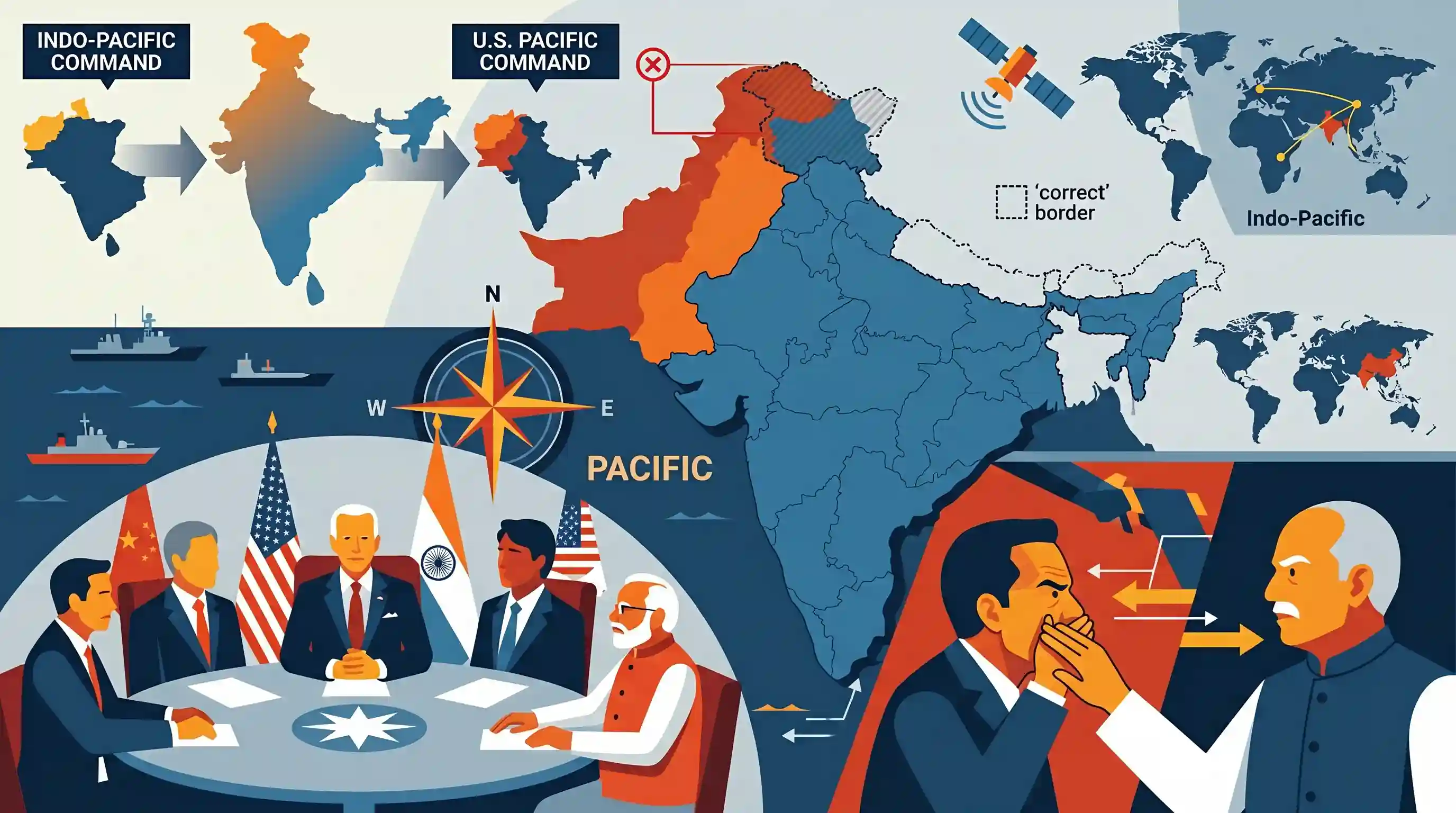
The decision to drop 'Indo' from the US Pacific Command potentially signals a shift in the US strategic posture and its perception of India's role in the region. The map controversy also touches on core Indian sensitivities regarding territorial sovereignty, impacting the broader India-US diplomatic relationship.
Summary
The United States has officially renamed its 'Indo-Pacific Command' back to the 'U.S. Pacific Command' (USPACOM), reversing a 2018 decision that originally highlighted India's strategic importance in the region. Alongside this change, the updated USPACOM Area of Responsibility map incorrectly depicted India's borders by showing Pakistan-occupied Kashmir (PoK) as part of Pakistan and missing portions of Jammu & Kashmir. The move, coming just ahead of Indo-US discussions at the G7 summit, has drawn sharp criticism from India's political opposition regarding the government's silence on the diplomatic and territorial affront.
Key Points
- The US has reverted the designation of its 'Indo-Pacific Command' back to 'Pacific Command', dropping 'Indo' from the title.
- The 'Indo' prefix was added in 2018 to underscore the strategic connectivity between the Indian and Pacific Oceans and India's role in it.
- The updated USPACOM map incorrectly depicts India's borders, showing PoK as Pakistan's territory and excluding parts of J&K.
- The timing of the name change and map controversy coincides with the Indo-US talks at the ongoing G7 summit.
Important Terms
U.S. Pacific Command (USPACOM)

The largest U.S. unified combatant command, responsible for a geographic area stretching from the U.S. West Coast to India's western border; its name was restored in 2026 to honor its 1947 roots.
UPSC context
GS-II: India-US relations; GS-III: Security challenges in the Indo-Pacific. Tests understanding of shift in strategic nomenclature and regional engagement.
U.S. Indo-Pacific Command (USINDOPACOM)
The designation of the U.S. Pacific Command between 2018 and 2026, intended to signal the strategic connectivity of the Indian and Pacific Oceans and highlight India's central role in regional security.
UPSC context
GS-II: Bilateral and regional groupings (Quad). Relevant for analyzing India's evolving status in U.S. maritime strategy.
U.S. Department of War
The historical name of the U.S. military's executive department; in 2026, the Trump administration reverted the "Department of Defense" to this title, signaling a "return to realism" in foreign policy.
UPSC context
GS-II: International relations and institutional changes. Tests awareness of U.S. domestic policy shifts affecting global security architecture.
Indo-Pacific
A geopolitical framework viewing the Indian and Pacific Oceans as a single strategic theatre; it is central to the Quad and India's "Act East" policy for maintaining regional stability.
UPSC context
GS-II: Regional and global groupings involving India. Fundamental concept for Indian maritime security and diplomacy.
Pakistan-occupied Kashmir (PoK)
The portion of the Indian Union Territory of Jammu and Kashmir under illegal Pakistani occupation; India maintains a constitutional claim over the entire region based on the 1947 Instrument of Accession.
UPSC context
GS-II: India and its neighborhood-relations; territorial integrity and sovereignty issues. Critical for understanding border disputes.
G7 (Group of Seven)
An intergovernmental forum of seven advanced economies; it serves as a platform for global policy coordination and high-level bilateral meetings, such as those between the Indian PM and U.S. President.
UPSC context
GS-II: Important International institutions, agencies and fora. Tests knowledge of global governance and India's outreach to advanced economies.
Prelims Trap
Dropping 'Indo' means India and the Indian Ocean are excluded from the US Command's Area of Responsibility (AOR).
False. Despite reverting to 'US Pacific Command', its actual AOR remains unchanged, covering half the earth from the US West Coast to the western border of India, inclusive of the Indian Ocean.
Static Concepts Connected
How does India's geographic definition of the Indo-Pacific differ from the US definition?
- India's inclusive vision: Spans the entire Indian and Pacific Oceans, stretching continuously from the eastern shores of Africa to the western shores of the Americas.
- US AOR vision: Geographically narrower, traditionally spanning from the western shores of the Americas to the western border of India, excluding the western Indian Ocean and African coast.
What is the official Indian legal stance on Pakistan-occupied Kashmir (PoK)?
- Constitutional integration: The entire Union Territories of J&K and Ladakh, including areas currently under illegal occupation by Pakistan and China, are integral parts of India.
- 1994 Resolution: A unanimous Parliamentary resolution firmly resolved that Pakistan must vacate the areas of the Indian State of J&K which they have occupied through aggression.
Cross-Topic Patterns
Cartographic assertions by global powers
The US map error parallels China's habitual 'Standard Map' releases claiming Aksai Chin and Arunachal Pradesh, making cartography a critical diplomatic front in modern sovereignty disputes.
G7 Outreach and Global South
The diplomatic friction at G7 highlights the tightrope India walks: acting as the 'Voice of the Global South' in Western-led forums while managing bilateral tensions over strategic posture.

Expect a 2026 prelims statement testing the exact geographical limits of the Indo-Pacific construct as defined by India versus the US.
Linked PYQs · 5
Linked PYQs · 5
- 2020MainsGS2
What is the significance of Indo-US defence deals over Indo-Russian defence deals? Discuss with reference to stability in the Indo-Pacific region.
- 2019MainsGS2
‘What introduces friction into the ties between India and the United States is that Washington is still unable to find for India a position in its global strategy, which would satisfy India's national self-esteem and ambitions.’ Explain with suitable examples.
- 2016MainsGS2
To what extent is Article 370 of the Indian Constitution, bearing marginal note "Temporary provision with respect to the State of Jammu and Kashmir", temporary? Discuss the future prospects of this provision in the context of Indian polity.
- 2022MainsGS2
How will I2U2 (India, Israel, UAE and USA) grouping transform India's position in global politics?
- 2019MainsGS2
‘The long-sustained image of India as a leader of the oppressed and marginalised nations has disappeared on account of its new found role in the emerging global order.’ Elaborate.
