Maharashtra Wakayama Sister State Agreement and Subnational Diplomacy
Source:Indian Express ↗
Why It Matters
Highlights the role of sub-national diplomacy (paradiplomacy) in India's foreign policy, specifically state-level engagement in India-Japan bilateral relations. It also connects contemporary cultural diplomacy with historical themes of Buddhism and Gandhara art (Bamiyan Buddhas), relevant for GS1 Art & Culture and GS2 International Relations.
Summary
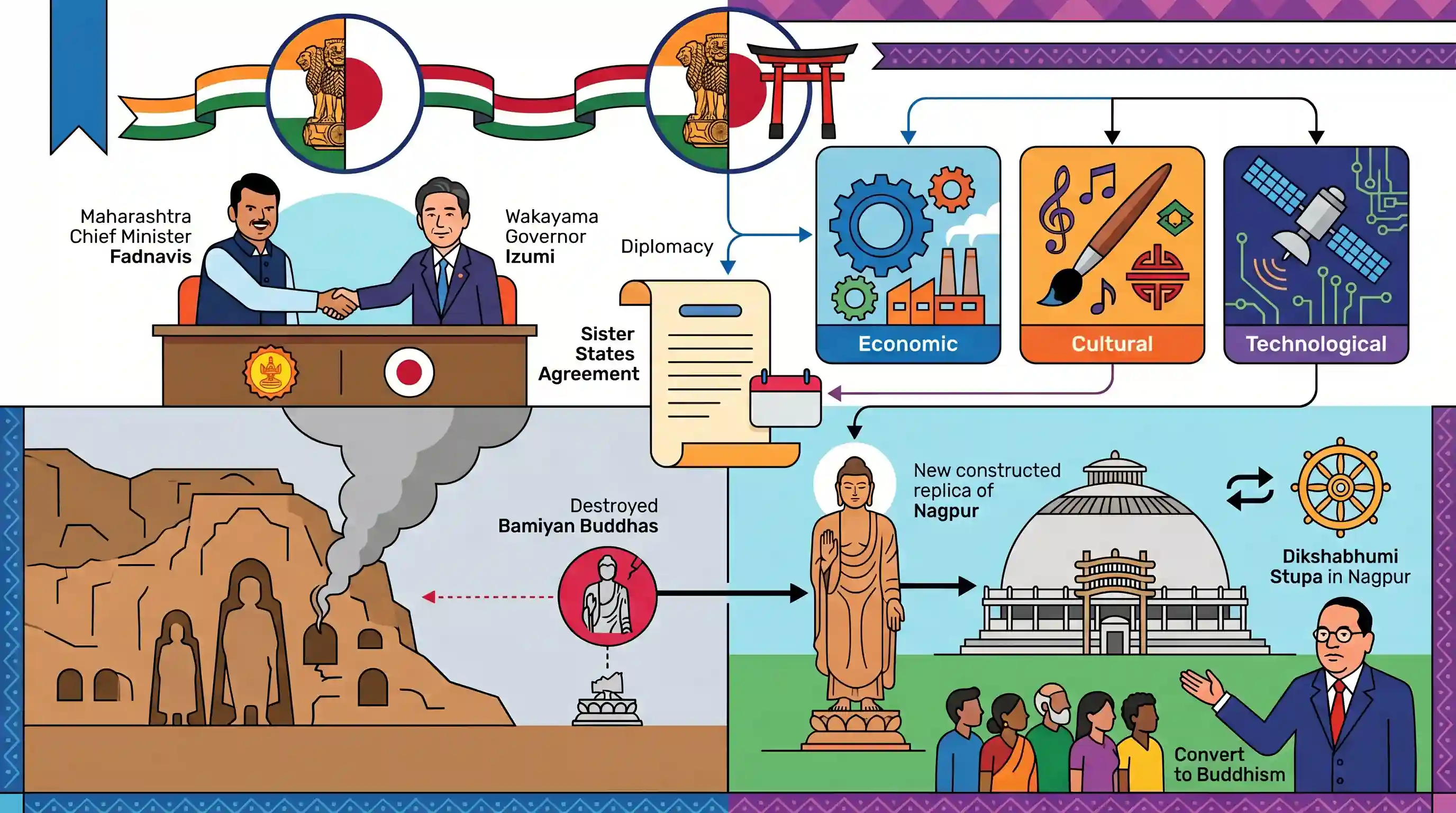
Maharashtra Chief Minister Devendra Fadnavis and Wakayama Governor Miyazaki Izumi have agreed to strengthen economic, cultural, and technological cooperation under their 'Sister States' agreement, which is set to be renewed in 2028. As part of this cultural exchange and to mark the 25th anniversary of the destruction of the Bamiyan Buddhas by the Taliban, a replica of the statues will be installed in Nagpur. Nagpur is historically significant as the site where Dr. B.R. Ambedkar converted to Buddhism. This sub-national diplomatic effort highlights the expanding scope of India-Japan bilateral ties through state-to-state collaboration and shared cultural heritage.
Key Points
- Maharashtra and Japan's Wakayama prefecture aim to deepen economic, cultural, and technological ties under their existing 'Sister States' agreement.
- A replica of the Bamiyan Buddha statues will be installed in Nagpur to commemorate 25 years since their destruction in Afghanistan.
- Nagpur was chosen for its historical importance as Deekshabhoomi, the site where Dr. B.R. Ambedkar embraced Buddhism.
- The initiative reflects sub-national diplomacy, highlighting how Indian states actively engage with foreign regional governments for mutual development and cultural exchange.
Important Terms
Sister State Agreement

A formal cooperative partnership between sub-national entities (like Maharashtra and Wakayama) from different countries to promote trade, cultural exchange, and technological collaboration.
UPSC context
GS Paper II: International Relations; tests 'Sub-national Diplomacy' (Paradiplomacy) and how states complement India's foreign policy goals.
FICCI
India's premier non-government business organization that facilitates policy advocacy and bilateral economic mechanisms, such as the India-Japan Business Cooperation Committee (IJBCC).
UPSC context
GS Paper III: Indian Economy; relevant for the role of business chambers in promoting Foreign Direct Investment (FDI) and trade.
Buddhist Diplomacy
The strategic use of India’s ancient Buddhist heritage as 'soft power' to deepen diplomatic, cultural, and people-to-people ties with East and Southeast Asian nations.
UPSC context
GS Paper II: IR and Soft Power; tests the cultural dimensions of India's 'Act East Policy'.
Bamiyan Buddhas
Two massive 6th-century statues in Afghanistan, symbols of Gandhara art, whose destruction by the Taliban in 2001 sparked global outrage and intensified focus on cultural heritage.
UPSC context
GS Paper I: Art and Culture; tests knowledge of international heritage sites and the impact of extremism on world history.
Deekshabhoomi
A sacred monument in Nagpur where Dr. B.R. Ambedkar and 500,000 followers embraced Buddhism in 1956, making it a focal point for modern Buddhist revival.
UPSC context
GS Paper I: Modern Indian History; covers the socio-religious reform movements and the legacy of Dr. Ambedkar.
Taliban
A fundamentalist Islamic movement in Afghanistan whose actions, including the destruction of pre-Islamic artifacts, significantly influence regional security and India’s neighborhood policy.
UPSC context
GS Paper II: IR/Security; relates to regional stability, terrorism, and India's challenges in its extended neighborhood.
Prelims Trap
"Dr. B.R. Ambedkar embraced the Mahayana sect of Buddhism at Deekshabhoomi in Nagpur."
Ambedkar founded and embraced 'Navayana' (Neo-Buddhism), which strictly rejected traditional sects like Hinayana and Mahayana, interpreting the religion through a socio-political lens of equality.
Static Concepts Connected
What is 'Para-diplomacy' and how is it managed in India?
- Constitutional mandate: Under the Seventh Schedule, 'Foreign Affairs' is exclusively a Union subject. States cannot sign binding international treaties independently.
- MEA States Division: Created in 2014, this MEA division assists states in engaging with foreign entities for FDI, technology transfers, and sister-state MOUs.
What are the key characteristics of the Gandhara School of Art?
- Hellenistic synthesis: It blends Indian Buddhist subjects with Greco-Roman and Sassanian styles, flourishing in the Northwest frontier, Hindu Kush, and Afghanistan.
- Realistic features: Characterized by realistic human anatomy, wavy hair, muscular builds, and heavy, draped garments with deeply incised folds.
Cross-Topic Patterns
Paradiplomacy and Competitive Federalism
Sub-national diplomacy marks a shift toward competitive federalism, where Indian states actively bypass traditional MEA bottlenecks to court foreign regional governments for FDI.
Buddhist Diplomacy in Act East Policy
Shared cultural heritage, particularly Buddhist circuits and historical links, remains India's primary soft-power tool in deepening the Quad and Act East policies.

Expect a 2026 Prelims question mixing Gandhara art of the Bamiyan Buddhas with the tenets of Ambedkar's Navayana Buddhism.
Linked PYQs · 3
Linked PYQs · 3
- 2019MainsGS2
‘The time has come for India and Japan to build a strong contemporary relationship, one involving global and strategic partnership that will have a great significance for Asia and the world as a whole.’ Comment.
- 2019MainsGS1
Highlight the Central Asian and Greco-Bactrian elements in the Gandhara art.
- 2018PrelimsGS1
With reference to Indian history, who among the following is a future Buddha, yet to come to save the world?
