Indira Gandhi Canal Ecological Impact on Thar Desert Pastures
Source:patrika ↗
Why It Matters
Important for RPSC RAS Prelims regarding the geographical, economic, and environmental impacts of the Indira Gandhi Canal Project on the Thar Desert ecosystem and agrarian patterns in Rajasthan.
Summary
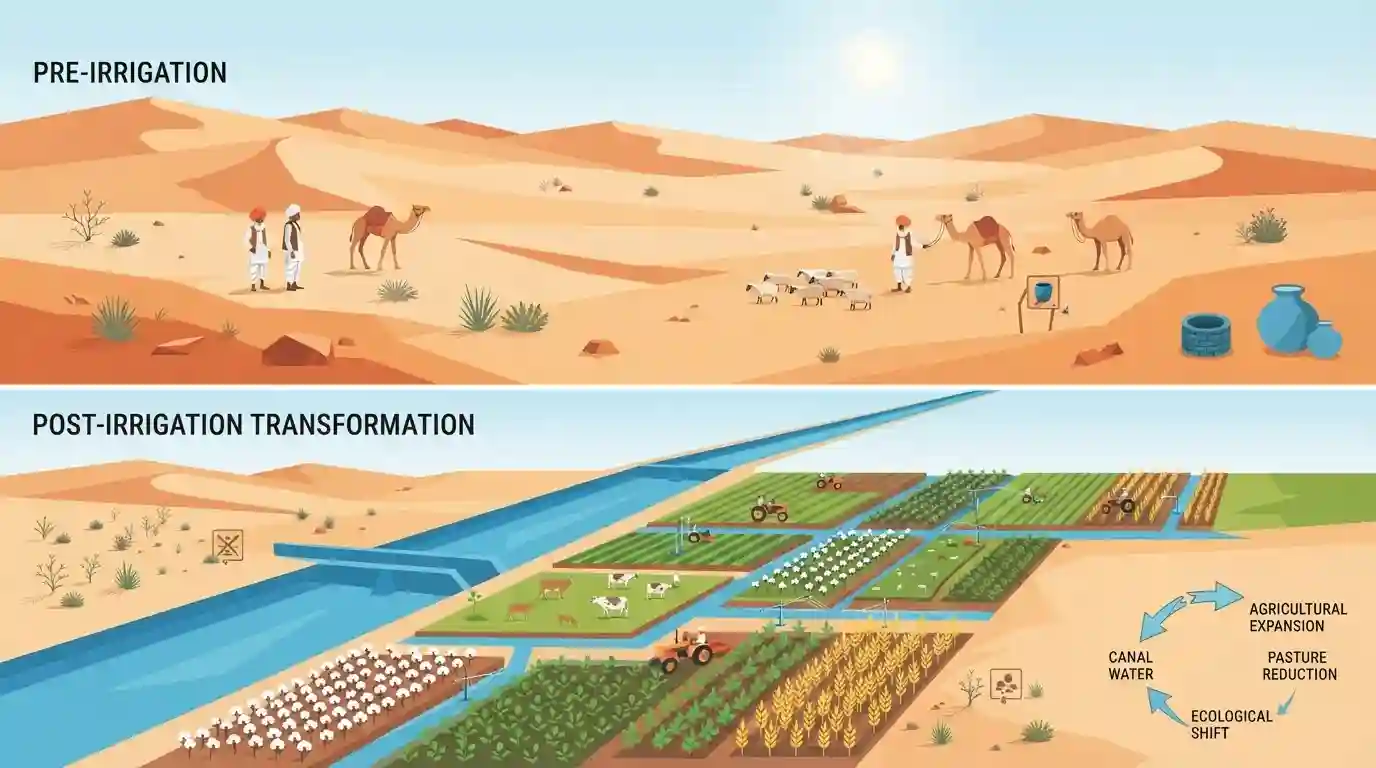
The article examines the profound ecological and agricultural transformation in the Thar Desert due to the Indira Gandhi Canal. While irrigation has enabled new crop cultivation, it is causing traditional pastures to shrink and raising ecological concerns like land-use shifts and loss of native desert ecosystems.
Key Points
- The arrival of Indira Gandhi Canal water in the Thar Desert has triggered a massive ecological and agricultural transformation.
- Traditional pastures (oran, gauchar) and native vegetation are shrinking as sandy tracts are converted into intensive agricultural fields.
- New commercial and water-intensive crops are replacing traditional desert-adapted crop patterns, altering the desert ecology.
- Environmental concerns such as soil salinity, waterlogging, and loss of native biodiversity are emerging in the command areas.
Important Terms
Indira Gandhi Canal Project

A massive irrigation project originating from the Harike Barrage in Punjab that brings water to the Thar Desert, transforming Rajasthan's geography, agriculture, and rural economy.
UPSC context
Crucial for RPSC (Rajasthan Geography and Economy); tests understanding of canal irrigation, command area development, and ecological changes in western Rajasthan.
Prelims Trap
The Indira Gandhi Canal has completely resolved all agricultural and water scarcity challenges in the Thar Desert without causing negative ecological side effects.
Aspirants often assume IGNP irrigation completely eliminates desert challenges; however, it introduces severe secondary problems like waterlogging, soil salinity, and the destruction of traditional gauchars.
Static Concepts Connected
What are the key stages, origin, and ecological impacts of the Indira Gandhi Canal Project in Rajasthan?
- Source & Origin: Origin point is the Harike Barrage in Punjab at the confluence of the Sutlej and Beas rivers.
- Two Stages: Stage-I covers feeder canals and lift canals serving Ganganagar, Hanumangarh, and northern Bikaner; Stage-II covers vast arid tracts in Jodhpur, Jaisalmer, Barmer, etc.
- Ecological Impact: Major ecological issues include severe waterlogging (e.g., Gharsana region), secondary soil salinity, and the shrinking of traditional orans and gauchars.
Cross-Topic Patterns
Canal Irrigation vs. Sacred Groves & Pastures
Canal command irrigation alters traditional community pastoral lands (Oran/Gauchar), intersecting Rajasthan Art & Culture sacred groves with environmental geography and land revenue acts.
Crop Shift & Arid Water Economics
Shifting from drought-resistant millets to water-intensive commercial crops in Thar links canal management directly to sustainable agriculture and groundwater depletion policies in arid zones.

IGNP stages, environmental hazards (waterlogging/salinity), and pastoral loss (oran/gauchar) frequently feature in RPSC statement-based questions.
Linked PYQs · 2
Linked PYQs · 2
- 2016RPSC_PRELIMSGS1
The district pair that benefits from the Chaudhary Kumbha Ram canal is
- 2018RPSC_PRELIMSGS1
In Rajasthan, for the first time, which of the following projects has made sprinkler irrigation mandatory?
