IndiGo Flight Disruptions and Regulatory Oversight by DGCA
Source:Indian Express ↗
Why It Matters
This exposes the fragility of India's fast-growing aviation sector when balancing rapid expansion with crucial safety and occupational health regulations (such as FDTL). It underscores the vital role of the DGCA in enforcing compliance and ensuring systemic resilience in critical infrastructure.
Summary
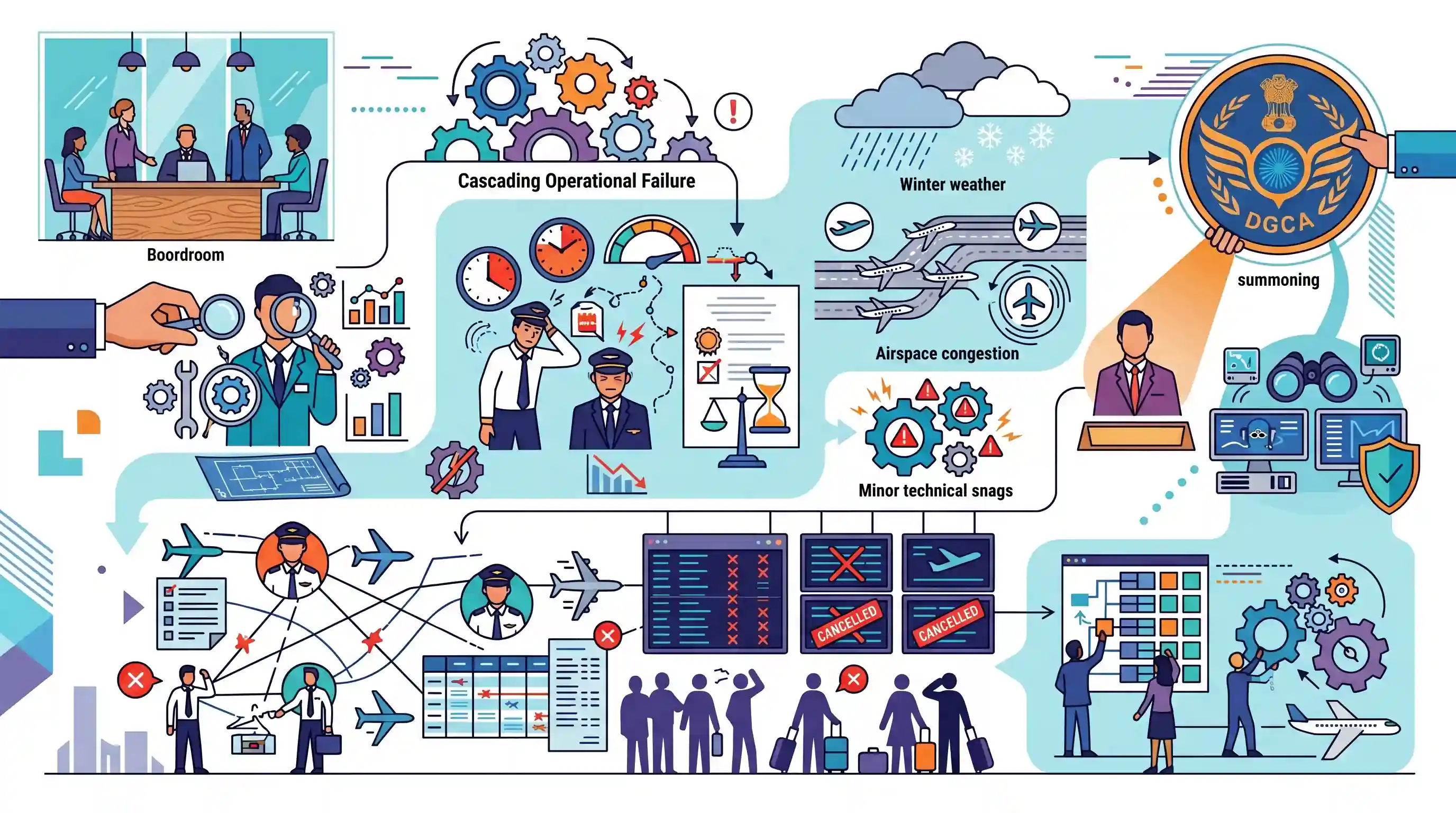
IndiGo's board has decided to bring in an external technical expert to investigate recent widespread flight cancellations, which Chairman Vikram Singh Mehta attributed to a cascading operational failure. The crisis, which peaked in early December, was largely triggered by the airline's failure to adequately adjust to newly implemented Fatigue-Duty Time Limits (FDTL) for pilots. Coupled with winter weather, airspace congestion, and minor technical snags, this led to a massive breakdown in crew rostering. The Directorate General of Civil Aviation (DGCA) has intervened, summoning the CEO and setting up a special oversight team to monitor the airline's recovery and compliance.
Key Points
- IndiGo experienced severe, nationwide flight cancellations peaking on December 5, prompting its board to enlist external technical experts to investigate the operational meltdown.
- The cascading disruptions were primarily caused by the airline's inadequate preparedness for new, stricter Fatigue-Duty Time Limits (FDTL) meant to address pilot fatigue.
- Additional factors compounding the crisis included minor technical issues, winter schedule changes, system-wide airspace congestion, and adverse weather conditions.
- In response to the crisis, aviation regulator DGCA summoned IndiGo CEO Pieter Elbers and constituted a dedicated oversight team to monitor the airline's daily operations.
Important Terms
Fatigue-Duty Time Limits (FDTL)

Regulatory standards capping pilot and crew duty/flight hours while mandating rest periods to mitigate fatigue-induced human error and ensure overall aviation safety.
UPSC context
GS3: Infrastructure and Labour Laws. Tests understanding of safety-critical regulations, employee welfare, and operational challenges in the transport sector.
Directorate General of Civil Aviation (DGCA)
The statutory regulatory body under the Ministry of Civil Aviation responsible for safety oversight, licensing, airworthiness standards, and enforcement of civil aviation requirements in India.
UPSC context
GS2: Statutory and Regulatory Bodies. Tests knowledge of institutional frameworks for infrastructure governance and oversight of public safety.
Bharatiya Vayuyan Adhiniyam, 2024
The primary legislation governing civil aviation in India, which replaced the colonial-era Aircraft Act of 1934 to modernize regulations for safety, drones, and operational efficiency.
UPSC context
GS2: Government Policies and Interventions. Tests understanding of legislative reforms to modernize infrastructure and align with global safety standards.
Window of Circadian Low (WOCL)
The scientific window (02:00 AM to 06:00 AM) where the human body’s physiological alertness and performance are at their lowest; used to set stricter night-duty limits.
UPSC context
GS3: Science and Technology/Disaster Management. Tests technical knowledge of safety risks in high-stakes environments and scientific basis for duty-time regulations.
Infrastructure Bottlenecks
Constraints in physical or human assets—such as pilot shortages, airspace congestion, or airport capacity—that hinder the growth and smooth functioning of the aviation network.
UPSC context
GS3: Infrastructure. Tests critical thinking on factors limiting India's growth as a global aviation hub despite record aircraft orders and high demand.
Prelims Trap
"FDTL rules for pilots are governed by the Ministry of Labour and Employment under the Occupational Safety Code."
FDTL are mandatory aviation safety standards issued and enforced specifically by the DGCA under the Ministry of Civil Aviation, completely separate from general labor laws.
Static Concepts Connected
What is the division of responsibilities between DGCA and AAIB?
- DGCA: Acts as the statutory regulatory body enforcing safety norms, issuing licenses, and monitoring daily airline compliance.
- AAIB: An independent entity created in 2012 to investigate major civil aviation accidents, ensuring no conflict of interest with the regulator.
What is the GAGAN system and its role in civil aviation?
- Developers: Jointly developed by the Indian Space Research Organisation (ISRO) and the Airports Authority of India (AAI).
- Function: A regional satellite-based augmentation system providing enhanced GPS accuracy to improve flight safety and airspace management.
Cross-Topic Patterns
Aviation Safety + Space Technology
Weather disruptions and airspace congestion highlight the critical need for indigenous space technology, like ISRO's GAGAN system, to enable precision landings and reduce reliance on manual rostering buffers.
Occupational Safety vs Sectoral Rules
Pilot fatigue norms (FDTL) showcase how highly specialized sectors rely on parallel, stringent safety-regulator frameworks (DGCA) rather than broad national labor codes for occupational health.

Questions on regulatory bodies in 2026 may test the statutory status of DGCA (granted in 2020) and its distinction from the AAIB.
Linked PYQs · 2
Linked PYQs · 2
- 2014MainsGS3
International civil aviation laws provide all countries complete and exclusive sovereignty over the airspace above their territory. What do you understand by 'airspace'? What are the implications of these laws on the space above this airspace? Discuss the challenges which this poses and suggest ways to contain the threat.
- 2025PrelimsGS1
GPS-Aided Geo Augmented Navigation (GAGAN) uses a system of ground stations to provide necessary augmentation. Which of the following statements is/are correct in respect of GAGAN? I. It is designed to provide additional accuracy and integrity. II. It will allow more uniform and high quality air traffic management. III. It will provide benefits only in aviation but not in other modes of transportation. Select the correct answer using the code given below.
